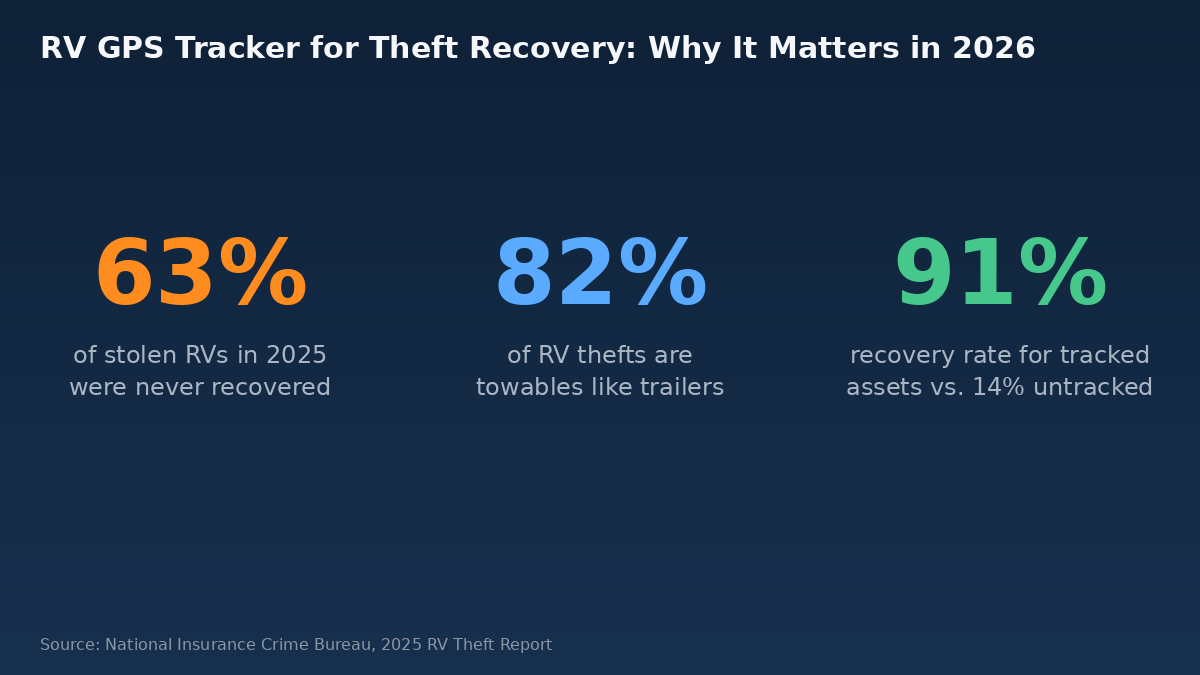
An RV GPS tracker for theft recovery is the single most effective piece of gear you can add to a trailer or motorhome this year. According to the National Insurance Crime Bureau, roughly 63% of recreational vehicles stolen in 2025 were never recovered — and towable RVs like travel trailers account for the large majority of those thefts. A hidden, self-powered tracker is what turns a “gone forever” situation into a police recovery within days. Below is a breakdown of how these trackers work, which type fits your rig, and the models worth buying in 2026.
Table of Contents
- Why RV Owners Need a Dedicated Theft-Recovery Tracker
- How GPS Trackers Actually Work: Cellular vs. Satellite vs. Hybrid
- Portable vs. OBD2 vs. Hardwired: Which Fits Your Rig
- Best RV GPS Trackers for Theft Recovery in 2026
- Setup Tips: Placement, Redundancy, and Subscription Costs
- FAQ
Why RV Owners Need a Dedicated Theft-Recovery Tracker
The numbers make the case better than any sales pitch. Roughly 59,000 recreational vehicles were reported stolen in 2025, and travel trailers and other towables make up around 82% of those incidents nationally, since they’re easy to hitch and disappear with no ignition key required. Per the National Insurance Crime Bureau’s 2025 RV theft report, close to two-thirds of stolen units are never recovered at all — and most recoveries that do happen occur within the first two weeks. After that window closes, the odds drop fast.
That’s the gap a dedicated tracker closes. Independent telematics data cited by industry sources puts recovery rates for tracked assets above 91%, versus roughly 14% for untracked equipment. A tracker doesn’t stop a determined thief from hitching up your trailer in a Cracker Barrel parking lot at 2 a.m. — but it tells you, and law enforcement, exactly where it went afterward. Pair it with a cloud-connected dash cam for footage of the moment it happened.
How GPS Trackers Actually Work: Cellular vs. Satellite vs. Hybrid
Every consumer GPS tracker uses the same underlying positioning system described by GPS.gov: a receiver in the device calculates its position from signals broadcast by the GPS satellite constellation, then a separate radio (cellular or satellite) relays that position to a server you can check from an app. The positioning is the easy part — the differentiator between trackers is how they get the data out.
- Cellular trackers use LTE/4G networks, which cover the vast majority of interstates, campgrounds, and storage lots — the same coverage map that determines whether Starlink Mini for your RV makes sense as a backup for your own connectivity. They’re cheap to run and update frequently, but they go dark in dead zones — which matters if your rig gets towed off-grid before you notice it’s missing.
- Satellite trackers report position from anywhere with sky view, no cell tower required. They’re the right call if you store or boondock in genuinely remote areas, though they typically report less frequently and cost more per month.
- Hybrid units fall back to satellite when cellular signal drops, giving you the best of both. If you can only buy one tracker, this is the category to prioritize — a single-network device is also easier for a thief to defeat with a signal jammer.
Portable vs. OBD2 vs. Hardwired: Which Fits Your Rig
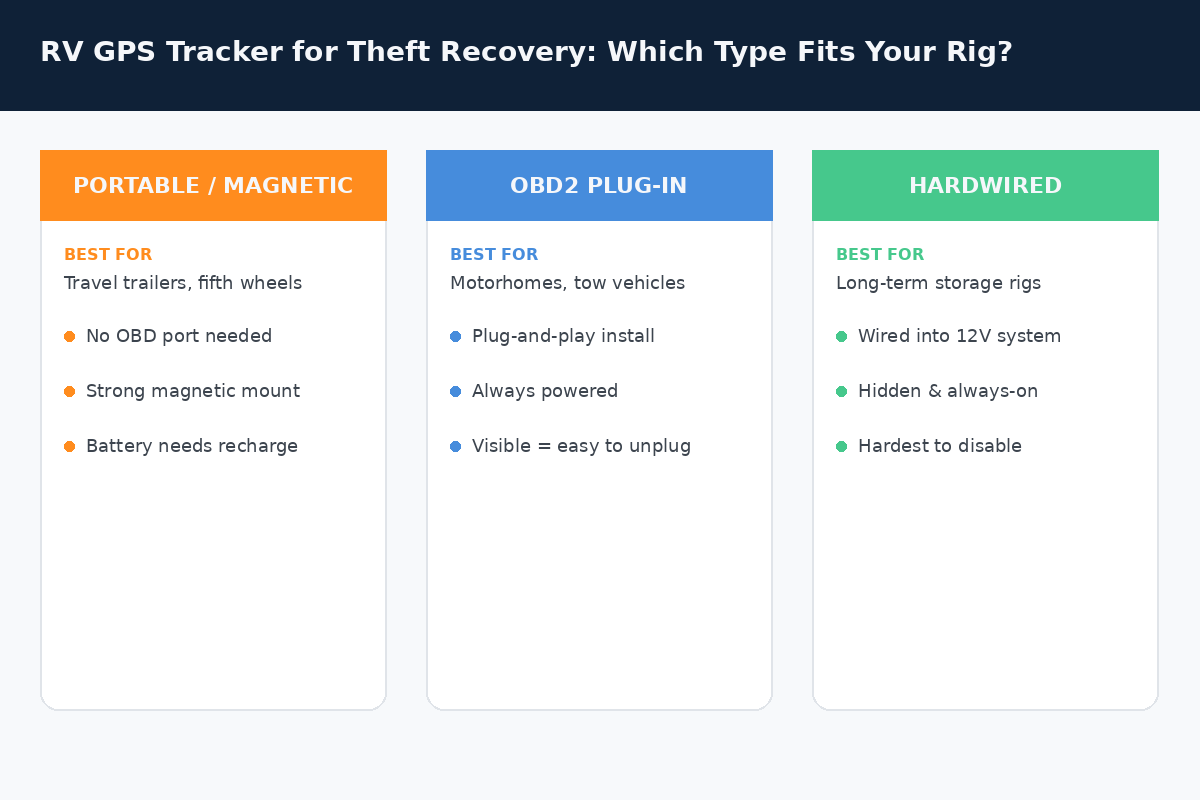
The right RV GPS tracker for theft recovery depends heavily on whether you’re protecting a towable or a motorized rig:
- Portable/magnetic trackers — battery-powered, mount anywhere on a steel frame with a strong magnet, and are the default choice for travel trailers and fifth wheels since there’s no OBD port to plug into. Trade-off: batteries need periodic recharging, typically every few weeks to a few months depending on ping frequency.
- OBD2 plug-in trackers — plug directly into a motorhome or tow vehicle’s diagnostic port, drawing power continuously so there’s no battery to manage. Fast to install, but only an option on rigs with an accessible OBD2 port, and a thief who knows where to look can unplug one in seconds.
- Hardwired trackers — wired directly into the RV’s 12V system and tucked inside a wall cavity, bumper, or storage compartment. Always-on, low-profile, and the hardest for a thief to find or disable, which makes this the strongest option for a trailer that spends long stretches in storage — arguably the most theft-resistant RV GPS tracker for theft recovery you can install.
Best RV GPS Trackers for Theft Recovery in 2026
Here’s how the top-rated options stack up if you’re shopping for an RV GPS tracker for theft recovery this year:
| Tracker | Type | Best For | Notable Strength |
|---|---|---|---|
| Tracki | Portable / cellular (4G LTE) | Most RV owners | Compact, real-time geofence alerts, budget-friendly entry price |
| LandAirSea 54 | Portable / magnetic | Trailers & tow vehicles | Strong magnetic mount, waterproof housing, long battery life |
| Trak-4 | Portable / long-life battery | Long-term storage | Extended standby time between charges, built for seasonal rigs |
Tracki is the best all-around pick for most buyers thanks to its low price and reliable real-time alerts. If your trailer sits in a storage lot for months at a time between trips, the LandAirSea 54 or Trak-4 are better suited to going long stretches without a recharge. Motorhome owners with an accessible OBD2 port can add a plug-in unit as a low-effort second layer alongside a hidden portable tracker. Whichever model you choose, the goal of any RV GPS tracker for theft recovery is the same: get you a real-time location the moment your rig moves without you.
Setup Tips: Placement, Redundancy, and Subscription Costs
Buying the right hardware is only half the job — how you install your RV GPS tracker for theft recovery determines whether it actually works when you need it.
- Hide it, don’t just mount it. A tracker zip-tied in plain view on the tongue jack gets found and tossed in five seconds. Tuck it inside a bumper, wheel well, or storage compartment where it’s not visible from a walk-around.
- Layer your coverage. The Insurance Information Institute recommends a layered approach to vehicle theft prevention — combine a tracker with a hitch lock or wheel boot so a thief has to defeat more than one obstacle.
- Budget for the subscription. Nearly every consumer GPS tracker requires a monthly or annual data plan on top of the hardware cost — factor that into which model actually fits your budget long term.
- Check your solar/battery draw. A hardwired tracker pulls a small continuous load from your house battery. If you’re already running tight on reserve capacity, revisit your solar and power budget math to make sure your system accounts for it.
- Set alerts before you need them. Configure geofence and motion alerts the day you install the tracker, not after something goes missing — fast alerts are the biggest single driver of successful recovery.
FAQ
Do I need a tracker if my RV has an alarm system?
An alarm can deter or delay a theft in progress, but it does nothing once the rig is gone. A dedicated RV GPS tracker for theft recovery is what gets it back.
Can thieves find and remove a GPS tracker?
A visible tracker can be found and removed in seconds. That’s why placement matters as much as the device itself — hidden, hardwired, or tucked-away units are far harder to defeat.
Is a portable tracker enough, or do I need a hardwired one?
For most weekend travelers, a portable magnetic tracker is enough. If your trailer spends long periods in unattended storage, a hardwired unit removes the battery-maintenance risk entirely — either way, having some RV GPS tracker for theft recovery installed beats having none.