A heated RV water hose can keep its own water moving while the filter beside it freezes solid. That is the winter-hookup mistake worth fixing before buying a longer hose or a lower temperature rating: protect the complete water path, and prove the power supply can support it.
These seven checks cover selection, protected connections, electrical supply, battery cost, fault diagnosis, monitoring, and outage planning. They are for a U.S.-style 120-volt campground hookup. Product details are manufacturer specifications, and the power examples are calculations—not claims of hands-on freeze testing.
Affiliate disclosure: As an Amazon Associate, we earn from qualifying purchases. Product links below are affiliate links.
On this page
1. Choose a heated RV water hose for your actual site
Buy the shortest heated RV water hose that reaches both the spigot and the electrical supply without tension. Measure the route around your slide, steps, and parking space rather than the straight-line distance. Extra length adds material to store, more water to drain, and potentially more heating load. Two short hoses also introduce another exposed connection.
For a heated RV water hose, the temperature number is a product rating under specified conditions, not a guarantee for your entire plumbing system. Camco’s manufacturer catalog lists the 25-foot 22911 with a 5/8-inch internal diameter, 120-volt operation, and protection to −20°F. Check the exact part number: similarly named hoses can use different controls and ratings.
Camco’s product catalog also identifies the drinking-water materials. Look for documented potable-water suitability rather than assuming any blue hose is appropriate. A livestock or garden listing alone does not answer that question.
Consider the Camco 22911 25-foot heated drinking-water hose when its length, voltage, and documented temperature rating match your campsite. Its thermostat-controlled design suits a powered hookup; it is not a substitute for protecting the tap or RV inlet. Confirm the model and seller before ordering.
2. Protect the fittings the heating element cannot reach
Trace the water route aloud: campground supply, spigot, regulator, filter, hose, inlet, and interior plumbing. Mark which pieces have their own freeze protection. The most expensive heated RV water hose can remain open while an unprotected filter housing splits beside it.
The Valterra manufacturer instruction sheet explicitly excludes protection beyond the hose connections. That means a warm hose jacket cannot establish that the pedestal supply or inlet is safe. Ask the campground which parts of its water system remain operational during freezes.
Keep removable filters and regulators within an approved protected arrangement. Do not bury a thermostat inside insulation or improvise a heated enclosure around an electrical connection. Follow each component’s instructions; adding insulation indiscriminately can change how the control senses temperature.
A pressure regulator still matters in winter. The Camco 40055 brass water-pressure regulator is a compact option with a manufacturer-stated 40–50 psi operating range. Choose a regulator compatible with your RV’s pressure limit and drinking-water requirements, and protect the regulator itself from freezing.
For a one-night stop, filling a genuinely freeze-protected onboard tank and draining the external connection may be simpler. Confirm how your specific RV heats that tank, pump, and supply lines. A warm living area does not prove that a compartment behind an exterior hatch stays warm.
3. Check the electrical supply before connecting water
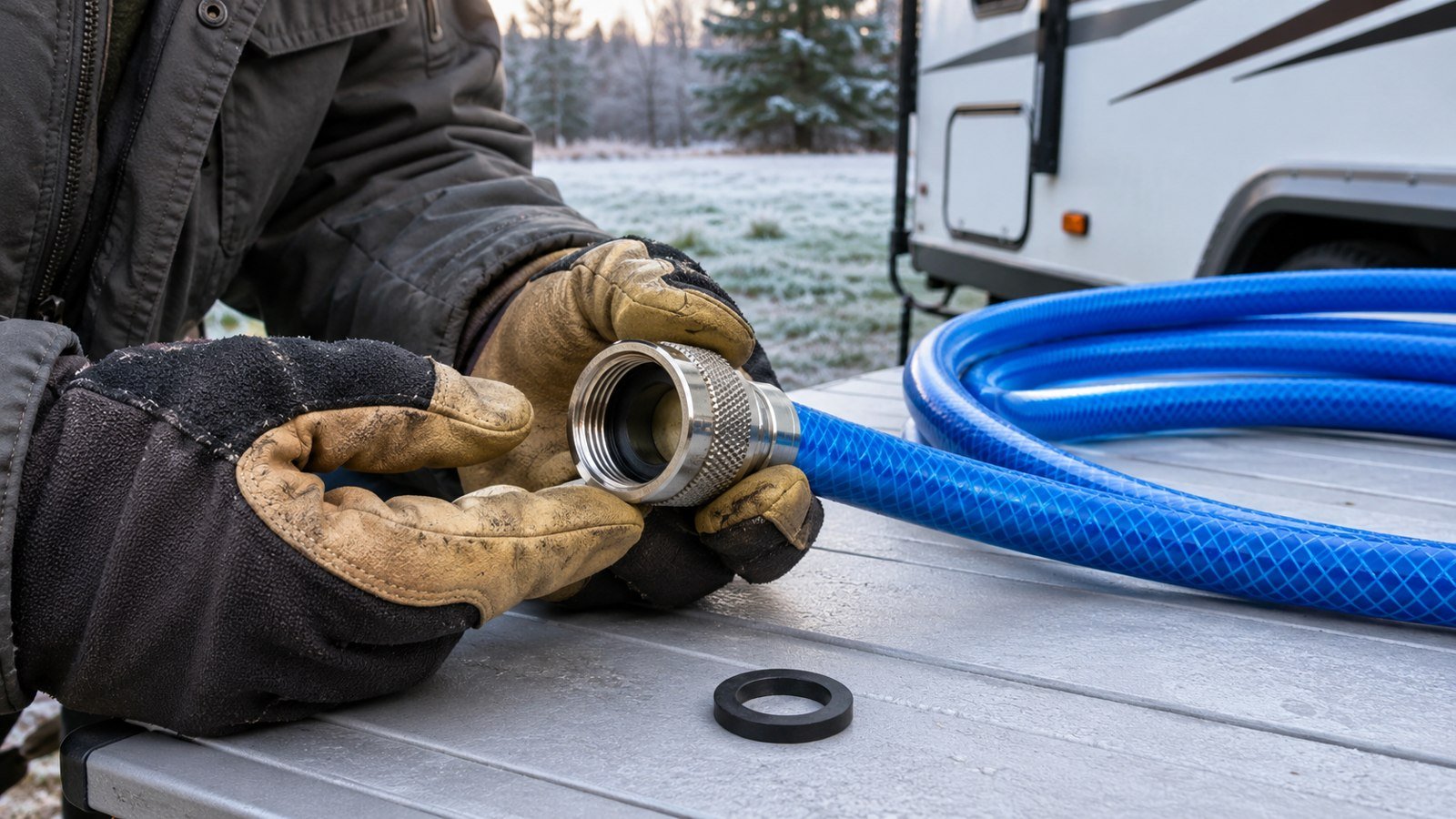
Inspect the heated RV water hose while it is disconnected: damaged jacket, loose strain relief, cracked plug, missing ground pin, or scorched plastic means stop using it. Keep the electrical connection dry and above standing water. A weather cover must close properly around the actual plug, not merely exist on the pedestal.
Use the supply voltage on the hose label and a working GFCI-protected outlet. The U.S. Consumer Product Safety Commission’s GFCI guidance explains why ground-fault protection matters around electrical equipment. A surge protector and a GFCI perform different jobs; buying one does not remove the need for the other.
Do not solve a short power lead by automatically adding an extension cord. Valterra’s sheet and the Camco instruction sheet linked below prohibit extension-cord use for those products. Reposition the setup or select an appropriate hose; instructions supplied with your exact model take precedence.
After flushing and connecting the water side according to the manual, pressurize it and correct leaks before energizing the heater. Inspect the faucet washer and RV inlet while everything remains accessible. Then connect power with dry hands and dry components. Never energize a visibly damaged heated RV water hose to “see if it still works.”
Our RV surge-protector guide covers shore-power protection for the rig. If the hose plugs into a separate pedestal receptacle, ask the campground which circuit feeds it; do not assume the RV’s protection device also monitors that outlet.
Heated RV water hose power math: watts are only the start
Read the heated RV water hose nameplate or obtain the manufacturer’s electrical specification. Do not copy wattage from a different brand’s 25-foot hose. Length alone cannot establish current draw, and a thermostat cycling on and off differs from a self-regulating cable varying its output.
For planning, suppose your chosen heated RV water hose is rated at 180 watts. This is an illustrative example, not a verified Camco 22911 rating. At 120 volts, 180 ÷ 120 = 1.5 amps. Ten hours at full draw uses 1.8 kWh; continuous operation for 24 hours uses 4.32 kWh.
At an assumed electricity tariff of $0.20/kWh, that 24-hour upper-bound example costs about $0.86. A 50% duty-cycle assumption halves energy use to 2.16 kWh, but the forecast is not a measurement. A longer or colder exposure can change the result; use your campground’s tariff and the product’s real specification.
4. Decide whether your battery budget can support it
A heated RV water hose is normally much easier to support on shore power than from a modest battery. An inverter can supply AC only if its rating, outlet protection, installation, and environment are suitable. It cannot make the heating energy disappear.
Using the same hypothetical 180-watt load for ten hours, a 90%-efficient inverter would require about 2,000 Wh from the battery: 1,800 ÷ 0.90. At a nominal 12.8 volts, that is roughly 156 Ah, before inverter standby consumption and other loads. This is a planning calculation, not a promised runtime.
A nominal 100 Ah, 12.8-volt bank contains about 1,280 Wh before reserve and operating limits. It cannot cover that example overnight, even if the inverter can start the load. Furnace blowers, tank pads, lights, and communications equipment still need their own allocation.
Use our boondocking electrical checklist to test the whole load budget before travel. For lithium systems, also check cold-weather battery charging: remaining discharge energy and permission to recharge are separate questions.
When dry camping without a protected water pedestal, a heated RV water hose may solve the wrong problem. An onboard water strategy, matched to the manufacturer’s winter operating instructions, can avoid an external electric heating load altogether. Plan tank refilling during suitable conditions rather than relying on unmeasured winter solar output.
5. Diagnose no water without guessing at the cause
If water stops after a cold night, keep the heated RV water hose disconnected from electricity while inspecting accessible components. Stop immediately for a wet plug, damaged insulation, burning smell, or a connection you cannot safely reach. Do not open a pedestal or probe live wiring.
First ask whether the campground supply is working. Next distinguish a frozen external route from an internal RV problem: if the protected onboard system operates normally under the RV manual’s procedure, the external hookup becomes the likely area to investigate. That comparison narrows the search; it does not locate the ice precisely.
Check any externally mounted regulator and filter before blaming the heated section. A blocked filter can reduce flow without a freeze; a kink can mimic the same symptom. Photograph the installed routing and note the overnight temperature, outlet status, and last time water flowed. Those details help a technician far more than “the hose is bad.”
If a GFCI trips, unplug the heated RV water hose if it is safe and dry to do so. Ask the campground to inspect the outlet and have the hose checked or replaced as appropriate. Do not repeatedly reset the device, remove the ground pin, or move the suspect heater to an unprotected outlet. A trip deserves investigation, even when the water is freezing.
| Symptom | Useful distinction | Next action |
|---|---|---|
| No city water, onboard water works | The external route is suspect; this does not identify the exact frozen part. | Ask about the campground supply, then inspect disconnected accessible fittings. |
| Flow was poor before freezing | A restricted filter, regulator, or kink may be contributing. | Check the installation and component instructions before replacing the heater. |
| GFCI trips with the hose connected | Electrical protection has operated; this is not proof of an overload. | Stop using the suspect heated RV water hose and request qualified inspection. |
| Cabin warm, compartment cold | Interior comfort is not evidence that hidden plumbing is protected. | Follow the RV maker’s cold-weather plan and reassess the external hookup. |
For thawing a heated RV water hose, use only the exact hose and RV manufacturer’s approved method. Never use flame, boiling water on plastic, or an improvised high-temperature heater. Do not force a frozen coupling with pliers. After thawing, inspect for leaks before restoring normal water pressure or power.
6. Monitor the cold spot, not just the thermostat inside
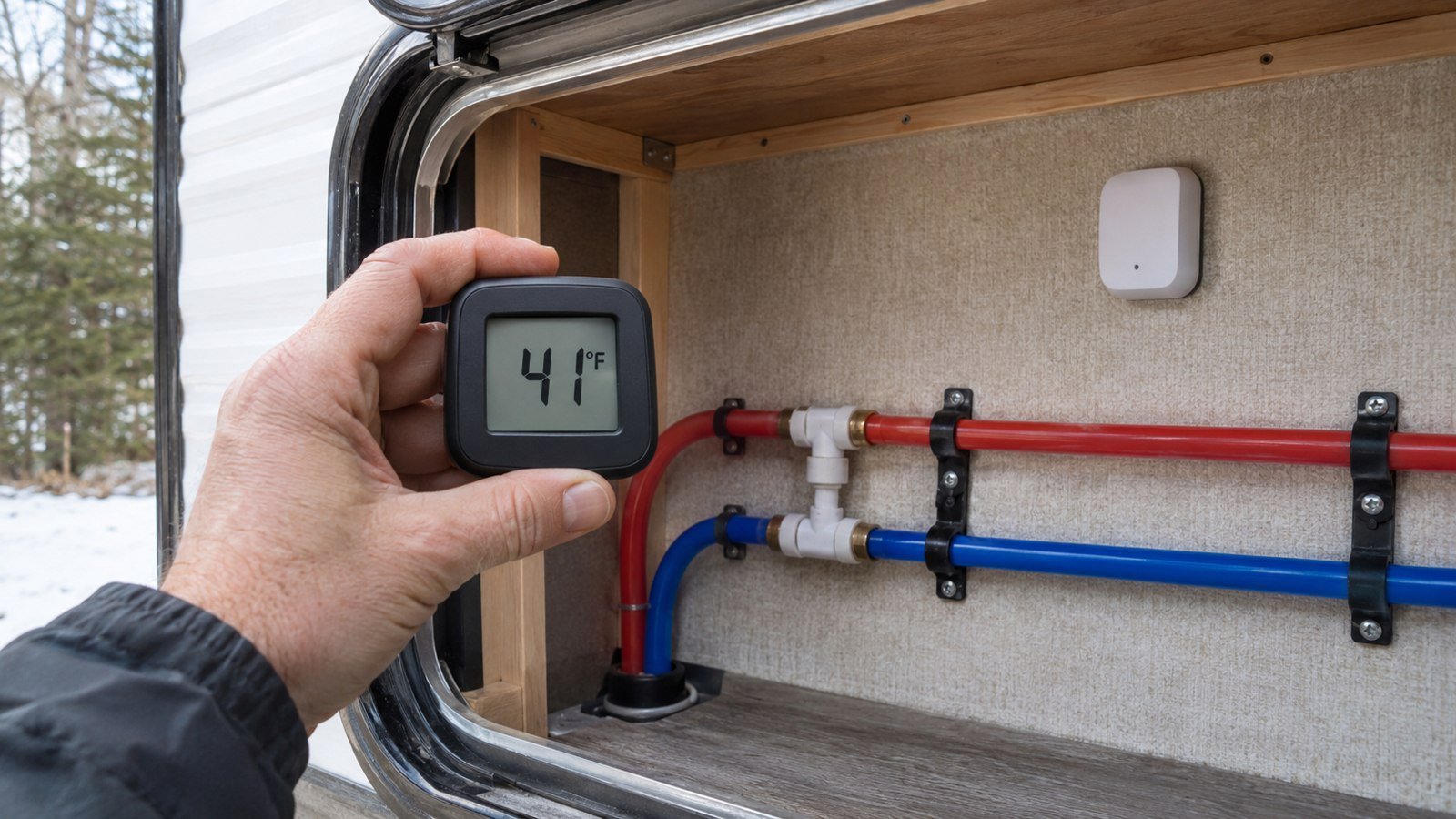
Place a suitable temperature sensor near the vulnerable water compartment, within its stated environmental limits. A display beside your sofa cannot tell you what happens behind the wet-bay door. Keep sensors clear of heater outlets, direct sun, and surfaces that give misleading readings.
The ThermoPro/TempPro TP60B indoor-outdoor thermometer is a useful optional local display for comparing cabin and compartment air temperatures. It does not prevent freezing, detect water temperature, or provide a guaranteed remote alarm; verify the supplied sensor’s operating range and placement instructions.
The manufacturer’s TP60B page documents the current model. Test reception with doors closed before trusting the display, and confirm a stale reading is not being mistaken for a stable temperature. Metal compartments can make placement more challenging.
Record the lowest compartment reading after your first cold night, then inspect the actual fittings. Keep enough temperature margin to act before a freeze develops; the appropriate margin depends on sensor accuracy, placement, and your RV. Monitoring a heated RV water hose is most useful when paired with a practical disconnect plan.
For wet windows and damp cabinets, use our RV condensation troubleshooting guide. Moisture control and plumbing freeze protection are different tasks, but both depend on knowing where cold surfaces and stagnant air collect.
7. Prepare for an outage before the first freeze
Choose your trigger for abandoning the external hookup before bedtime: lost power, a forecast beyond the product rating, an unavailable protected tap, or an RV compartment approaching unsafe temperatures. Write down the disconnect procedure and keep the required gloves and light accessible.
For the heated RV water hose, follow its manual’s shutdown sequence. Disconnect electrical power before handling water connections, isolate the supply, relieve pressure as instructed, drain, and store appropriately. The Camco care-and-handling sheet includes its drainage and storage requirements. Confirm that sheet matches your product generation.
Leave a small separate supply of drinking water where it will remain usable. Know whether the campground has an indoor water source and whether you can move before conditions deteriorate. A replacement hose delivered tomorrow does not restore tonight’s water.
For extended storage, change plans entirely: an unattended RV needs its manufacturer’s winterization procedure, not merely a heated RV water hose left connected. Our electrical winterization guide complements the rig’s plumbing instructions. Check battery and controller manuals for their specific storage requirements.
Before the next trip, inspect the heated RV water hose again in daylight. Document the exact model, purchase date, and any fault symptoms for warranty support. Replace damaged parts rather than attempting to splice an integrated heated assembly. The most reliable winter setup is one you can safely inspect, shut down, and restart.
For winter RV camping, make the first cold-night check while you can still change the RV water hookup in daylight. Write the heated RV water hose model and its electrical rating beside the forecast and your compartment reading. This small log separates three different decisions: whether the heater is suitable, whether the plumbing has adequate RV freeze protection, and whether the available electrical supply can support the heated hose power draw.
Questions before a freezing night
Will a heated RV water hose keep my RV pipes from freezing?
No. It protects its heated section under the manufacturer’s stated conditions. The spigot, filters, regulators, inlet, tanks, and internal lines need their own approved freeze protection.
How much electricity does a heated hose use?
Use the exact model’s rated watts and operating time. A hypothetical 180-watt heater running continuously for ten hours uses 1.8 kWh. Thermostat cycling can reduce actual consumption; measure or obtain model-specific data rather than borrowing another hose’s specification.
Can I use an extension cord with a heated water hose?
Only if the exact product’s instructions permit it. The Camco and Valterra instruction sheets referenced here prohibit extension cords. Choose a setup that reaches a suitable protected outlet without contradicting the manual.
Why is my heated hose frozen even though it is plugged in?
Possible causes include lost electrical power, an exposed fitting or filter, an incorrectly positioned control, damaged heating components, or conditions beyond the product’s rating. Inspect safely with power disconnected and consult the manufacturer instead of assuming the hose is receiving heat.
What should I do if my heated hose trips the GFCI?
Disconnect it if safe, stop using it, and have the hose and campground supply checked. Never bypass the GFCI, remove the ground pin, or repeatedly reset the device to keep a suspect heater running.
Should I disconnect my water hose overnight?
A drained external hookup can be a sensible option if your onboard tank, pump, and plumbing are genuinely protected and the RV manual permits that operating plan. If you stay connected, every exposed component and the power supply must remain suitable for the conditions.