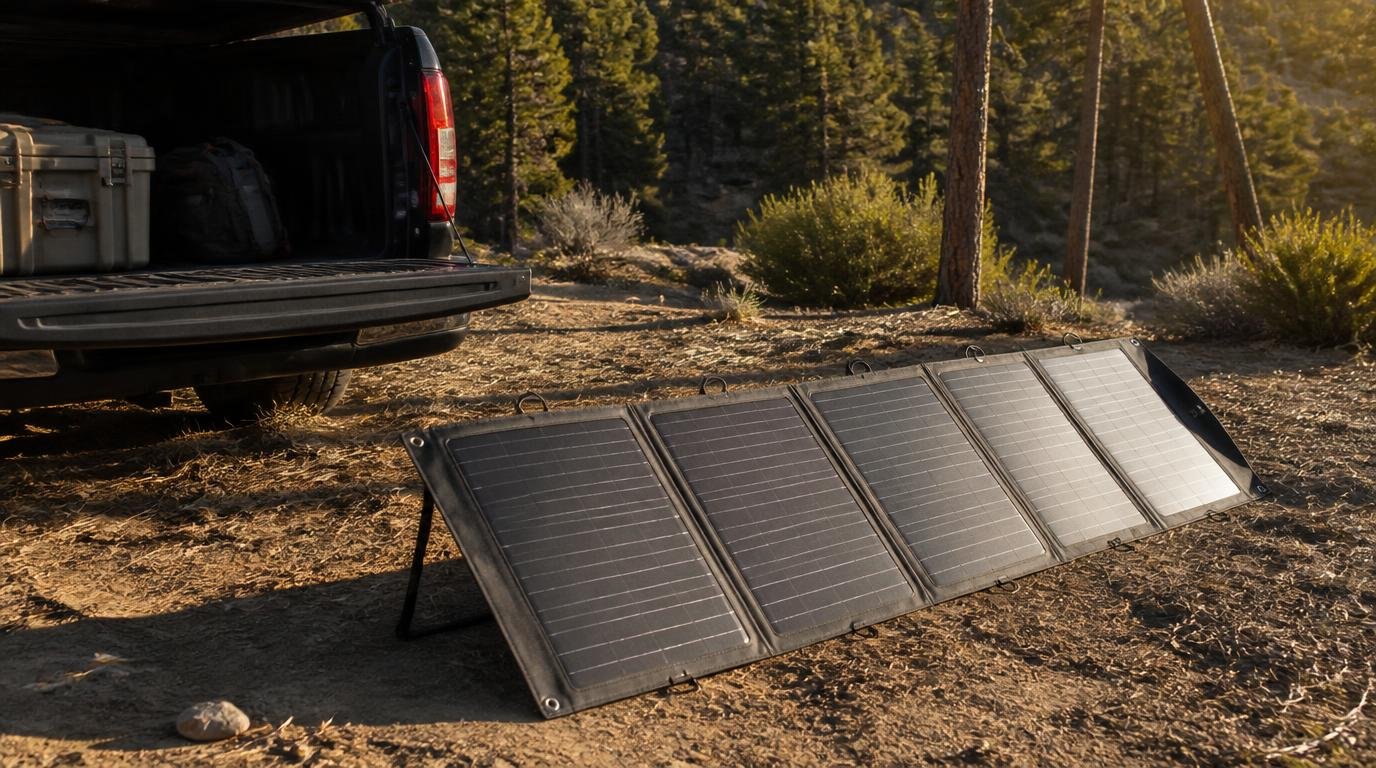
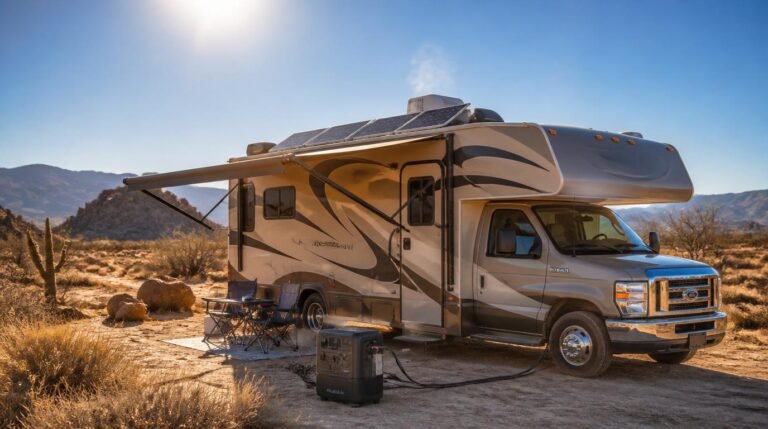
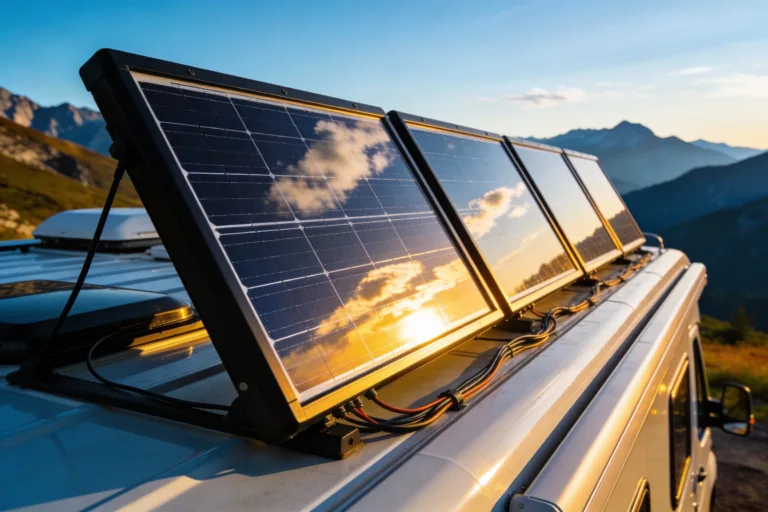
If you’ve ruled out roof-mounted solar because you don’t want to drill into your truck cap or don’t own the RV outright, portable solar panels for truck camping solve that problem without a single new hole in your rig. They fold flat, slide behind a seat or into a storage bay, and can be aimed straight at the sun instead of being stuck at whatever angle your roof happens to sit at.
This guide breaks down which portable panels are actually worth buying in 2026, how much real-world power to expect once you account for losses, and how to match a panel to the loads you’re actually running.
Table of Contents
- Why Portable Beats Roof-Mounted for Many Setups
- How Much Solar Power Do You Actually Need?
- Best Portable Solar Panels for Truck Camping in 2026
- Real-World Output: What Rated Watts Actually Deliver
- Matching a Panel to Your Loads
- Buying Checklist
- Bottom Line
Why Portable Beats Roof-Mounted for Many Setups
Roof-mounted solar is the right call if you’re in one rig long-term and want a fully automated system. But it’s the wrong call for a lot of truck campers and part-time RVers, for a few practical reasons:
- No drilling or permanent mounting — renters, lessees, and anyone running a slide-in truck camper can’t put permanent penetrations in a roof.
- You can chase the sun. A folding panel can be repositioned to face the sun directly, recovering output that roof panels lose when stuck flat.
- It travels with you, not the rig. Swap trucks, swap campers, or lend it to a buddy — the panel isn’t bolted to one vehicle.
- Shade management is easier. Move the panel out from under a tree or your rig’s own shadow instead of re-parking the whole truck.
The tradeoff is that you have to deploy and store it manually, and it can’t charge while you’re driving down the highway. For boondockers who park for days at a time, that’s rarely a dealbreaker.
How Much Solar Power Do You Actually Need?
Before buying, tally your daily loads in watt-hours (watts × hours used). According to the Department of Energy, standard solar module testing is done at 1,000 W/m² irradiance and 25°C — lab conditions you won’t see in the field, which is why sizing with a buffer matters. (Source: U.S. Department of Energy, Solar Photovoltaic Technology Basics)
As a rule of thumb for 2026 panels:
- 100–200W covers phone/laptop charging, LED lighting, and a 12V fan or two.
- 200–300W keeps a 12V fridge and moderate device use running through a sunny day.
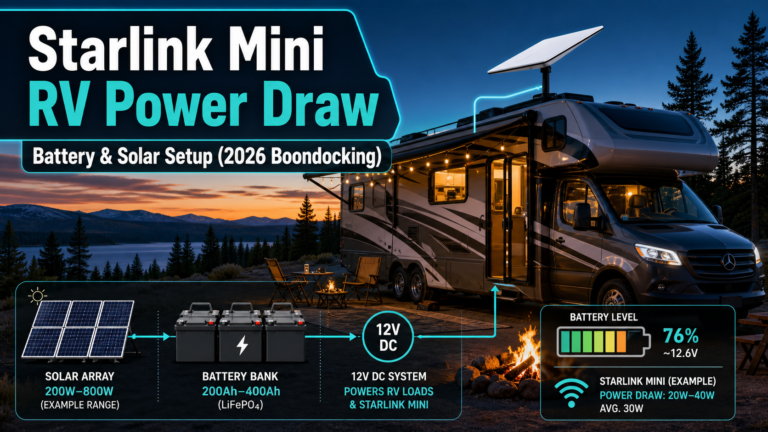
- 400W+ supports continuous RV-style use — fridge, fans, Starlink, and a laptop — with headroom for cloudy stretches.
If you already run a dedicated battery bank, our RV DIY & installation guides walk through sizing your charge controller and wiring to match whatever panel wattage you land on.
Best Portable Solar Panels for Truck Camping in 2026
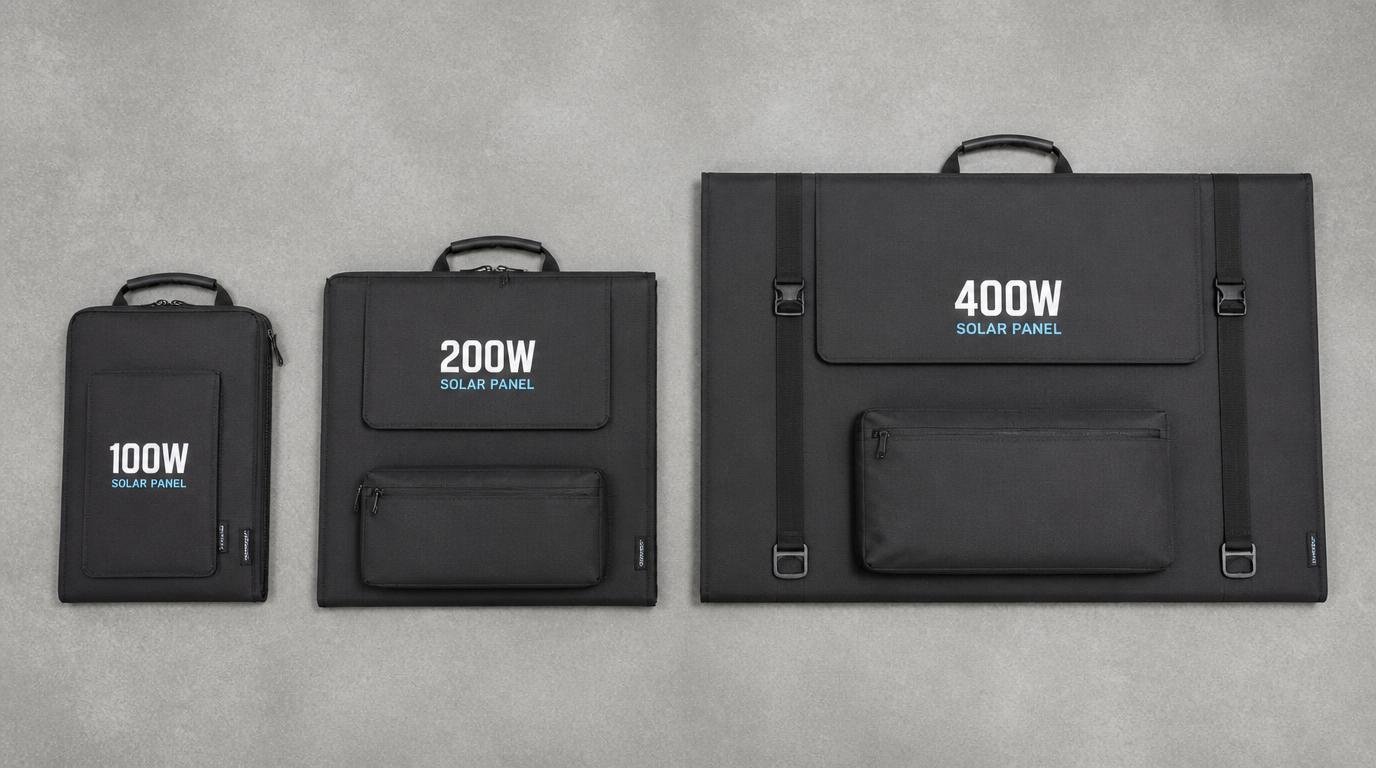
Here’s how the top folding panels stack up this year, based on measured (not just rated) output and real-world durability:
Renogy 200W Portable Panel — The best overall pick for most truck campers. Delivers a measured ~178W in testing, weighs 13.9 lbs, and folds down small enough to store behind a bench seat.
EcoFlow 160W Portable Panel — Best for rugged, wet-weather use. Carries an IP68 waterproof rating and is built to charge mid-size power stations quickly without babying it in rain.
Renogy 400W Solar Blanket — Best for continuous, RV-style power draws. Unfolds to roughly 8 feet of surface area, weighs 16 lbs, and still folds flat enough to slide under a seat or into a cargo bay.
HQST 200W Portable Panel — A reliable mid-tier option with consistent output and a more budget-friendly price point than Renogy’s equivalent.
BougeRV 200W Portable Panel — Best budget pick, with roughly 23% cell conversion efficiency that punches above its price point.
Real-World Output: What Rated Watts Actually Deliver
A “200W panel” almost never produces a steady 200W in the field. Temperature, panel angle, partial shading, and dust all cut into output, and quality folding panels typically deliver 70–90% of their rated wattage in real-world conditions — so budget for the lower end of that range when sizing your system, not the number printed on the box.
Weatherproofing matters more than most buyers realize, too. An IP65 panel resists rain and dust but isn’t built for submersion, while an IP68 panel can handle sustained water exposure — useful if you’re camping somewhere wet more often than not. (Source: Jackery, IP Ratings for Solar Panels Explained) For most truck camping use, IP65–IP67 is plenty; IP68 is a nice-to-have, not a requirement.
For the electrical fundamentals behind why panel output varies with temperature and cell type, NREL’s technical primer is a solid reference. (Source: NREL, Solar Photovoltaic DC Systems: Basics and Safety)
Matching a Panel to Your Loads
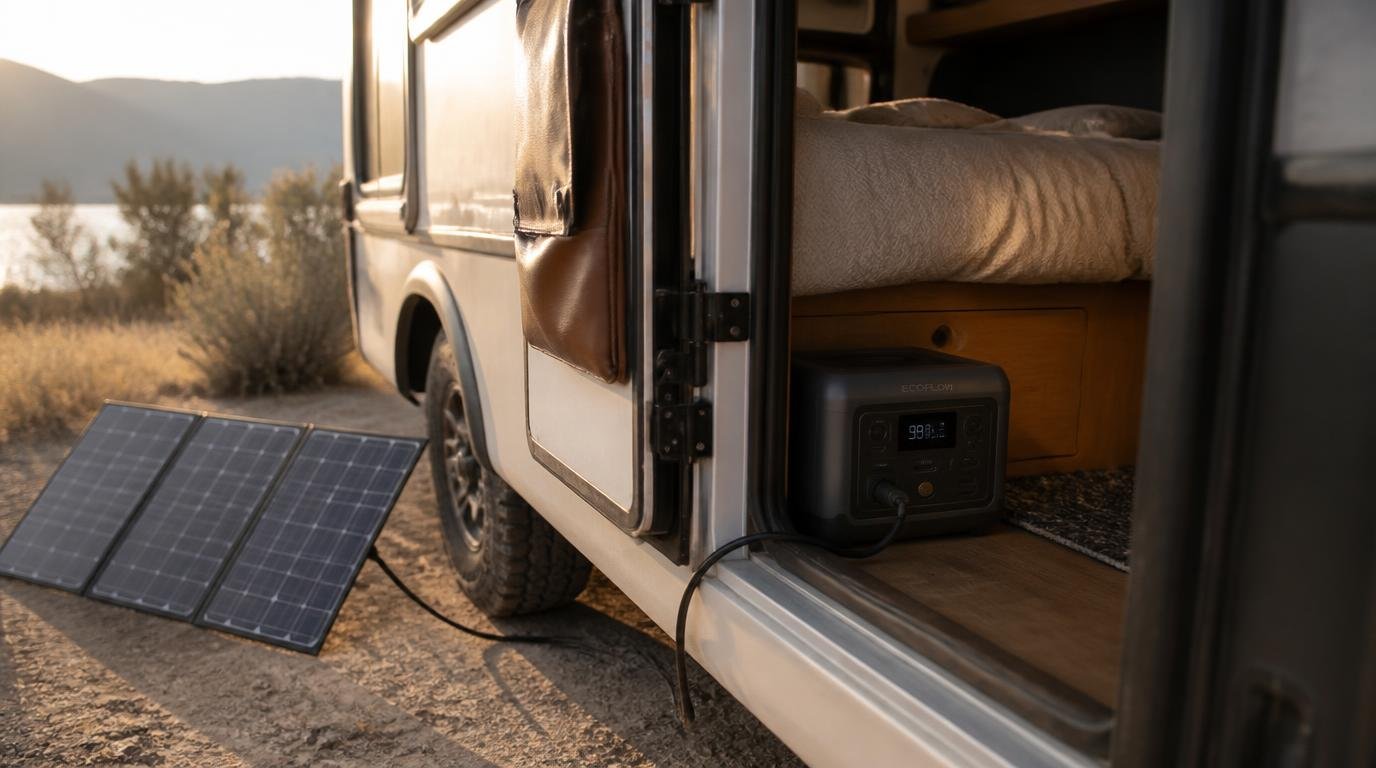
Once you know your panel’s realistic output, match it against what you’re actually trying to run:
- Charging a battery bank: A 200W panel feeding a quality LiFePO4 battery can realistically replace 600–900Wh a day in decent sun — enough to keep a modest setup topped off without shore power.
- Running 12V accessories: Smaller loads like 12V camper fans sip so little power that even a 100–160W panel can keep one running most of a sunny day without touching your battery reserve.
- Running a fridge plus electronics: Bump up to 300–400W and build in a cloudy-day buffer, since fridges cycle throughout the day regardless of sun.
Buying Checklist
Before you buy, confirm:
- Panel wattage covers your daily watt-hour total with a 20–30% buffer for real-world losses
- IP rating matches your typical camping conditions (IP65+ for most, IP68 if you camp in consistently wet climates)
- Folded dimensions fit your actual storage space (measure before you buy)
- Connector type (MC4, Anderson, or proprietary) matches your battery station or charge controller
- Panel includes a built-in kickstand or you have a plan to angle it toward the sun
Bottom Line
Portable solar panels for truck camping give you roof-mounted-level power without permanent installation, and 2026’s best folding panels — like the Renogy 200W and EcoFlow 160W — get close enough to their rated output to make sizing straightforward. Tally your daily watt-hours, buy with a real-world efficiency buffer instead of the sticker wattage, and match the panel to your battery bank using our RV DIY & installation guides before you head out on your next trip.
One Comment