By Danilo C.G. | May 20, 2026 | 10 min read
📋 What You’ll Find Here
- Why Camper Ventilation Is a Survival Skill, Not a Comfort Upgrade
- How to Choose the Right 12V Fan (CFM, Noise & Power Draw)
- The Biggest Myth About RV Ventilation You Need to Stop Believing
- Strategic Fan Placement for Maximum Camper Airflow
- The Installation Workflow: Seed to Finish
- Advanced Off-Grid Cooling: Thermostats, Solar & Smart Wiring
- Frequently Asked Questions
- My Top Recommended Gear
Why Camper Ventilation Is a Survival Skill, Not a Comfort Upgrade
The best 12V fans for camper ventilation balance CFM output, amp draw, and noise level to create consistent airflow without draining your battery. Roof-mounted exhaust fans paired with a low-mounted intake produce a cross-ventilation stack effect — the single most effective passive-plus-active cooling strategy for any camper, van, or RV.
Here’s a stat that stopped me cold the first time I saw it: the interior of a parked vehicle in direct sunlight can reach 70°C (158°F) within 60 minutes — even on a relatively mild day, according to research published by the National Highway Traffic Safety Administration. That’s not a camper comfort problem. That’s a safety problem.
I’ve spent years helping people wire up campers, troubleshoot 12V systems, and build out rigs for full-time van life. And the single most underestimated upgrade I see people skip — or do badly — is 12V fans for camper ventilation. Everyone obsesses over solar panels, refrigerators, and lithium batteries. But without proper airflow, none of that matters when you’re lying awake at 2 a.m. in a 90°F tin box.
The fix isn’t complicated. But it does require you to think about airflow as a system — not just slapping a fan somewhere and calling it done. Let me walk you through the workflow that actually works.
How to Choose the Right 12V Fan (CFM, Noise & Power Draw)
What does CFM actually mean for a camper, and why should you care?
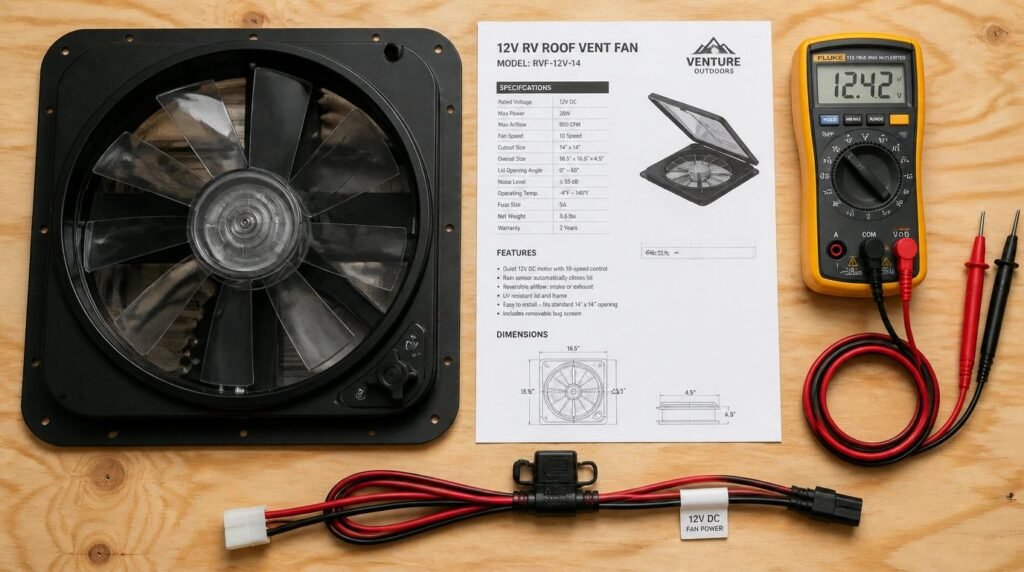
CFM stands for Cubic Feet per Minute — it’s the volume of air a fan moves in 60 seconds. For camper ventilation, I use a simple rule of thumb: target at least 1 CFM per cubic foot of interior space, with the goal of achieving 15–20 complete air exchanges per hour in hot conditions. A typical cargo van interior runs about 200–250 cubic feet, so you want a fan rated in that ballpark at a minimum — and ideally 300+ CFM when you factor in cooking smells, humidity, and body heat.
But here’s what most buying guides won’t tell you: CFM numbers are measured under zero static pressure. The moment you add a roof vent lid, a bug screen, or any restriction, actual airflow drops — sometimes by 20–30%. So when you see a fan marketed as “250 CFM,” budget for real-world delivery closer to 180–200 CFM. Buy with that buffer in mind.
How do I balance fan power draw against my 12V battery bank?
This is where the math gets interesting — and where van lifers often make a costly mistake. Most quality 12V RV fans draw between 1.5 and 5 amps at high speed. At low speed (where most people run them overnight), that drops to 0.5–1.5 amps. A 100Ah lithium battery, assuming you use 80% of its capacity, gives you roughly 80 usable amp-hours. Running a 2-amp fan all night for 8 hours costs you just 16Ah — totally manageable even without solar input.
TBH, the amp draw question matters most when you’re stacking appliances. If you’re running a 12V portable fridge alongside a cooler and a fan simultaneously, you need to total your loads and verify your system can handle the draw without voltage sag.
Why noise level matters more than most specs sheets admit
Noise is the spec nobody brags about in marketing materials, but it’s the one that will make or break your sleep quality. Look for fans with brushless DC motors — they run 30–40% quieter than brushed equivalents and last significantly longer in the vibration-heavy camper environment. Quality units like the Maxxair series operate around 40–45 dB on low speed, which is roughly equivalent to a quiet library. Cheaper fans with brushed motors often buzz, rattle, or develop bearing noise within a season.
The Biggest Myth About RV Ventilation You Need to Stop Believing
Ready for this? A bigger fan does not automatically mean better ventilation. I know — it feels counterintuitive. But I’ve seen people install a 500 CFM industrial fan in a camper van and wonder why it’s still sweltering inside. The problem isn’t the fan’s power. It’s the absence of an intake path.
Think of your camper like a sealed bottle. No matter how powerful your exhaust fan is, it can only pull air out as fast as replacement air can flow in. Without a dedicated intake — either a low-mounted second fan, a cracked window, or purpose-built intake vents — your exhaust fan creates negative pressure inside the cabin and essentially throttles itself. You’re running a powerful motor to move very little air.
The fix is elegant and cheap: crack a window on the opposite end of the rig from your exhaust fan, or better yet, install a second low-mounted 12V fan as a dedicated intake. The pressure differential does the rest — and suddenly that “underpowered” 200 CFM roof fan feels like twice the machine it was before. This also ties directly into your overall RV safety and electrical planning — poor ventilation can contribute to moisture buildup, mold risk, and even CO accumulation if you’re running propane appliances.
Strategic Fan Placement for Maximum Camper Airflow
Where exactly should I mount a 12V exhaust fan in my camper van?
Placement is where the physics of thermodynamics meets the art of the build — and getting it right makes a dramatic difference. Hot air rises. That’s not a metaphor; it’s convective physics. Your roof is where heat concentrates most aggressively, which makes a roof-mounted exhaust fan your single highest-leverage ventilation tool.
Position it toward the rear of the vehicle, ideally over your sleeping area or kitchen — the two highest heat-generating zones. If you have a choice between center and rear mounting, go rear. This placement also aligns your exhaust point away from the cab, reducing the chance of hot exhaust air being drawn back in through the windshield when parked.
For the intake side, mount a secondary fan or vent low on the front-facing wall — 12 to 18 inches from the floor. Cool air at floor level gets drawn in, flows across the living space, rises as it warms, and exits through your roof fan. That’s a full convective loop, and it’s the most energy-efficient airflow pattern you can engineer into a camper.
Does fan direction matter — intake or exhaust — for camper cooling?
Yes, and most people set this up backwards. In hot, sunny conditions, run your roof fan in exhaust mode — pulling hot air out. The lower ambient temperature outside (especially in shade or at elevation) will naturally flow in as replacement air. At night when outside temperatures drop, you can reverse the fan direction to push cooler outside air in. Many quality 12V RV fans include a reversible motor for exactly this reason — it’s a feature worth paying for.
The Installation Workflow: Seed to Finish
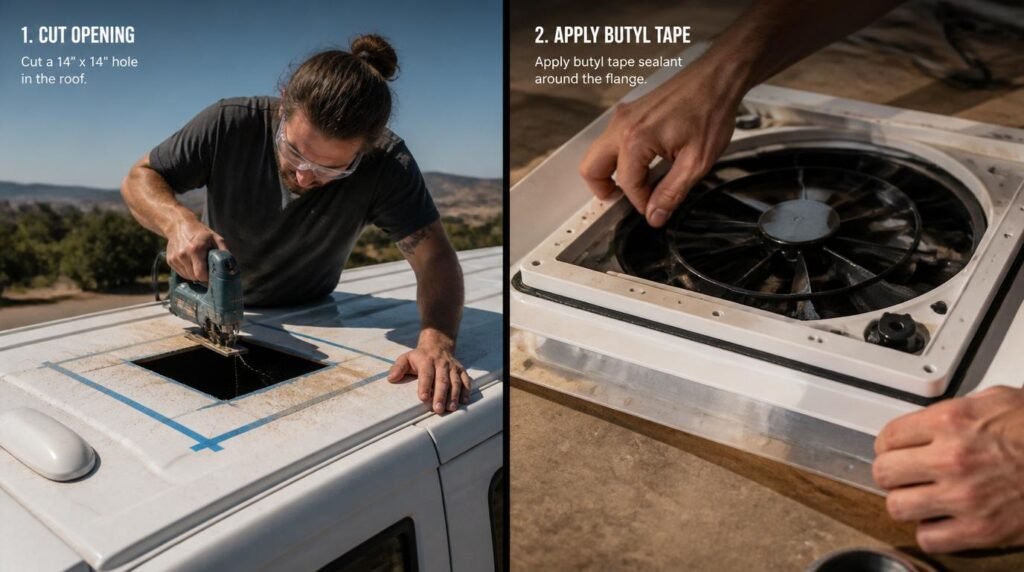
Installing a 12V roof fan isn’t as scary as it looks — but it does demand methodical execution, especially around the roof penetration. Here’s the workflow I walk people through:
- Step 1 — Calculate your interior cubic footage. Length × width × height. Target a fan rated for at least that many CFM.
- Step 2 — Choose your fan and verify amp draw. Confirm your existing 12V electrical system can handle the additional load without exceeding fuse ratings.
- Step 3 — Mark and cut the roof opening. Most standard roof vent fans require a 14×14 inch cutout. Tape, measure twice, cut once — this is permanent.
- Step 4 — Apply butyl tape to the fan flange. Run a full bead around the entire flange perimeter before setting the fan in place. This is your primary water seal.
- Step 5 — Wire to your 12V fuse block. Use appropriately gauged wire (16–18 AWG for most fans). Install an inline fuse within 18 inches of the positive battery terminal connection, per NFPA 1192 recreational vehicle wiring standards.
- Step 6 — Apply dicor lap sealant. After the fan is secured, run a bead of self-leveling dicor around the entire base. Let it cure 24 hours before testing in rain conditions.
If your camper build also includes interior LED lighting, it’s worth running your fan wiring at the same time to minimize redundant wall penetrations and keep your electrical routing clean. I covered that logic in depth when I wrote about 12V LED lights for RV interiors — the wiring principles carry over directly.
Expert Commentary: Mortons on the Move — one of the most technically rigorous full-time RV channels on YouTube — walks through a complete roof fan installation with real electrical measurements and sealant application detail you won’t find in a manufacturer’s PDF. If you’re doing this for the first time, watch the sealant sequence at least twice before you touch your roof. Worth every minute.
Advanced Off-Grid Cooling: Thermostats, Solar & Smart Wiring
Can I automate my 12V camper fan with a thermostat controller?
Absolutely — and this is where the real efficiency gains live. A 12V thermostat controller lets you set a temperature threshold (say, 75°F / 24°C) above which the fan automatically kicks on, and a lower threshold where it shuts off. You set it once, forget it, and your rig self-regulates all day while you’re hiking. These controllers typically cost $15–$40 and wire inline between your fan and power source. IMO, this is the single highest ROI upgrade after the fan itself.
For even more granular control, some premium fan models (Maxxair’s digital line, for example) include built-in thermostat and rain sensors that close the lid automatically when moisture is detected. If you camp in areas with unpredictable afternoon storms, that rain sensor alone is worth the price premium — I’ve come back to a dry van interior more times than I can count because of it.
How do 12V camper fans pair with a solar power system?
This pairing is practically made for each other. A single 100W solar panel in good sun conditions generates roughly 5–7 amps per hour. A quality 12V camper fan at medium speed draws 2–3 amps. Do the math: on a sunny day, your solar panel powers your fan directly and still sends surplus current to your battery bank. You’re ventilating your camper essentially for free.
The key is making sure your solar charge controller — whether PWM or MPPT — is properly sized to handle your total panel wattage, and that your wiring from panel to controller to battery to fan load is correctly fused at each stage. I walk through the full refrigeration and power system logic (which shares the same wiring architecture) in my guide on best 12V RV refrigerators — the electrical principles are directly transferable to your fan setup.
What wire gauge should I use for a 12V camper fan circuit?
For fans drawing up to 5 amps on a run under 10 feet, 18 AWG is sufficient. For runs between 10–20 feet, step up to 16 AWG to account for voltage drop. Beyond 20 feet or for fans with higher peak draw, use 14 AWG. Voltage drop calculators are freely available online — I use one every single time I plan a new circuit, even after years of doing this. A 10% voltage drop across a 12V fan circuit means your fan runs at 10.8V instead of 12V — that’s audible in the motor sound and measurable in reduced CFM output.
Also: always fuse at the source, not just at the device. An unfused wire run from your battery is a fire hazard, full stop. The EPA’s guidance on indoor air quality reinforces why functional ventilation paired with safe electrical practices is a genuine health priority — not just an upgrade. 🙂
Frequently Asked Questions About 12V Fans for Camper Ventilation
What size 12V fan do I need for camper ventilation?
For most camper vans and small RVs, a fan rated between 150 and 300 CFM handles daily ventilation comfortably. Larger rigs or hot climates benefit from 400+ CFM units. Match the fan’s CFM rating to your rig’s cubic footage — roughly 1 CFM per cubic foot of interior space for adequate air exchanges per hour.
How much power does a 12V camper fan use?
Most 12V camper fans draw between 1.5 and 5 amps depending on speed setting and fan size. A quality roof vent fan like the Maxxair or Fan-Tastic typically pulls 3–4 amps at high speed, meaning a 100Ah battery can run it for 20–30 hours — making them highly efficient for off-grid camping.
Can I run a 12V RV fan on solar power?
Yes — 12V fans are one of the best appliances to pair with a solar setup. Their low amp draw means even a modest 100W solar panel can power a quality camper fan through most of a sunny day without touching your battery bank. Pair with a PWM or MPPT charge controller for best results.
Where should I mount a 12V fan in my camper for best airflow?
Mount the primary exhaust fan on the roof toward the rear of the camper to pull hot air out, and position a secondary intake fan low on the opposite end to draw cool air in. This cross-ventilation strategy creates a stack effect that flushes heat far more effectively than a single fan placement.
Is a roof vent fan better than a sidewall fan for camper ventilation?
Roof vent fans outperform sidewall fans for heat exhaustion because hot air naturally rises to the ceiling. A roof-mounted 12V fan captures and expels that heat directly. Sidewall fans work well as intake units or for targeted personal cooling, but they lack the thermal efficiency of a ceiling-mounted exhaust fan.
What is the quietest 12V fan for van life sleeping comfort?
The Maxxair 00-07500K and Fan-Tastic Vent Model 1200 are consistently rated among the quietest 12V roof fans for van life, operating at under 45 decibels on low speed. For personal fans, brushless DC motor designs run significantly quieter than brushed motors and last longer in the vibrating camper environment.
My Top Recommended Gear
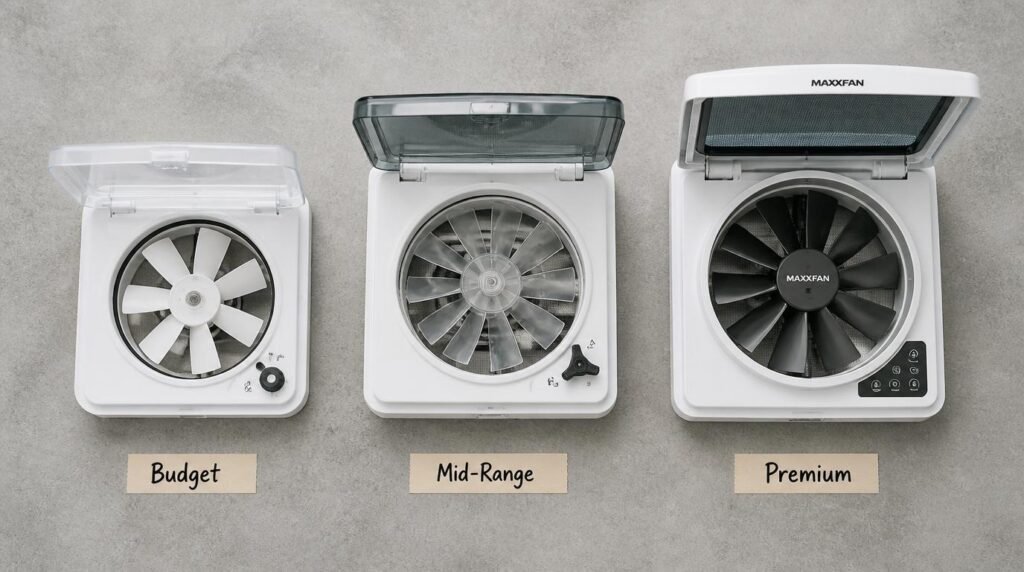
These are the three fans I point people toward depending on their budget and build goals. I’ve either personally tested these or researched them exhaustively — no filler recommendations here.
🟢 Budget Pick — HQST 12V Roof Vent Fan with Remote
A no-nonsense entry point for builders who want reliable airflow without the premium price tag. It covers the basics — three speed settings, reversible motor, manual rain lid — and holds up well for seasonal campers who aren’t living in their rig full-time. Solid value, ngl.Check Price on Amazon →
🔵 Mid-Range Pick — Maxxair 00-07500K MaxxFan Deluxe
This is the fan I most often recommend to full-time van lifers and RV owners who want the best balance of price, performance, and quiet operation. Ten fan speeds, a built-in thermostat option, and a rain sensor that closes automatically — all in a unit that pulls around 900 CFM at peak. It’s been on the market long enough to have a proven reliability track record in harsh conditions.Check Price on Amazon →
🟡 Premium Pick — Fan-Tastic Vent 6300 Series with Thermostat
For serious full-timers or anyone building a high-end rig, the Fan-Tastic 6300 series is about as good as 12V roof ventilation gets. Whisper-quiet brushless motor, automatic thermostat, rain sensor, and a three-speed system that gives you surgical control over airflow. It’s the fan I’d put in my own build if budget weren’t a constraint — and that’s saying something.Check Price on Amazon →
Disclaimer: This post contains affiliate links. As an Amazon Associate, I may earn a commission from qualifying purchases at no additional cost to you. I only recommend products I’ve personally tested or rigorously researched.