The 12V portable fridge vs cooler debate has ruined more camping forum threads than wet firewood has ruined campfires. Here’s the problem: you’re planning a truck camping trip or loading up the RV, and you need cold food that stays cold — not “sort of cool” by day three when your ice has become a sad soup your sandwiches are swimming in. The frustration of soggy groceries and warm drinks after spending $15 on gas station ice bags? I’ve lived it. Multiple times. The solution isn’t always what the loudest voices on Reddit tell you. It depends on how you travel, how long you go, and what you’re actually willing to spend. I’ve tested both options extensively over a decade of RV and truck adventures, and I’m going to break it all down — honestly.
Table of Contents
- What’s the Real Difference Between a 12V Fridge and a Cooler?
- Temperature Performance: The Only Metric That Truly Matters
- True Cost Analysis: Stop Ignoring the Ice Math
- Power Consumption and Off-Grid Realities
- Portability, Durability, and Practical Footprint
- 3 Myths I Need to Kill Right Now
- Who Should Buy What: My Honest Recommendations
- Frequently Asked Questions
- My Top Recommended Gear
What’s the Real Difference Between a 12V Fridge and a Cooler?
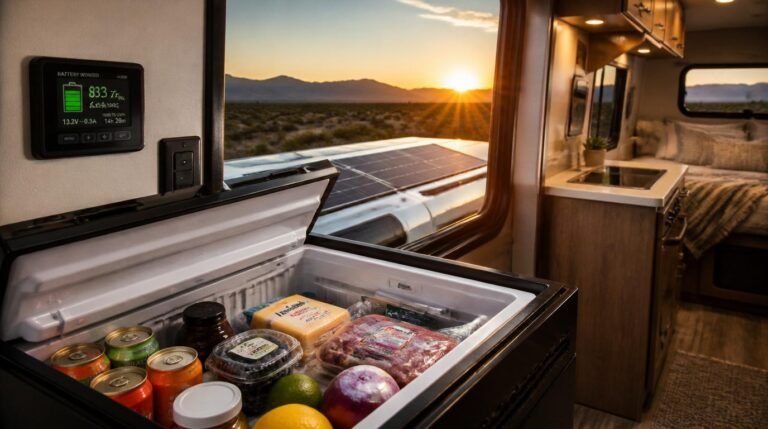
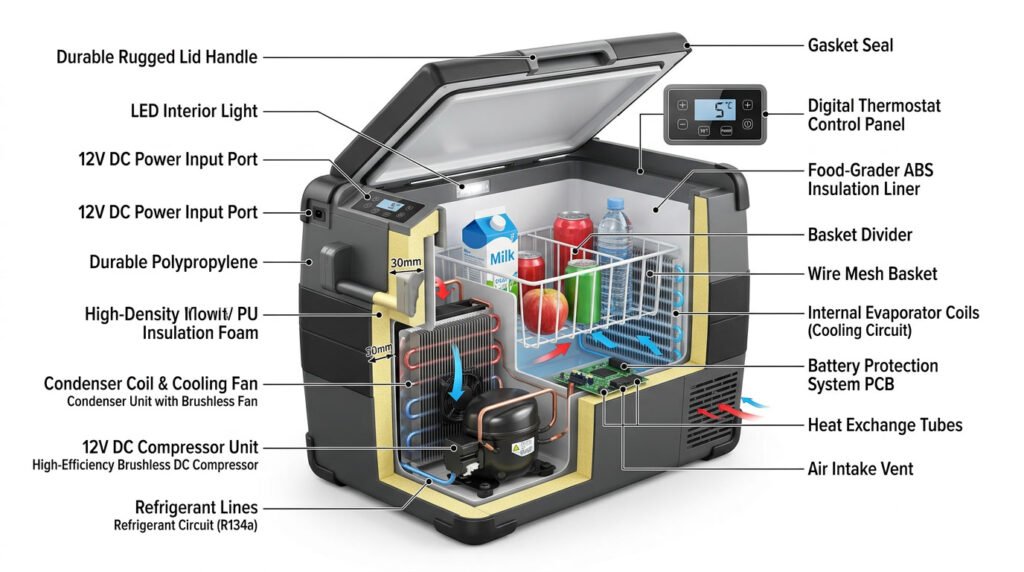
A 12V portable fridge uses a compressor or thermoelectric system to actively refrigerate contents to a set temperature, powered by your vehicle’s 12-volt electrical system. A cooler is a passive, insulated container that relies on ice or ice packs to absorb heat. The fridge maintains precise temperatures indefinitely; the cooler’s performance degrades as ice melts.
That’s the textbook answer. But let me give you the real-world version. A 12V fridge is a miniature version of your kitchen refrigerator — it has a compressor, a thermostat, and it actively cools. You set it to 37°F, and it holds 37°F whether you’re parked in Arizona in July or cruising through Colorado in October. A cooler, even a premium rotomolded beast, is fighting a losing battle against thermodynamics from the moment you close the lid.
I’m not saying coolers are garbage. Far from it. My YETI Tundra has served me faithfully on countless weekend trips. But understanding this fundamental difference — active cooling vs. passive insulation — frames every other comparison point. If you’re exploring broader truck and RV comfort and 12V appliances, this distinction becomes the foundation of every gear decision you make.
Temperature Performance: The Only Metric That Truly Matters
Here’s where the portable cooler comparison gets brutal for cooler loyalists. The USDA’s food safety guidelines state that perishable food must stay below 40°F (4°C) to prevent bacterial growth. This is the “danger zone” — and it’s not a suggestion, it’s a hard biological fact.
A quality 12V compressor fridge holds whatever temperature you set. I’ve run mine at 34°F for days straight in 95°F ambient heat. No fluctuation, no drama. Some dual-zone models even let you run a freezer compartment at 0°F while keeping the other side at fridge temps. That’s legitimately incredible for off-grid food storage on extended trips.
Now, a premium cooler? Even the best rotomolded options start losing the battle within hours. Here’s what the manufacturers don’t plaster on their ads: those “10-day ice retention” claims assume you pre-chill the cooler for 24 hours, use a 2:1 ice-to-content ratio, and barely open the lid. In real camping conditions — opening it a dozen times a day, sitting in direct sunlight, ambient temps in the 80s — you’re looking at 2-4 days of reliable cold. Maybe 5 if you’re disciplined.
For a weekend trip? Totally fine. For a week-long RV adventure or truck camping expedition? You’re buying ice every other day and dealing with the waterlogged food nightmare. According to the Department of Energy, maintaining consistent cold temperatures is the single most important factor in food preservation — and only active refrigeration delivers that reliably.
True Cost Analysis: Stop Ignoring the Ice Math
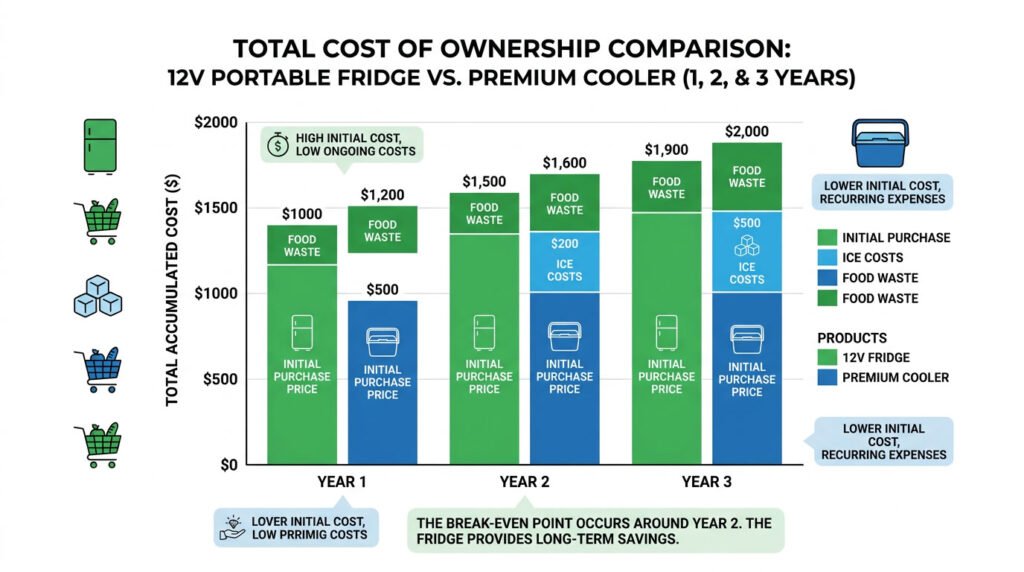
People love to say “coolers are cheaper.” And on day one? Sure. A solid rotomolded cooler runs $250-$400. A quality 12V truck camping fridge starts around $300 for budget models and hits $600-$1,200 for premium compressor units from brands like Dometic, ARB, or Alpicool.
But let me hit you with some math that cooler defenders conveniently skip. If you camp 30 weekends per year and buy two $5 bags of ice per trip, that’s $300 annually in ice alone. Add in the food you throw away because it got waterlogged or wasn’t cold enough — let’s conservatively say $10 per trip — and you’re at $600/year. A $800 12V fridge pays for itself in roughly 16 months. After that? You’re saving money every single trip.
I’ve detailed the economics of different 12V RV refrigerators including compressor vs absorption models before, and the long-term math always favors powered cooling for frequent travelers. IMO, if you camp more than 15 nights per year, a 12V fridge is the smarter financial move — period.
Power Consumption and Off-Grid Realities
This is the section where cooler fans think they have the knockout punch: “But a fridge needs power!” Yes, it does. And managing that power is easier than most people think.
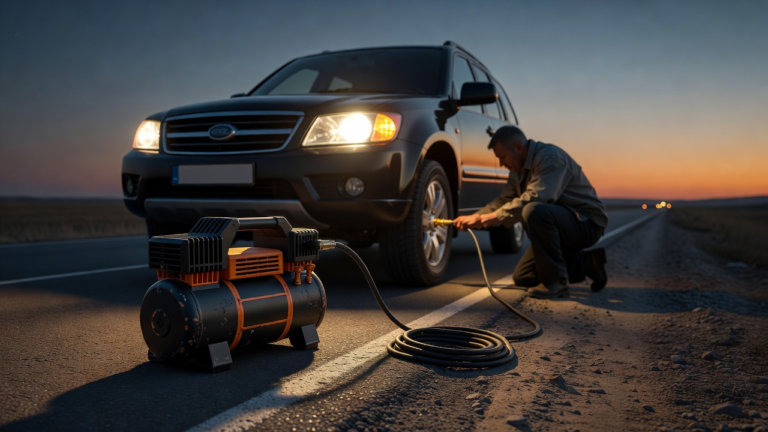
A typical 12V compressor fridge draws 40-50 watts while the compressor runs, and the compressor cycles — it doesn’t run continuously. Real-world daily consumption averages 30-45 amp-hours from a 12V battery, depending on ambient temperature and how often you open the lid. While driving, your alternator handles this without breaking a sweat. Your truck or RV’s electrical system generates far more power than the fridge consumes.
The real question is overnight or stationary use. If you’re truck camping for multiple days without driving, you need a plan. Options include:
- Secondary/auxiliary battery: A 100Ah lithium battery runs most 12V fridges for 2+ days without recharging.
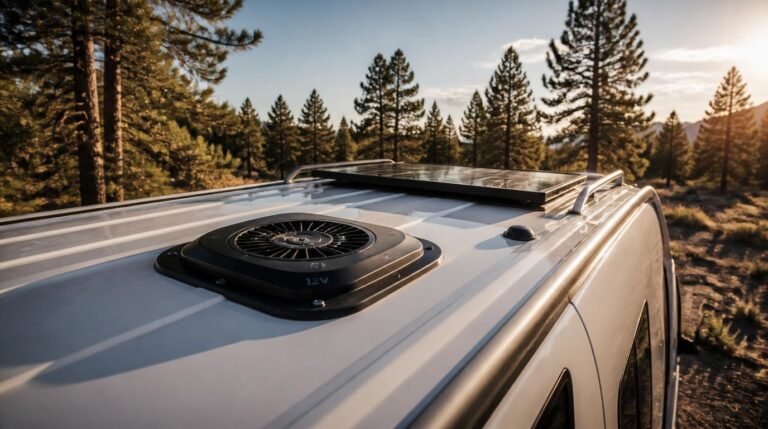
- Portable solar panel: A 100W panel in decent sunlight keeps most fridges topped off indefinitely.
- Battery isolator/DC-DC charger: Charges your auxiliary battery while driving and disconnects it at rest to protect your starter battery.
Research from the National Renewable Energy Laboratory shows portable solar panels have dropped dramatically in price while increasing in efficiency — making solar-powered fridge setups incredibly accessible for off-grid food storage. You can set up a reliable system for under $200.
Most modern 12V fridges also include low-voltage cutoff protection, meaning they automatically shut down before draining your battery to dangerous levels. This isn’t 2005 — the technology has matured significantly, and if you want to explore more about setting up your 12V comfort appliance ecosystem, you’ve got plenty of smart options.
Expert Commentary: This real-world comparison video does an excellent job demonstrating the practical temperature differences and day-to-day usability of 12V fridges versus coolers in actual camping scenarios — worth watching before you spend a dime.
Portability, Durability, and Practical Footprint
Alright, let’s be fair to coolers here — because this is one area where they genuinely shine. A cooler has zero moving parts. Drop it off a tailgate? It’s fine. Leave it in the rain? Doesn’t care. No compressor to fail, no wiring to troubleshoot, no fuse to blow.
Weight-wise, a 45-liter cooler loaded with ice weighs about the same as a 45-liter 12V fridge loaded with food. The fridge itself is heavier (compressors aren’t light), but you’re not adding 20 pounds of ice on top. So it’s roughly a wash.
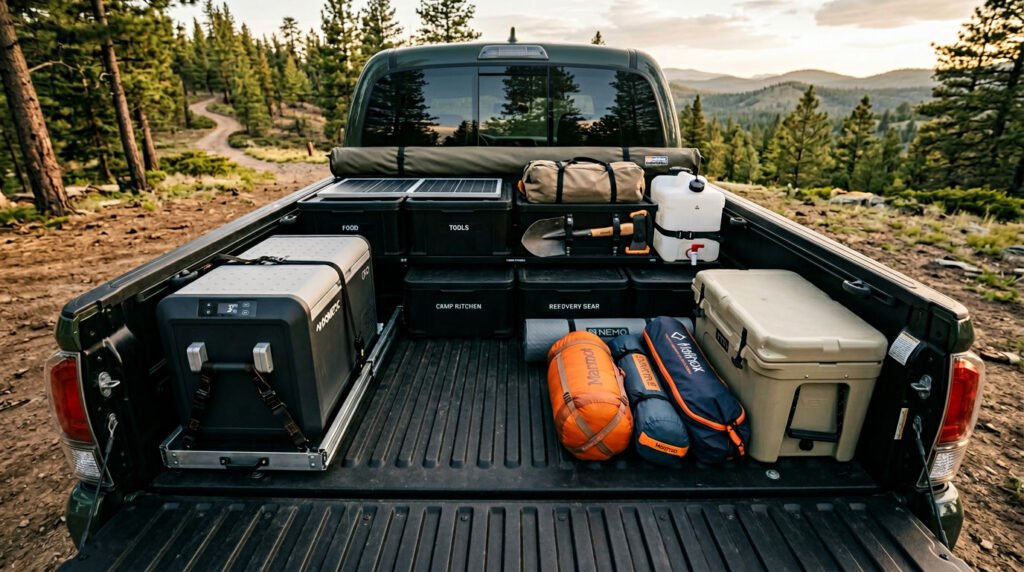
Where things get interesting is footprint. A cooler can go anywhere — your truck bed, the back seat, the ground at a campsite. A 12V fridge needs to stay connected to power, which limits placement options unless you run extension cables. Some RV travelers install dedicated fridge slides in their trucks, which is an elegant solution but adds cost.
Durability-wise, quality 12V fridges are built tough. Brands like Dometic and ARB use reinforced cases designed for off-road vibration. I’ve bounced mine down unpaved forest roads for years without issues. But a cooler is still simpler, and simpler means fewer failure points. For short trips where you want zero fuss? Hard to beat a good cooler’s simplicity 🙂
3 Myths I Need to Kill Right Now
Myth #1: “Thermoelectric coolers are just as good as compressor fridges.”
No. Hard no. Thermoelectric (Peltier) coolers can only cool about 30-40°F below ambient temperature. In 90°F heat, your “fridge” is sitting at 50-60°F — well into the USDA danger zone. They also draw power continuously without cycling. I consider them an overpriced fan, not a refrigeration solution. If you see a $50-80 “12V cooler/warmer” on Amazon, that’s thermoelectric. Avoid it for serious food storage.
Myth #2: “Any cooler works fine if you use enough ice.”
Physics doesn’t negotiate. A cheap $30 cooler with thin walls and poor seals will burn through ice in 8-12 hours in summer heat regardless of how much ice you stuff in there. Insulation R-value matters. Gasket quality matters. If you’re going the cooler route, invest in a quality rotomolded option — or you’re literally throwing money into a melting puddle.
Myth #3: “12V fridges will kill your truck battery overnight.”
This fear comes from older models without low-voltage protection. Every reputable modern 12V fridge — from Alpicool to Dometic — includes automatic low-voltage cutoff. I’ve run mine overnight on a single auxiliary battery more times than I can count. As the Battery University research suggests, understanding basic battery management makes this a non-issue.
Who Should Buy What: My Honest Recommendations
Buy a quality cooler if:
- You camp fewer than 10 nights per year
- Your trips are 1-3 days maximum
- You want zero complexity and maximum toughness
- Budget is tight and you’re not ready for a power system investment
- You primarily attend tailgates, beach days, or short outings
Buy a 12V portable fridge if:
- You camp more than 15 nights per year
- Your trips regularly exceed 3 days
- You store medications, fresh meat, or dairy that demands precise temps
- You’re building out an RV or truck camping rig for extended travel
- You’re tired of buying ice and dealing with soggy food (aren’t we all? 😅)
And here’s my controversial take: for serious truck camping or RV travel, own both. I use my 12V compressor fridge as my primary food storage and keep a small cooler for drinks and quick-access snacks. Best of both worlds — and my main food stays perfectly cold while the cooler handles the high-traffic items.
Frequently Asked Questions
Is a 12V portable fridge worth the money over a regular cooler?
Yes, for trips lasting more than 2-3 days. A 12V portable fridge maintains consistent temperatures without ice, keeps food at safe USDA-recommended levels, and eliminates the recurring cost and hassle of ice replenishment. Over a year of regular use, most owners recoup the upfront investment through ice savings and reduced food spoilage.
How much power does a 12V portable fridge draw?
Most quality 12V compressor fridges draw between 30-60 watts while actively cooling and cycle on and off to maintain temperature. Average daily consumption ranges from 30-50 amp-hours depending on ambient temperature, insulation quality, and how often you open the lid. Many models include low-voltage cutoffs to protect your vehicle battery.
Can I run a 12V fridge off my truck battery without draining it?
You can run a 12V fridge while driving without issue, as your alternator supplies ample power. For overnight or stationary use, you should add a secondary battery, a battery isolator, or a small solar panel setup to avoid draining your starter battery. Most modern 12V fridges include built-in low-voltage protection as a safety net.
How long does a high-end cooler keep ice compared to a budget one?
Premium rotomolded coolers like YETI or Pelican can retain ice for 5-10 days under ideal conditions, while budget coolers typically last 1-3 days. Real-world performance depends heavily on pre-chilling the cooler, ambient temperature, how often you open the lid, and the ice-to-contents ratio.
What size 12V fridge do I need for truck camping or RV travel?
For solo truck camping, a 30-40 liter fridge handles a long weekend easily. Couples should look at 45-55 liters. For families or extended RV travel, consider 60-75 liters or a dual-zone model that offers both fridge and freezer compartments. Always measure your available space before purchasing.
My Top Recommended Gear
After years of hands-on testing across dozens of camping trips, RV adventures, and truck builds, here are the three products I consistently recommend for anyone weighing the 12V portable fridge vs cooler decision:
- Dometic CFX3 45 Portable Fridge/Freezer — My go-to recommendation for serious truck camping and RV travel. The CFX3 line offers rock-solid compressor performance, WiFi app monitoring, and a low-voltage cutoff you can actually trust. This is the fridge I personally run on extended trips.
- YETI Tundra 45 Cooler — If a cooler is the right fit for your trip style, I won’t steer you toward anything less than a YETI or equivalent rotomolded build. The Tundra 45 is the sweet spot of capacity and portability for weekend adventures. It’s the cooler I grab for sub-3-day trips.
- Renogy 100W Portable Solar Panel Suitcase — If you buy a 12V fridge, pair it with this. A 100W portable panel keeps your auxiliary battery charged during stationary camping, making your fridge setup truly off-grid capable without running your engine. I consider this an essential RV travel accessory.
Disclaimer: This post contains affiliate links. As an Amazon Associate, I may earn a commission from qualifying purchases at no additional cost to you.