You know that feeling. You’re ten hours into a haul or three days deep into boondocking, and all you want is a hot meal that doesn’t taste like gas station despair. But you’re hesitant. You don’t want to kill your battery bank just to heat up a burrito. This is the constant battle for truck and rv comfort and 12v appliances—balancing the luxuries of home with the brutal reality of finite power.
Most people get this wrong. They buy cheap gear that melts their cigarette lighter sockets, or they overcomplicate things with massive inverters that suck power like a vampire at a blood bank. It drives me crazy.
After a decade of blowing fuses, testing gear, and living on the road, here is the no-nonsense, battery-saving guide to living well—including exactly what to buy and how to wire it up without setting your rig on fire.
Table of Contents
- Why 12V Native is Better Than an Inverter
- The Holy Grail of Cold: 12V Compressor Fridges
- Cooking Without the Cord: Low Power RV Appliances
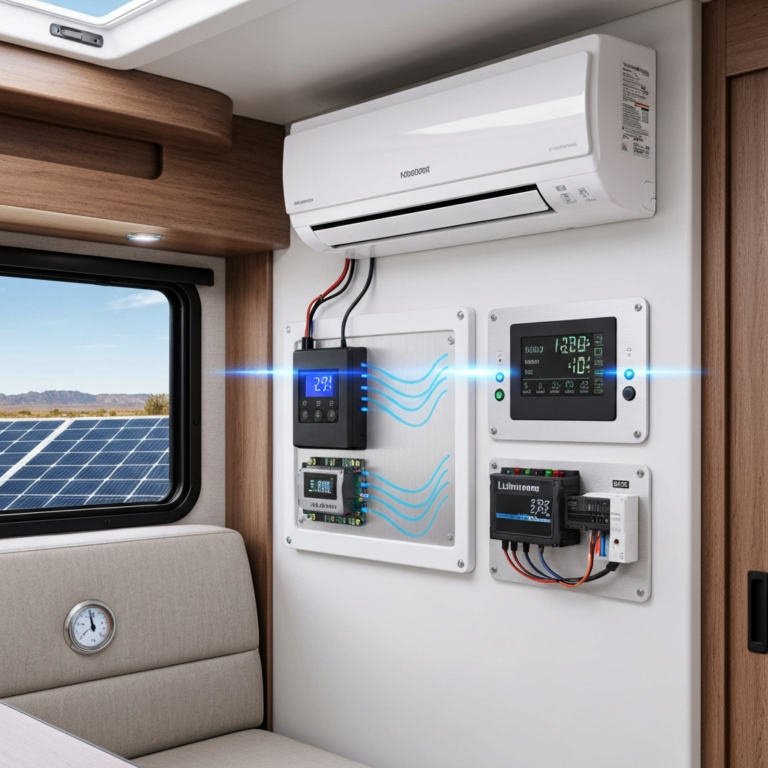
- Climate Control: Sleep Like a Baby
- The Power Behind the Comfort: Lead Acid vs. Lithium
- How to Audit Your Energy Needs (Don’t Skip This)
- The “Napkin” Wiring Diagram: How to Hook It Up
- Final Verdict: Where to Start?
Why 12V Native is Better Than an Inverter
What is the advantage of using 12V appliances over 110V?
The primary advantage of using native 12V appliances in trucks and RVs is energy efficiency. When you use an inverter to convert 12V DC battery power to 110V AC, you lose approximately 10–15% of your energy as waste heat. Running appliances directly off 12V eliminates this conversion loss, extending your battery life significantly while off-grid.
I see this mistake constantly. A newbie RVer buys a standard household toaster and tries to run it off a cheap inverter. Don’t do this.
Every time you convert electricity, you pay a “tax” in the form of heat and efficiency loss (we call this “parasitic draw”). If you are serious about off-grid rv appliances, you want to stay in the DC (Direct Current) ecosystem as much as possible. It’s cleaner, simpler, and usually safer.
Plus, 12V gear has evolved. We aren’t talking about those flimsy 1990s truck stop fans anymore. The tech is actually good now.
The Holy Grail of Cold: 12V Compressor Fridges
Let’s talk about the biggest game-changer in rv comfort appliances: the fridge.
For years, the industry standard was the “absorption” fridge (propane/electric mix). IMO, they are a pain. They have to be perfectly level to work, they take forever to cool down, and they are notoriously finicky in hot weather.
Enter the 12V compressor fridge.
- They get cold fast. (Like, freezing water in an hour).
- They don’t need to be level. You can park on a slope, and your milk won’t spoil.
- They sip power. Modern units draw incredibly low amps (often 1-2 amps) once they reach temperature.
The “Expert” Verdict: What to Buy
Stop buying the $90 thermoelectric coolers at truck stops. They only cool 40° below ambient temperature. If it’s 90°F in your cab, your milk is 50°F (spoiled).
- The Gold Standard: Dometic CFX3 Series
- Why: This is the industry king. They use a variable-speed compressor (meaning it throttles down to save power) and are nearly indestructible. If you have the budget, get the Dometic CFX3 35 or 45.
- The “Insider” Value Pick: ICECO VL Series
- Why: Here is a secret—ICECO uses the SECOP (formerly Danfoss) compressor. This is the exact same engine found in fridges that cost twice as much. They cut costs on the plastic shell, not the mechanicals. The ICECO VL45 is a tank and costs significantly less than Dometic.
Cooking Without the Cord: Low Power RV Appliances

Cooking is where people get nervous. “Can I really cook a steak with a 12 volt battery?” Yes, but you have to be smart about it. You can’t run a 1500-watt air fryer on a stock battery.
Here is my “Tier List” for truck 12 volt appliances for cooking:
1. The 12V Lunchbox Stove (The “Slow Cooker”)
These look like plastic tackle boxes. You put your food in a foil tin, plug it in, and drive. Two hours later, your stew, chili, or frozen lasagna is piping hot.
- The Pick: RoadPro 12-Volt Portable Stove. It is legendary among truckers for a reason. It heats up to 300°F and draws only about 12 amps.
- Pro Tip: Buy the disposable aluminum liners. Cleaning chili out of the corners of this thing is a nightmare.
2. The 12V Rice Cooker
I love these things. They are small, efficient, and versatile. You aren’t just making rice; you can steam veggies, make oatmeal, or cook quinoa.
- The Pick: Moss & Stone 12V Mini Rice Cooker. It takes longer than a home unit (about 45 mins), but it gets the job done without blowing a fuse.
3. The Kettle Dilemma
Okay, let’s be real. Watching a 12V kettle boil water is like watching paint dry. It takes 20+ minutes.
- Verdict: Skip it. Use a Jetboil or a small propane camp stove for boiling water. It’s just not efficient to use electricity to boil water unless you have a massive lithium setup.
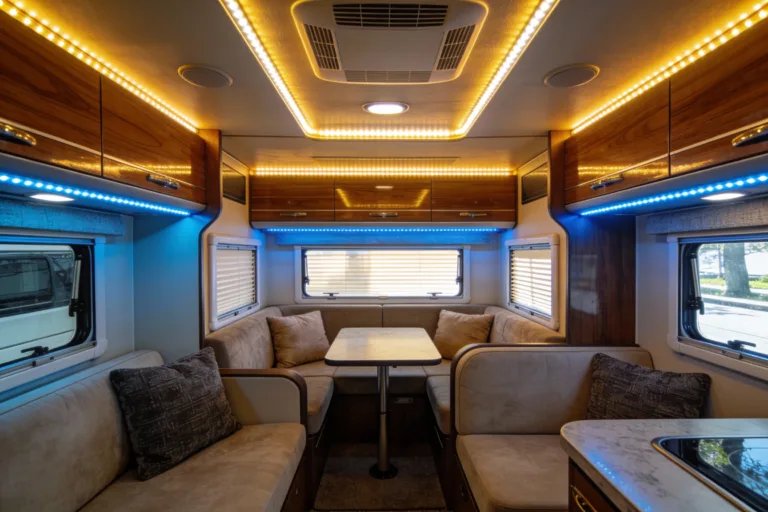
Climate Control: Sleep Like a Baby
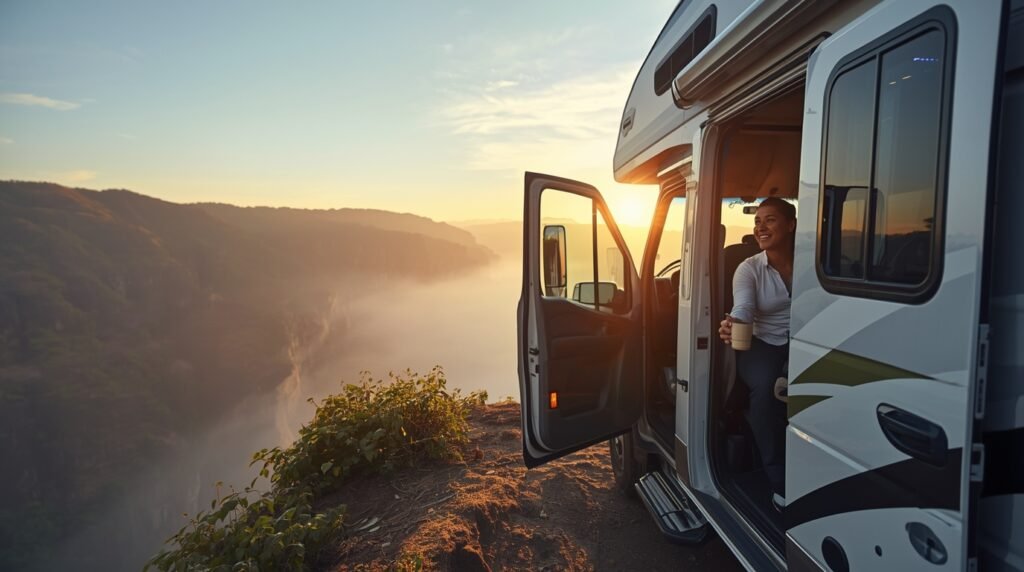
Nothing destroys morale faster than trying to sleep in a sweltering cab or a freezing camper.
The Real Hero: High-Velocity Roof Fans
If you can’t afford a $3,000 A/C setup, you need high-end airflow.
- The Only Choice: MaxxAir MaxxFan Deluxe.
- Why: It has a built-in “Rain Shield” that allows you to leave the fan open and running while it is raining. The competitor (Fantastic Fan) automatically closes when wet, cutting off your air. MaxxAir wins every time.
Heating: The “Heated Body” Strategy
Insider Tip: If it’s cold, do not try to heat the air with a 12V space heater (they are terrible). Heat your body instead.
- The Upgrade:Ignik Topside Heated Blanket.
- Most 12V blankets are cheap fleece that break in 3 months. The Ignik is designed for outdoor camping—it’s durable, regulates heat intelligently, and sips power (approx 4 amps).
The Power Behind the Comfort: Lead Acid vs. Lithium
You can’t talk about rv 12v appliances without talking about the fuel tank for those appliances: your battery.
If you are still running standard Lead Acid or AGM batteries, you are fighting a losing battle.
- Usable Capacity: You can only discharge lead acid batteries to 50% without damaging them. So, your “100 Amp Hour” battery actually only gives you 50 Amp Hours.
- Voltage Sag: As the battery drains, the voltage drops. This makes sensitive electronics (like your fancy fridge) shut off early.
Switch to LiFePO4 (Lithium Iron Phosphate).
Yes, they cost more upfront. But you get 100% capacity, they weigh half as much, and the voltage stays flat.
The Battery Recommendations
- Money Is No Object: Battle Born Batteries. Built in Nevada, 10-year warranty, and if you call them, a human answers.
- The Smart Money: LiTime (formerly Ampere Time). They are the “Amazon favorite,” but they have proven themselves over the last few years. A 100Ah LiTime costs 1/3rd the price of Battle Born and works perfectly for 99% of users.
How to Audit Your Energy Needs (Don’t Skip This)
I know, math is boring. But waking up to a dead truck at 3 AM is worse.
Here is the “Napkin Math” method to sizing your needs using the formula:
Amps × Hours = Amp Hours (Ah)
Let’s look at a typical “Comfort” Scenario:
You park at 6 PM and leave at 8 AM (14 hours of idle time).
- Fridge (ICECO VL45): Runs 50% of the time (cycles on/off).
- Calculation: 2.5 Amps × 12 hours = 30 Ah
- Fan (MaxxAir): Low speed while sleeping.
- Calculation: 1.0 Amp × 8 hours = 8 Ah
- Laptop/TV: Movie before bed.
- Calculation: 4.0 Amps × 2 hours = 8 Ah
- Phone Charging: Top up overnight.
- Calculation: 1.5 Amps × 3 hours = 4.5 Ah
- Total Daily Draw: ~50.5 Ah
The Verdict:
- If you have a standard Lead Acid Battery (50Ah usable), you are dead in the water.
- If you have a single 100Ah Lithium Battery (100Ah usable), you wake up with 50% power remaining.
The “Napkin” Wiring Diagram: How to Hook It Up
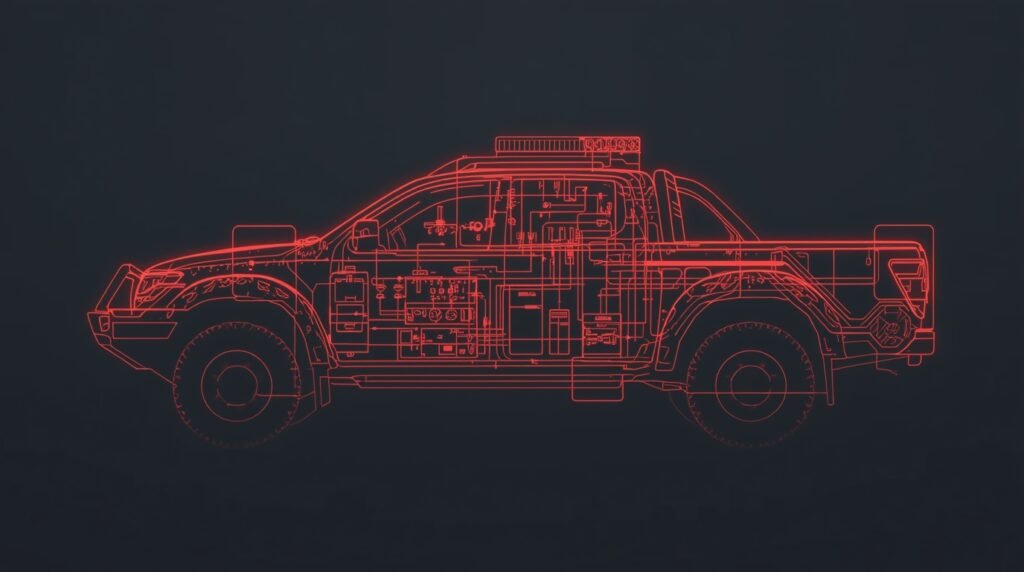
So you bought the gear. Now, how do you connect it without calling the fire department? I’m going to give you a text-based schematic. It’s clean, safe, and expandable.
The Golden Rule: Fuses protect the wire, not the appliance. If you use a thin wire with a huge fuse, the wire melts before the fuse blows.
Phase 1: The Shopping List
- 12-Way Fuse Block (Blue Sea Systems or generic).
- 10 AWG Wire (Red & Black) for battery connection.
- 12 or 14 AWG Wire for the appliances.
- Main Fuse (40A) and Blade Fuses (10A, 15A).
Phase 2: The Step-by-Step Connection
Step 1: The Main Artery (Battery → Fuse Block)
- Connect a 10 AWG Red Wire to your Positive Battery Terminal.
- STOP: Install a 40A Main Fuse within 6 inches of the battery. (This is non-negotiable safety).
- Run that wire to the Positive Post on your Fuse Block.
- Run a 10 AWG Black Wire from the Negative Battery Terminal to the Negative Post on your Fuse Block.
- Status: Your Fuse Block is now “Live.”
Step 2: Connecting the Fridge (ICECO VL45)
- Most 12V fridges come with a cigarette lighter plug. Cut that off. Hardwiring is reliable; plugs wiggle loose.
- Connect the Fridge Red Wire to Slot 1 Positive on the block.
- Connect the Fridge Black Wire to Slot 1 Negative on the block.
- Insert a 15 Amp Fuse.
Step 3: Connecting the Fan (MaxxAir)
- Run 14 AWG Wire from the Fuse Block up to the fan.
- Connect Wire to Fan Leads (Usually Black is Power, White is Ground—but check your manual!).
- Insert a 10 Amp Fuse into Slot 2.
Step 4: The Smoke Test
Double-check your crimps. Turn on the fridge. If it hums and nothing smells like burning plastic, you just became a certified 12V electrician. Congrats.
Final Verdict: Where to Start?
If you are just starting to upgrade your rig for truck and rv comfort and 12v appliances, don’t go buy everything at once. Start here:
- Upgrade your battery. Grab a LiTime 100Ah. If you don’t have the power, the toys don’t work.
- Get the Fridge. The ICECO VL45 changes your life more than any other appliance.
- Install the Fan. MaxxAir Deluxe. Airflow is king.
- Buy the Blanket. Ignik Topside. Cheap, effective comfort.
Stop suffering through bad sleep and worse food. The technology exists to make your rig feel like a home, provided you respect the laws of physics and don’t try to run a jacuzzi off a starter battery.
Ready to start? Pick one item from the list above this week, install it, and see how much better your next trip feels.
As an Amazon Associate, I earn from qualifying purchases.
2 Comments