This post contains affiliate links. As an Amazon Associate we earn from qualifying purchases, at no extra cost to you.
An RV diesel heater can keep a well-sealed camper warm through a 15°F night while drawing roughly a quarter to a third of the battery power your propane furnace needs. That single number explains why so many owners are bolting one under the floor this winter. It also hides the parts that go wrong: undersized wiring, exhaust aimed at a window, gelled fuel and a battery that dies during the glow-plug start.
The seven checks below come from manufacturer spec sheets, furnace data plates and the failure stories RVers keep posting in forums. Work through them in order and you will know whether an RV diesel heater fits your rig, how big it should be, and how to wire, vent and fuel it so it runs for years.
Table of Contents
Why an RV Diesel Heater Beats the Furnace on Battery Power
A standard ducted RV furnace is a propane appliance with a big 12V blower. Suburban’s popular SF-30 series lists a 7.0 amp draw on its spec sheet, and many older furnaces pull 8 to 11 amps once the motor bearings wear. That blower runs every time the burner fires.
An RV diesel heater works differently. A glow plug lights the burner, then shuts off, and only a small fan and a metering pump keep running. Eberspächer rates its Espar Airtronic S2 D2L at 6 to 31 watts of electrical draw for 7,500 BTU of heat. At 12.8 volts that is about 0.5 to 2.4 amps.
An RV diesel heater also modulates. Instead of slamming between full blast and off like a furnace, it throttles down to a low burn and stays lit. That gives steadier cabin temperatures and far fewer high-current start cycles.
The trade-offs are real, though. You add a second fuel, a combustion exhaust you are responsible for, and a unit that only heats where its ducts reach. The checks below deal with each one.
Check 1: Size Your RV Diesel Heater to the Floor Plan, Not the Box Label
One kilowatt equals about 3,412 BTU per hour. A true 2 kW heater therefore delivers around 6,800 BTU, and a true 5 kW unit around 17,000 BTU. Compare that with a Suburban SF-35F, whose data plate shows 35,000 BTU of input and 27,300 BTU of output.
That gap looks alarming, but furnaces are sized for the fastest possible warm-up, not for holding temperature. Once the cabin is warm, our rough estimate is that a well-sealed 25- to 30-foot trailer often needs under 10,000 BTU per hour to stay there on a 20°F night. Poor insulation, single-pane windows and slide-outs push that higher.
Is a 2 kW unit enough for a travel trailer?
For vans, truck campers and trailers up to roughly 24 feet, yes. For 25 to 35 feet, a 2 kW heater can hold temperature in moderate cold but recovers slowly after the door has been open. In that range a 4 kW to 5 kW unit, or a 2 kW heater paired with the existing furnace for morning warm-up, is the more comfortable choice.
Fifth wheels over 35 feet and anything with a cold slide-out floor usually need either two heaters or a 5 kW unit with split ducting.
Why the “8 kW” label on cheap units misleads buyers
Most budget all-in-one heaters sold as 5 kW or 8 kW use the same burner design as the original 2 kW Webasto and Espar clones. Owners who measure output with a thermometer and airflow meter consistently report far less heat than the label promises, so treat the rating as marketing. Buy on burner size, fuel consumption and fan airflow, not the number printed on the case.
Oversizing a diesel heater for RV use has a cost too. A heater that is too big for the space runs at minimum burn and cycles off and on, and low, cool combustion is what carbons up glow plugs and burner screens fastest.
If you want a proven 2 kW diesel heater for RV use with a real service network, the Autoterm Air 2D with the PU-5 controller is a strong pick. The company is Latvia-based, its heaters are sold through RV dealers such as etrailer, and its altitude and diagnostics behavior is far more predictable than unbranded kits.
Check 2: Do the Battery Math Before You Buy
Diesel heater amp draw has two phases, and mixing them up is the source of most bad runtime estimates.
- Start-up: the glow plug pulls about 8 to 10 amps for two to three minutes. That is roughly 0.4 to 0.5 amp-hours per start.
- Running: 0.5 to 2.5 amps depending on burn level, fan speed and brand.
- Shutdown: the fan keeps running for two to five minutes to cool the burner. Never cut power during this phase.
RV diesel heater battery math for a 10-hour night
Here is how the two systems compare over a 10-hour night at about 15°F outside, using spec-sheet figures and a typical duty cycle. Your numbers will vary with insulation and thermostat setting, so treat these as planning estimates.
| Heat source | Assumed draw | Duty cycle | Estimated overnight use |
|---|---|---|---|
| Propane furnace (7 A blower) | 7 A when firing | about 50% | about 35 Ah |
| Older furnace (10 A blower) | 10 A when firing | about 50% | about 50 Ah |
| 2 kW diesel heater, modulating | 1.2 A average | runs continuously, 1–2 starts | about 13 Ah |
| Diesel heater cycling on/off (oversized) | 1.2 A plus 6 starts | about 60% | about 10 Ah, plus more carbon |
A single 100 Ah lead-acid battery gives you about 50 usable amp-hours. That covers one furnace night, barely. The same battery can run a modulating diesel heater for three nights. With a 100 Ah lithium battery, the margin grows further, as long as the battery itself stays warm enough to accept a charge in the morning. Our guide to lithium battery charging in cold weather covers that part.
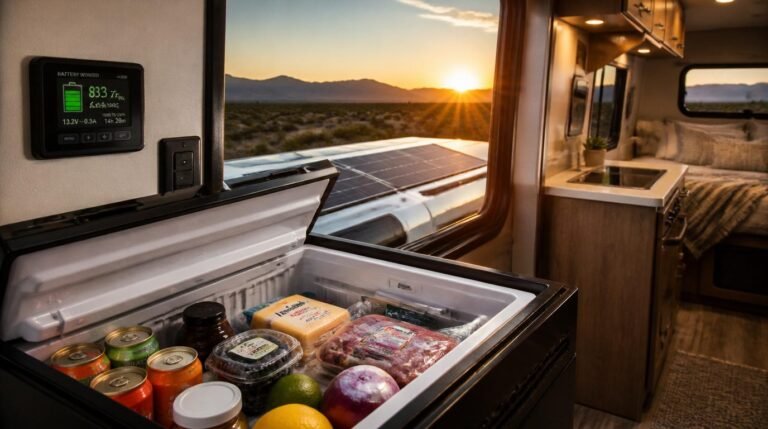
Measure instead of guessing. A shunt-based monitor such as the Victron SmartShunt 500A logs every amp-hour, so after two nights you will know exactly what your RV diesel heater costs. If you are choosing between brands, see our Victron vs Renogy battery monitor comparison.
Check 3: Wire It Like a Permanent 12V Appliance
Most RV diesel heater failures that look like fuel or glow-plug problems are actually voltage problems. When battery voltage sags during the glow-plug phase, the controller aborts ignition, retries, and eventually throws an error after dumping unburned fuel into the chamber.
Follow these wiring rules:
- Run a dedicated circuit from the house battery or main DC bus. Do not tap a 12V outlet or a lighting circuit.
- Size the wire for voltage drop, not just ampacity. A 10-amp start load over a 20-foot round trip calls for 12 AWG to keep drop near 3%. Check your run in our RV wire gauge chart.
- Fuse at the source with the rating the heater manual specifies, typically 15 to 25 amps for 2 kW units. Our fuse vs breaker guide explains where the fuse belongs and why.
- Never cut power to stop the heater. Use the controller so the cool-down cycle finishes. Killing power mid-burn overheats the burner and can warp the heat exchanger.
- Keep the battery disconnect in mind. If your rig has a disconnect that kills the house bus, the heater dies with it, so put that on your shutdown checklist.
For the fuse itself, a sealed holder like the Blue Sea Systems 5065 waterproof inline ATO/ATC fuse holder is a smart upgrade over the flimsy holder bundled with budget kits. Underfloor installs see road salt and slush, and corroded fuse clips are a common cause of failed starts.
Check 4: Mount It, Vent It, and Respect Carbon Monoxide
A properly installed RV diesel heater is sealed combustion. It pulls combustion air from outside, burns fuel in a closed chamber, and sends exhaust outside through a stainless pipe. Cabin air passes over the hot heat exchanger but never touches the flame.
That only holds if the install is done right. The CDC lists fuel-burning heaters and furnaces among common carbon monoxide sources and notes that people who are asleep can die before they ever feel symptoms. Treat the exhaust as a life-safety system.
- Mount the heater in a sealed bay or underneath the floor, never loose on the cabin floor with a hose out a cracked window.
- Fit the base gasket so the combustion side is sealed from the cabin.
- Point the exhaust down and away, clear of windows, roof vents, door seals, slide-outs and your generator exhaust.
- Separate intake and exhaust by at least the distance the manual specifies so the heater does not breathe its own fumes.
- Keep the exhaust free of snowdrifts when you park for days in snow.
Then add detection. Your RV’s built-in CO alarm sits near the floor because propane is heavy, and it may be years old. A second, battery-powered alarm such as the Kidde AA-battery carbon monoxide detector in the sleeping area costs little and keeps working even if a low-voltage event shuts the house electronics off. The CDC recommends replacing CO detectors per the maker’s instructions or about every five years.
Many owners install a diesel heater for RV use without cutting the floor at all. They mount the heater in an exterior bay or in a box beside the rig and duct hot air in through an existing vent. This video shows that direct-vent approach on a real RV:
Check 5: Plan the Fuel Supply and Beat Diesel Gelling
Espar lists the D2L at 0.1 to 0.28 liters of diesel per hour, which is roughly 0.03 to 0.07 gallons. A 10-hour night at a medium setting burns around half a gallon. A typical 10-liter (2.6-gallon) standalone tank lasts three to five cold nights.
Separate tank or tap the main tank?
- Diesel motorhomes and vans: install a dedicated standpipe in the main tank. Do not tee into the engine fuel line, because the heater pump can pull air and starve either system.
- Gas motorhomes and all towables: you need a separate tank. Mount it outside the living space, vented, and secured against road shock.
- Truck and trailer combos: a diesel tow vehicle does not help a trailer heater unless you are camping attached, so plan an onboard tank.
Stop fuel from gelling in the heater line
An RV diesel heater fuel line is thin, slow-moving and fully exposed to the cold, so it gels before your truck’s tank does. According to an Auto Care Association filter manufacturers’ service bulletin, typical #2 diesel cloud points run from about +20°F down to −18°F, while #1 diesel and kerosene sit near −40°F.
In practice, buy winter-blend fuel from a busy truck stop in the region you are camping, and fill a small heater tank with #1 diesel if you expect single-digit nights. Do not run gasoline or used oil through the heater. Both damage the burner and void every warranty.
Check 6: Account for Altitude and Cold Starts
Air thins as you climb, but the fuel pump keeps pulsing the same amount. Without adjustment, a heater set up at sea level runs rich at 7,000 feet, smokes, and carbons up within a few days.
- Premium heaters such as the Espar S2 D2L are rated to about 9,900 feet and adjust automatically or with a sensor kit.
- Autoterm controllers include a high-altitude mode you enable before you climb.
- Budget units often claim automatic altitude adjustment. Verify by watching the exhaust after start-up: white or black smoke after the first five minutes means the mixture is wrong.
Cold starts also take a toll on an RV diesel heater. Each start uses glow-plug power and leaves a trace of carbon. Two habits keep a heater healthy for seasons: run it on high for 20 to 30 minutes before shutting down at least once a week, and run it for 15 minutes once a month during summer so seals and the pump stay lubricated.
If you dry camp at elevation all winter, fold the heater into your RV boondocking electrical checklist so battery state, fuel level and exhaust clearance get checked every morning together.
Check 7: Diesel Heater vs Propane Furnace, and When to Keep Both
Replacing the furnace outright sounds tidy. For most RVs that camp in real cold, it is the wrong move, because the factory furnace does one job a cabin heater cannot: it pushes heat into the basement and the holding tank bay.
| Factor | RV diesel heater (2 kW) | Propane furnace (30,000 BTU) |
|---|---|---|
| 12V draw while heating | 0.5–2.5 A | 7–11 A |
| Heat output | about 6,800 BTU, modulating | about 23,000 BTU output, on/off |
| Fuel | Diesel, 0.03–0.07 gal/h | Propane from house tanks |
| Heats tank bay | Only if you duct it there | Yes, on most four-season models |
| Warm-up speed | Slow | Fast |
| Noise inside | Low fan hum | Loud blower bursts |
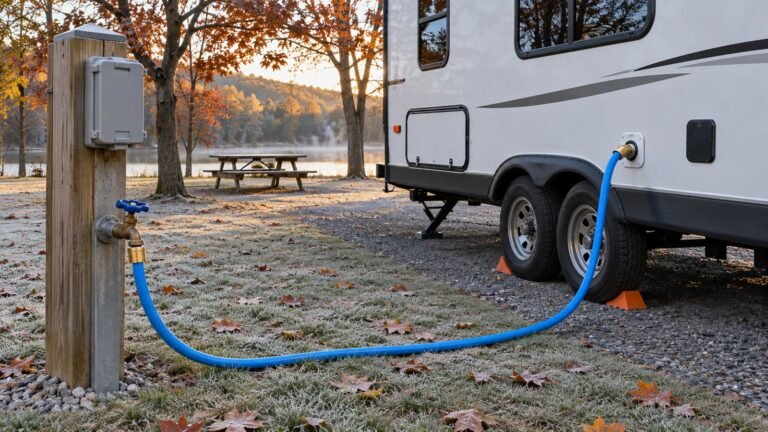
The winning setup for most owners is both. Let the RV diesel heater carry the overnight load and quiet hours, and run the furnace briefly in the morning or whenever temperatures drop low enough that the tanks and water lines need protection. Pair that with a heated RV water hose when you are on hookups.
There is a moisture bonus too. Because both appliances vent combustion gases outside, neither adds water vapor to the cabin the way an unvented catalytic heater does. If you have been fighting wet windows, our RV condensation fixes explain why that matters.
Keeping both also gives you redundancy. If the RV diesel heater throws an error at 2 a.m., the furnace is a thermostat switch away, and the reverse is true when you run low on propane in a small town with no fill station open.
The Install Order That Avoids Rework
Owners who end up re-drilling holes usually did the steps in the wrong sequence. This order keeps you from cutting twice:
- Pick the RV diesel heater location by checking what is under the floor: frame rails, propane lines, wiring looms and the tank.
- Plan the exhaust route and confirm clearance from windows, vents, slides and the generator.
- Plan the warm-air outlet so it blows across the floor, ideally toward the coldest end of the rig.
- Choose the fuel source and tank location, keeping the fuel line short and rising slightly toward the pump.
- Run the dedicated power circuit with the fuse at the battery end.
- Mount the heater, gasket and pump, then make the fuel and exhaust connections.
- Prime the fuel line, start on high, and watch the exhaust and controller readout for the first 30 minutes.
If any step falls outside your comfort zone, especially cutting the floor or working near propane lines, pay an RV or marine heater installer for that part. A professional install is far cheaper than repairing a scorched floor or a fuel leak.
Before your first night, run the new RV diesel heater for two hours with the CO alarm in the bedroom and check the battery monitor before bed. That rehearsal tells you more than any spec sheet.
RV Diesel Heater FAQ
How much battery does an RV diesel heater use overnight?
After a start-up surge of about 8 to 10 amps for two to three minutes, a 2 kW diesel heater typically runs at 0.5 to 2.5 amps. Over a 10-hour night that works out to roughly 10 to 20 amp-hours, compared with 35 to 50 amp-hours for a typical propane furnace blower.
Is it safe to sleep with an RV diesel heater running?
Yes, when it is a sealed-combustion unit installed with the exhaust vented outside, away from windows, vents and slide-outs, and with a base gasket fitted. Always run a working CO alarm in the sleeping area. Never use a portable heater inside the cabin with its exhaust hose out a window.
Can I put a diesel heater in a gas motorhome or travel trailer?
Yes. You just need a separate diesel tank, usually 5 to 10 liters, mounted outside the living space and vented. Do not try to run the heater on gasoline unless you buy a model specifically built for petrol.
Will a diesel heater keep my RV holding tanks from freezing?
Not on its own. A cabin-mounted diesel heater warms the living space, while most four-season RV furnaces also duct heat into the tank bay. In hard freezes, keep the furnace or tank heater pads available for the underbelly.
What size diesel heater do I need for a 30-foot travel trailer?
A 2 kW unit can hold temperature in a well-insulated 30-foot trailer in moderate cold but warms it slowly. A 4 to 5 kW heater, or a 2 kW heater backed up by the furnace for morning warm-up, is the more comfortable choice below about 20°F.
How do I stop a diesel heater from carboning up?
Size it so it rarely runs at minimum burn, set the altitude mode correctly, and run it on high for 20 to 30 minutes at least once a week. Use clean winter-blend or #1 diesel, and run it for 15 minutes monthly during the off-season.
Is an RV Diesel Heater Worth It?
If you boondock in freezing weather, yes. A correctly installed RV diesel heater turns a battery-killing furnace night into a light load, gives quieter and steadier heat, and costs very little to fuel.
Your next step is simple: write down your battery bank’s usable amp-hours, your rig’s length and your coldest planned night, then match them to the sizing and battery tables above. Those three numbers will tell you which heater to buy and whether your electrical system is ready for it.