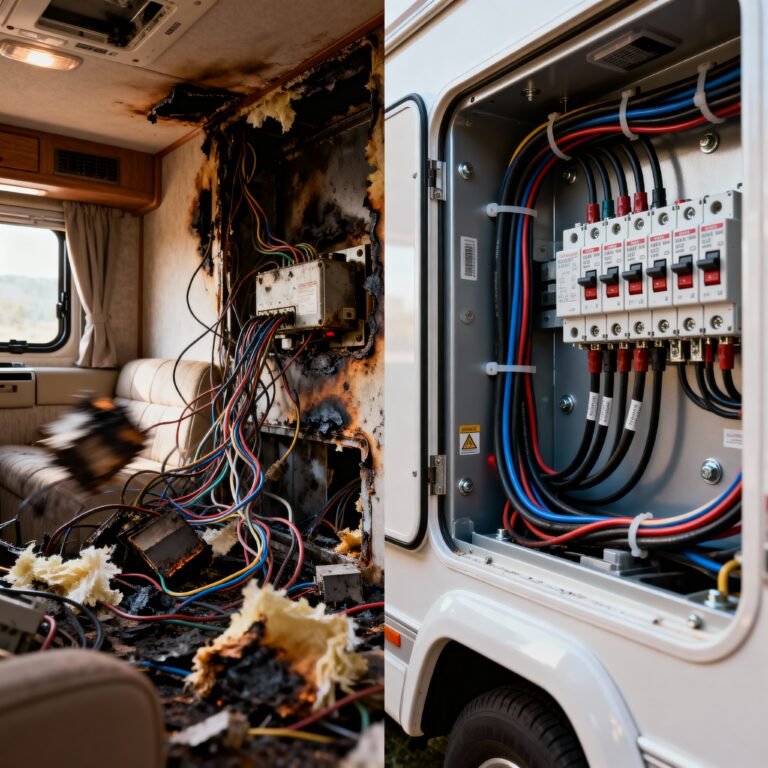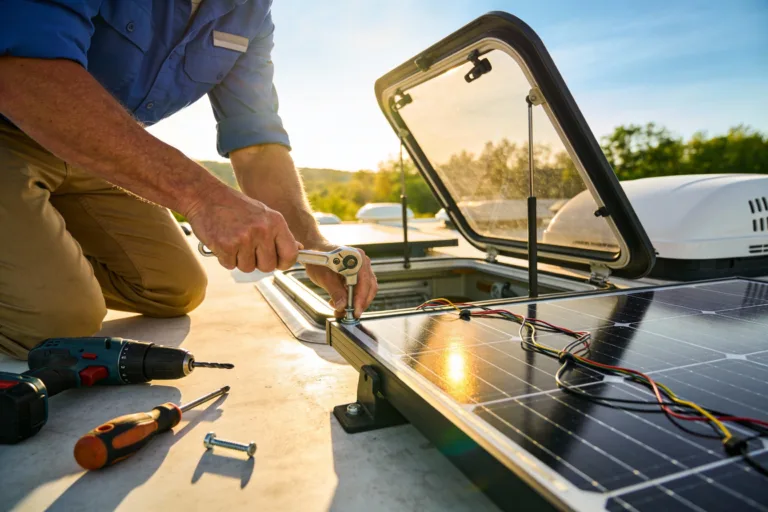
RV fuse vs breaker is the wrong way to frame the decision for most rigs — because the safest 2026 RV electrical systems don’t pick one over the other, they use both, in the right places. If you’re wiring a solar-plus-lithium setup, adding a fridge circuit, or just trying to figure out why your panel keeps tripping, understanding where each device belongs is what keeps your rig from becoming a fire statistic. This guide breaks down how fuses and breakers actually work, where professional RV electricians put each one, and the placement rule almost every DIY wiring diagram gets wrong.
Table of Contents
- What’s the Real Difference Between a Fuse and a Breaker?
- How a Fuse Works
- How a Circuit Breaker Works
- Why Most 2026 RV Builds Use Both
- The Rule Every RV Wiring Diagram Should Follow
- Fuse vs Breaker: Where to Use Each
- Sizing Your Protection to Your Wire (Not Just Your Load)
- Common RV Wiring Mistakes That Cause Fires
- A Simple Pre-Trip Electrical Safety Checklist
- Frequently Asked Questions
What’s the Real Difference Between a Fuse and a Breaker?
Both devices exist to do the same job: stop current before an overloaded or shorted wire gets hot enough to start a fire. The difference is what happens after they do that job.
A fuse is a single-use sacrifice. Once it blows, it’s trash — you replace it with a new one of the same rating. A circuit breaker is a mechanical switch that trips and can be reset by flipping it back on, as long as the fault that caused it has been cleared.
That reusability sounds like it makes breakers the obvious winner, but fuses have real advantages in a 12V RV system: they’re cheaper, smaller, faster-acting, and far less likely to fail from vibration over years of driving down washboard roads.
How a Fuse Works
Inside every fuse is a thin metal element sized to melt at a specific current. Push more amps through it than it’s rated for, and that element burns open in a fraction of a second — some automotive blade fuses clear a dead short in roughly 2 milliseconds. That speed matters on a 12V system, where a direct short from battery to chassis can dump hundreds of amps into a wire almost instantly.
The tradeoff is access. A blown fuse buried behind a panel in the middle of a boondocking trip means digging out a fuse puller and a spare kit, not just flipping a switch.

How a Circuit Breaker Works
A breaker uses a thermal or magnetic mechanism to physically open the circuit under overload, then lets you reset it once things cool down or the short is fixed. In an RV, manual-reset breakers are common on main battery feeds and inverter circuits — places where you want overcurrent protection but don’t want to be hunting for a replacement fuse mid-trip.
Breakers are generally slower to trip than a fast-blow fuse and, being mechanical, are a bit more susceptible to nuisance tripping or long-term wear from constant vibration. That’s part of why they’re usually reserved for a handful of key circuits rather than every branch in the system.

Why Most 2026 RV Builds Use Both
Ask an RV electrician which is “better” and the honest answer is neither — the current standard in marine and RV wiring is a hybrid approach: individual branch circuits (lights, fans, pumps, USB outlets) get protected by blade fuses in a central fuse block, while the main feed from the battery bank runs through a single resettable manual breaker.
This mirrors what you’ll see in commercial trucks and marine vessels, and it’s the same logic behind guidance in our RV DIY & installation guides: protect every circuit at the right amperage, and don’t rely on one device type to catch every kind of fault. If you’re wiring 12V LED lighting for your RV interior, for example, that circuit should run through its own fuse in the block — not share protection with your fridge or fans.
The Rule Every RV Wiring Diagram Should Follow
Here’s the placement rule that trips up more DIY installs than any other: overcurrent protection has to sit close to the battery’s positive terminal, not just somewhere convenient along the wire run.
The ABYC’s widely-cited standard for marine and RV 12V systems calls for a fuse or breaker within about 7 inches of the battery’s positive terminal, extendable to roughly 40 inches if the wire runs through a sheath or conduit. NFPA 1192, the standard covering recreational vehicle electrical systems, echoes the same principle — many RV builders working to it target an inline fuse within about 18 inches of the positive terminal for accessory circuits. For a deeper technical breakdown, Blue Sea Systems’ guide to choosing circuit protection and Marine How To’s overview of battery bank over-current protection are both excellent references.
The reasoning is simple: any length of positive wire between the battery and its protection device is completely unprotected. If it chafes against a metal edge or gets pinched under a mounting bracket, there’s nothing standing between that short and a fire except the wire’s own insulation.
Fuse vs Breaker: Where to Use Each
| Location in your system | Best protection | Why |
|---|---|---|
| Battery positive to main bus/fuse block | Manual-reset breaker | Resettable without a spare parts kit; single failure point to check first |
| Individual branch circuits (lights, fans, USB, water pump) | Blade fuse in a fuse block | Cheap, fast-acting, easy to carry spares for every rating |
| Solar charge controller input/output | Breaker or fuse per the controller’s spec sheet | Follow manufacturer sizing — solar circuits often need both PV and battery-side protection |
| Inverter feed | Manual-reset breaker sized to inverter’s continuous draw | High current draw benefits from a resettable device you won’t run out of |
| Appliances like a 12V LiFePO4 battery bank | Class T or ANL fuse at the battery terminal | High fault-current chemistry needs a fast, high-interrupt-rating fuse |

Sizing Your Protection to Your Wire (Not Just Your Load)
The single biggest sizing mistake is fusing a circuit to protect the appliance instead of the wire. Your fuse or breaker rating should always be based on the ampacity of the wire it’s protecting — if you’ve upsized your wire gauge for a long run, that doesn’t mean you can upsize the fuse to match; the fuse protects whichever is weaker.
A quick gut-check most RVers use: undersized wire on a fused circuit for something like 12V fans in a camper ventilation setup will nuisance-trip long before it’s actually dangerous — that’s the system working as designed, not a fuse that’s “too sensitive.”
Common RV Wiring Mistakes That Cause Fires
- Skipping the fuse “because it’s a short run.” Every length of unprotected positive wire is a risk, regardless of how short it looks.
- Reusing a higher-amperage fuse after one keeps blowing. That’s masking a real fault, not fixing it.
- Mixing wire gauges without adjusting fuse size. The fuse must match the weakest wire in that circuit, every time.
- Mounting fuse blocks where they can get wet. Corrosion increases resistance at the terminals, which generates heat.
- Assuming a breaker never needs replacing. Mechanical wear from years of road vibration is real; test breakers periodically, don’t just trust them.
A Simple Pre-Trip Electrical Safety Checklist
- Confirm every positive lead off the battery has fuse or breaker protection within roughly 7–18 inches of the terminal.
- Check that fuse/breaker ratings match wire gauge, not just appliance draw.
- Inspect fuse block and breaker terminals for corrosion or loose connections.
- Carry a labeled spare-fuse kit covering every rating used in your system.
- Test manual-reset breakers by tripping and resetting them once a season.
Frequently Asked Questions
Can I replace a breaker with a fuse of the same rating, or vice versa?
Usually yes for the amperage, but check the interrupt rating too — high fault-current sources like lithium battery banks often need fuses (like Class T) rated for much higher fault currents than a standard automotive breaker can safely interrupt.
Do I need a fuse AND a breaker on the same circuit?
No — that’s redundant. The hybrid approach means different circuits get different device types, not double protection on one circuit.
How often do RV circuit breakers actually fail?
Not often, but road vibration and corrosion take a toll over years. If a breaker won’t hold a reset with no obvious fault downstream, replace it rather than fighting it.
Get the placement and sizing right once, and you won’t think about it again until it’s protecting you from a fault you never see coming. Walk your rig’s wiring today, confirm every positive lead is protected within that 7–18 inch window, and swap anything that doesn’t meet it before your next trip.