
An RV wire gauge chart tells you the one thing your instinct can’t: exactly how thick each wire needs to be so it won’t overheat, drop voltage, or start a fire. You’ve wired plenty of stuff before. Trailers, boats, that fridge in the garage. You eyeball the wire, twist it on, and it works. So why would you need a chart to tell you something you already know? Here’s the uncomfortable answer. “It works” and “it’s safe” are two different things. Your gut can’t see voltage drop. It can’t feel a wire heating up behind a wall. A chart can. Let me show you why this simple tool matters more than 20 years of instinct.
Table of Contents
Why Undersized RV Wire Overheats Behind Walls
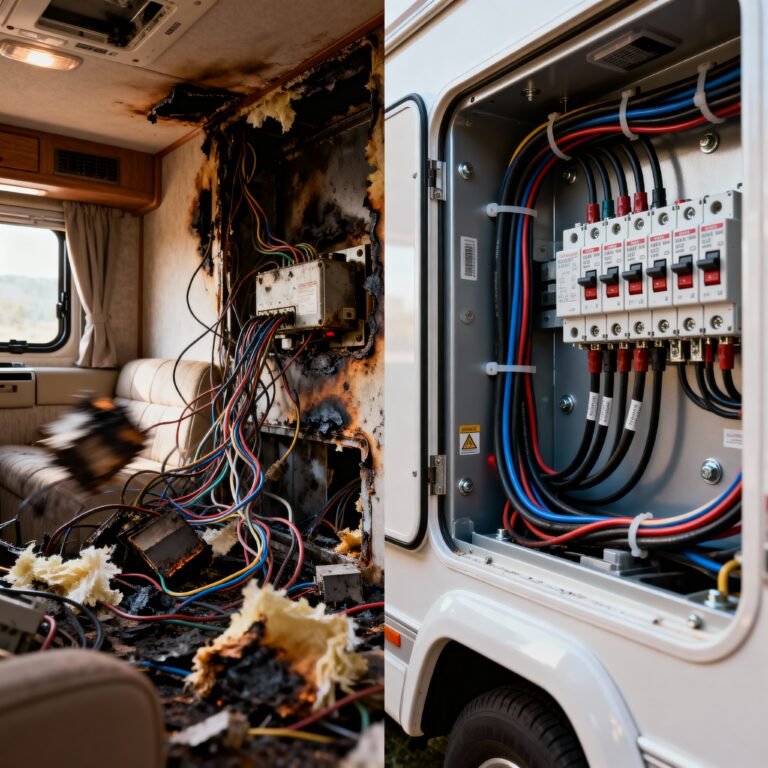
Undersized wire doesn’t fail loudly. It fails quietly. A too-thin wire carries current just fine at first. But it fights that current. That fight creates heat. And heat builds up inside the insulation, where you can’t see it.
Here’s the part people miss: The wire can feel fine to the touch at the ends. The hottest spot is often buried in a wall or under a seat. By the time you smell it, the damage is already done.
RV fires are more common than most owners think. According to the U.S. Fire Administration, fire departments responded to an estimated 4,200 RV fires a year between 2018 and 2020, causing roughly 15 deaths, 125 injuries, and $60 million in property loss annually — and electrical problems rank among the leading causes. A wire gauge chart exists to keep you out of that statistic — and it’s one of the cheapest safety upgrades you can make. You’re not paranoid for checking. You’re smart.

Does Thicker Wire Really Matter? Wire Resistance Explained
Let’s tackle the belief head-on. Many experienced folks think thicker wire is a scam to sell more copper. I get it. Copper isn’t cheap. Nobody wants to buy 8-gauge when 12-gauge looks plenty fat.
But here’s the logic you can’t argue with. Wire has resistance. Resistance turns some of your power into heat and loss. Thinner wire has more resistance than thicker wire.
So thin wire does three bad things at once:
- It wastes your power as heat.
- It drops your voltage before it reaches the device.
- It raises your fire risk.
Thicker wire isn’t an upsell. It’s the fix for a real physics problem. The chart just tells you how thick is thick enough.
Why 12-Volt RV Wiring Needs Thicker Wire
Here’s where RV wiring gets sneaky. Most home outlets run on 120 volts. Your RV’s DC side runs on just 12 volts. That low number changes everything.
To move the same power, a 12-volt system has to push a lot more current than a 120-volt one. More current means more heat. It also means more voltage drop. So your RV’s DC wire size often needs to be much thicker than you’d guess.
Think about it this way. A small drop on a 120-volt line is nothing. The same drop on a 12-volt line is a huge chunk of your power. Your water pump gets weak. Your lights dim. Your fridge struggles. A hungry load like an RV induction cooktop feels it first. And you blame the appliance, when the real villain was the wire.
That’s why a 12-volt wire gauge chart accounts for all of this. Your gut does not.
How Wire Length and Voltage Drop Change Wire Size
Here’s the mistake even careful people make. They pick wire based on amps alone. Amps matter. But distance matters just as much.
The longer the wire run, the more resistance it has. More resistance means more voltage drop. So a wire that’s perfect for a 3-foot run can be dangerously thin for a 30-foot run.
And here’s the trick most beginners miss: You have to count the round trip, not one direction. Current flows out to the device and back. So a device 15 feet away means a 30-foot round trip.
A wire gauge chart is built around this exact idea. It crosses your amps with your distance. That’s the whole point. It answers a question your instinct simply can’t.
So how do you actually know what gauge you need?
To find the right RV wire gauge, cross the circuit’s maximum amps with the round-trip length of the run on a 12-volt voltage-drop chart. Higher amps and longer runs both require thicker wire. For key loads like pumps and electronics, size the wire to keep voltage drop under 3%.
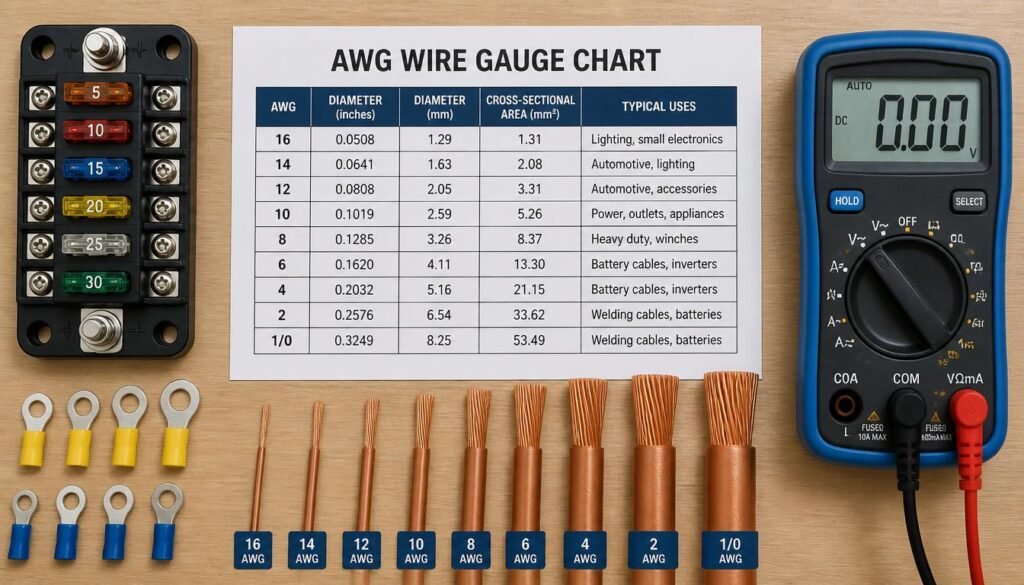
RV Wire Gauge Chart: Amp Capacity by AWG Size
Let me give you a rough reference so this feels real. These are ballpark numbers for short runs at 12 volts. Treat them as a starting point, not gospel.
| Wire Gauge (AWG) | Rough Amp Capacity (short run) |
|---|---|
| 16 | ~10 amps |
| 14 | ~15 amps |
| 12 | ~20 amps |
| 10 | ~30 amps |
| 8 | ~40 amps |
| 6 | ~55 amps |
| 4 | ~70 amps |
| 2 | ~95 amps |
| 1/0 | ~150 amps |
Remember the golden rule of AWG. A smaller number means a thicker wire. So 6-gauge is fatter than 12-gauge. It trips up newcomers every time.
Now here’s the key warning. These numbers shrink fast on long runs.
The Same 20-Amp Load, Two Very Different Wire Sizes
Let me make the length point concrete. Say you’re wiring a 20-amp load. On a short run near your battery, 12-gauge wire handles it fine.
Now move that same 20-amp load 15 feet away. That’s a 30-foot round trip. Suddenly 12-gauge isn’t enough. To keep your voltage drop low, you might need to jump to 10-gauge or even 8-gauge.
Same amps. Same device. Totally different wire. That’s why a flat “20 amps equals this gauge” rule fails. The chart catches the difference. Your memory won’t.
This is the exact spot where guessing bites people. They size for amps, ignore distance, and wonder why things run weak.
Is Undersized RV Wire Safe If It Hasn’t Failed Yet?
“But I’ve never had a problem.” Fair. Maybe you haven’t. Let me give that its due. Plenty of undersized wire runs for years without a fire. That’s true.
But “no fire yet” is not the same as “safe.” Two things are usually happening under the surface:
- You’re losing power and performance every single day.
- You’re running a risk that builds over time.
Heat cycles wear down insulation slowly. Vibration on the road loosens connections. RVs shake, flex, and bake in the sun — then freeze all winter, which is why it pays to winterize your RV electrical system every year. A marginal wire has a much harder life than one in your house.
So the wire that’s fine today may not stay fine. The chart isn’t about paranoia. It’s about margin. It gives you room to be wrong and still be okay.
You wouldn’t tow at your trailer’s exact max weight limit on purpose. Wire deserves the same buffer.
How Voltage Drop Causes Dim Lights and Weak Pumps
Forget fires for a second. Let’s talk about your sanity. Undersized wire causes a hundred small headaches that are hard to trace:
- Dim lights that flicker when the pump kicks on.
- A fridge that won’t hold temperature off the battery.
- An inverter that shuts down for no clear reason.
- A battery that seems to drain too fast.
You chase these problems for hours. You swap parts. You blame the battery. You blame the appliance. But the real cause was a voltage drop you never measured — often somewhere in your RV power and solar system.
The chart would have flagged it before you ever cut a wire. Fixing it after the fact means tearing panels apart. Doing it right the first time takes 30 seconds with a chart. That math is hard to argue with.
How Correct RV Wiring Protects Insurance and Resale
Here’s an angle the skeptics rarely consider. If an electrical fire damages your RV, your insurer will ask questions. Wiring that ignores safety standards can slow down or hurt your claim. Doing it by the book protects your rig and your wallet.
The same goes for resale. A buyer who sees clean, correctly sized wiring trusts the whole build. Sloppy wiring makes people wonder what else you cut corners on. Following a proper gauge chart is part of doing it right. It’s a small habit with a long payoff.
Why Experienced RV DIYers Still Use a Wire Gauge Chart
Let me speak directly to the seasoned DIYer. You’ve earned your instincts. That’s real. But the best pros in any trade still check their references.
Electricians use tables. Engineers use charts. Marine electricians size every DC run against the ABYC E-11 tables — not because they’re beginners, but because they respect how easy it is to be off by a little and cause a lot.
Using a wire gauge chart isn’t admitting you don’t know. It’s proof that you do. The amateur guesses and hopes. The expert verifies and moves on with confidence. Which one do you actually want to be?
How to Use an RV Wire Gauge Chart Step by Step
Good news. It’s simple — and it’s exactly the kind of job our DIY install and wiring guides are built for. Here’s the quick routine.
- Find the max amps the circuit will draw.
- Measure the round-trip length of the wire run.
- Cross those two numbers on a proper DC voltage-drop chart.
- Pick that gauge, or go one size thicker for margin.
- Match your fuse or breaker to the wire, not just the device.
That last step matters. The fuse protects the wire. Size it so it blows before the wire overheats. Not sure what a circuit actually draws? Run the numbers first — the same load math you’d use to size solar for a Starlink setup.
One more tip. Aim to keep voltage drop under 3% for anything important, like pumps and electronics. Lights and small loads can tolerate a bit more. This is exactly how the ABYC E-11 standard sizes wire — 3% for critical circuits, always measured on the round-trip length from the power source to the device and back.
RV Wire Sizing and ABYC Standards
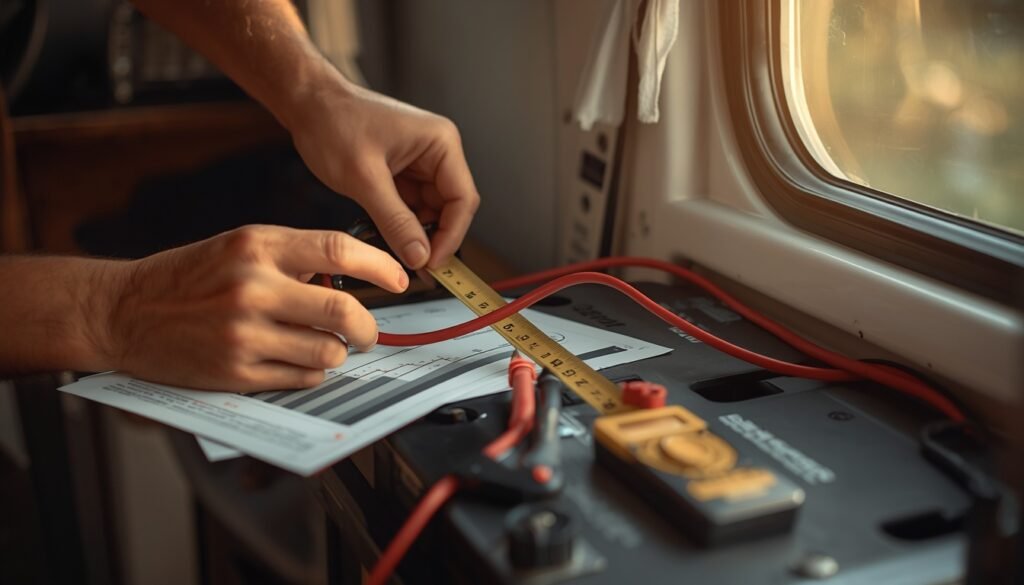
I’ll be straight with you, because this is about safety. The chart above only shows the idea. Real installs also depend on the wire’s insulation, the heat around it, and whether wires are bundled together. RV and boat wiring usually follows ABYC standards, and those rules are stricter than home wiring rules.
So before you cut copper, check your size against a full ABYC-style 12-volt voltage-drop chart that uses your exact amps and length. That’s not hedging. That’s how careful builders work. The chart is the tool. Using the right one is the skill.
Watch: Sizing RV Wire by Amps and Length
Want to see the amps-plus-length method on a real build? This walkthrough sizes the wires for a camper’s DC system step by step — the same logic an RV wire gauge chart automates for you.
Why an RV Wire Gauge Chart Is Worth 30 Seconds
Your instinct is good. It’s just blind to the one thing that matters most here: voltage drop across 30 feet of cable. It can’t see that. An RV wire gauge chart can. So do the boring thing that keeps your rig out of that 4,200-fires-a-year column — pull up a proper RV DC wire gauge chart, print it, tape it inside your toolbox lid, and check every run against it before you cut a single strand of copper. Thirty seconds now beats tearing panels apart later. Or worse.





3 Comments