Finding the best RV solar generator can feel overwhelming if you’re still running a single 100Ah battery and a portable panel propped against your RV steps — but 2026’s all-in-one power stations will make you rethink your whole setup. These power stations pack lithium battery banks, pure sine inverters, MPPT solar charging, and multiple output types into one box you can move between the truck bed, the RV, and the campsite picnic table — no wiring, no fuse panel, no permanent install.
We compared the top RV solar generators for 2026 based on usable capacity, output wattage, solar input speed, RV-specific compatibility (30A/50A plugs), weight, and price per watt-hour, so you can match a portable power station for your RV to how you actually camp — whether that’s weekend boondocking or full-time off-grid living.
Table of Contents
- Why All-in-One Power Stations Are Taking Over RV Power Setups
- What to Look for Before You Buy
- Best RV Solar Generators for 2026, Compared
- Anker Solix F2000 — Best Overall for RV Use
- EcoFlow Delta 3 Ultra Plus — Best for High-Draw Setups
- Jackery Solar Generator 2000 Plus — Best Expandable System
- Jackery Solar Generator 1000 v2 — Best for Weekend Road Trips
- Bluetti AC180P — Best Budget Option
- How Much Solar Generator Capacity Do You Actually Need?
- FAQ: RV Solar Generators in 2026
- Bottom Line

Why All-in-One Power Stations Are Taking Over RV Power Setups
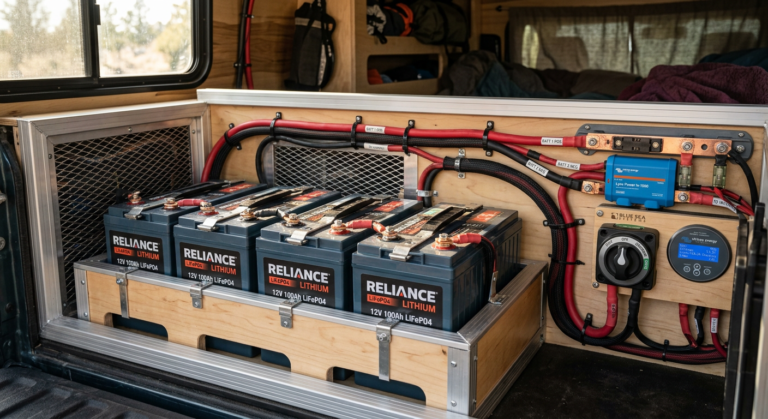
Traditional RV electrical upgrades mean a lead-acid or lithium battery bank, a separate inverter, a charge controller, and an electrician’s afternoon of wiring. All-in-one solar generators collapse that into a single unit you plug into and go. For renters, part-time RVers, and truck campers who don’t want to modify a factory electrical system, that’s the entire appeal.
The category has also matured fast. Units that shipped in 2023 topped out around 1,500Wh with slow 500W solar input. The 2026 lineup routinely offers 2,000-3,000Wh base capacity, expandable battery packs for multi-day boondocking, and solar input fast enough to fully recharge in under two hours of good sun.
What to Look for Before You Buy
- Usable capacity (Wh): Match this to your daily draw — a fridge, CPAP, laptop charging, and lighting typically need 1,000-1,500Wh per day.
- Continuous output (W): Determines what you can run simultaneously. Microwaves and induction cooktops often need 1,500W+.
- Solar input (W): Higher input means faster recharge — look for 800W or more if you’re relying on solar charging rather than shore power.
- RV plug compatibility: Some units include a native 30A NEMA TT-30 output; others require an adapter.
- Expandability: Add-on battery packs let you scale capacity later instead of buying a bigger unit up front.
- Weight and warranty: Anything over 60 lbs isn’t moving in and out of your rig often — factor that into where you plan to mount or store it.
Best RV Solar Generators for 2026, Compared
| Model | Capacity | Output | Solar Input | RV Plug | Weight | Price |
|---|---|---|---|---|---|---|
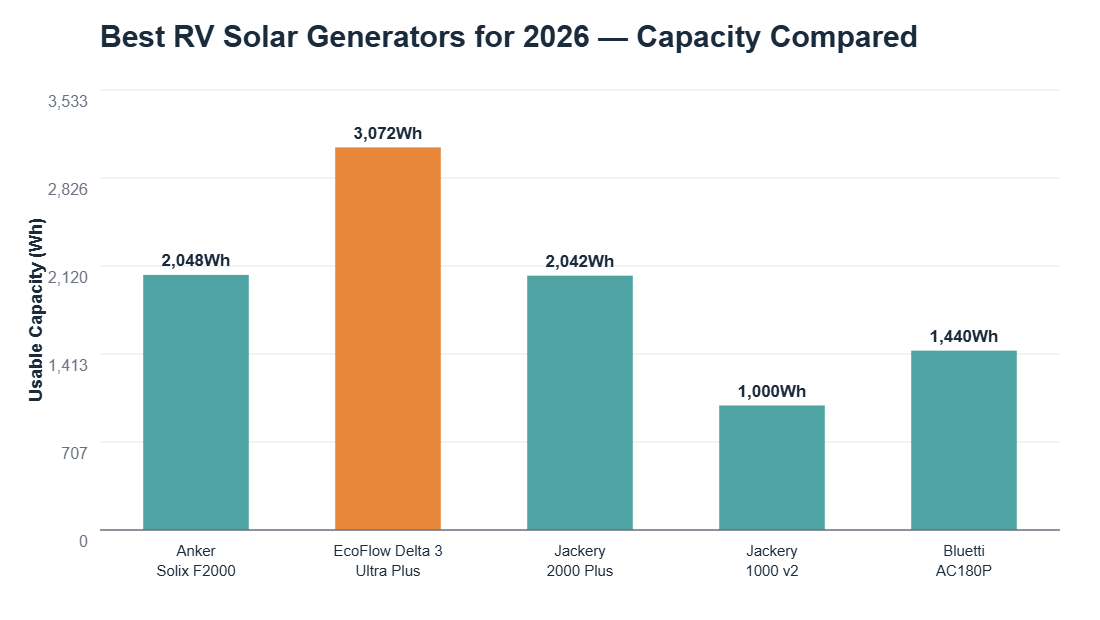
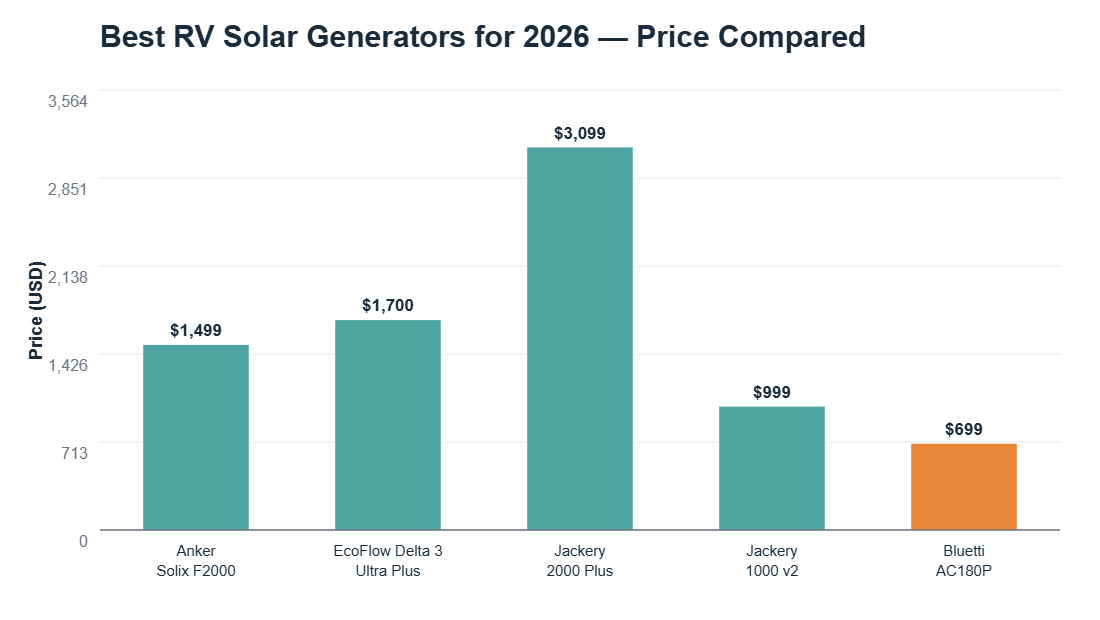
| Anker Solix F2000 | 2,048Wh | 2,400W | Up to 1,000W | Built-in | 67.2 lbs | ~$1,499 |
| EcoFlow Delta 3 Ultra Plus | 3,072Wh (exp. to 11kWh) | 2,600W (3,900W surge) | Up to 1,000W | Adapter needed | ~90 lbs | ~$1,700+ |
| Jackery Solar Generator 2000 Plus | 2,042Wh (exp. to 12kWh) | 3,000W | Up to 800W | Adapter needed | 32 lbs | ~$3,099 |
| Jackery Solar Generator 1000 v2 | ~1,000Wh | 1,500W | Up to 500W | Adapter needed | ~24 lbs | ~$999 |
| Bluetti AC180P | ~1,440Wh | 1,800W | Up to 900W | Adapter needed | ~40 lbs | ~$699 |
Anker Solix F2000 — Best Overall for RV Use
The F2000 is the only unit on this list with a built-in RV plug, which alone makes it worth the premium for anyone hooking straight into a trailer or fifth wheel’s shore power inlet.
At 2,048Wh capacity and a 2,400W continuous output, it covers roughly what a typical RV uses in a full day of moderate use — fridge, lights, device charging, and a few hours of AC-adjacent loads. Anker backs it with a 5-year warranty, tying EcoFlow for the longest coverage in this comparison.
EcoFlow Delta 3 Ultra Plus — Best for High-Draw Setups
If you’re running an induction cooktop, an electric kettle, and a mini-split AC off the same unit, the Delta 3 Ultra Plus has the headroom: 3,072Wh base capacity, expandable to 11kWh with add-on batteries, and a 3,900W surge rating that handles compressor startup loads other units can’t.
The tradeoff is size and price — this is a home-backup-grade unit that happens to work for RVs, not a purpose-built RV unit, and it needs an adapter for a standard RV plug.
Jackery Solar Generator 2000 Plus — Best Expandable System
Jackery’s 2000 Plus starts at 2,042Wh but scales to 12kWh with additional battery packs — useful if you plan to grow from weekend trips into full-time or extended boondocking without replacing the core unit. At 32 lbs it’s dramatically lighter than the Anker or EcoFlow units of similar capacity, though the 2-year warranty is shorter than either competitor.
Jackery Solar Generator 1000 v2 — Best for Weekend Road Trips
Not every RVer needs 2,000+ Wh. For weekend trips, tent-adjacent truck camping, or as a backup rather than primary power source, the 1000 v2 hits a sweet spot of fast recharge times, a sub-25-lb form factor you can actually carry one-handed, and a price under $1,000.
Bluetti AC180P — Best Budget Option
At roughly $699, the AC180P is the entry point for solar-capable backup power without stepping down to a no-name brand. It won’t run a rooftop AC unit, but for lights, device charging, a CPAP, and a small fridge overnight, it covers the basics reliably.
How Much Solar Generator Capacity Do You Actually Need?
Add up the watt-hours of what you run daily: a 12V compressor fridge draws roughly 300-600Wh per day, a CPAP machine around 40-60Wh per night, a laptop 50-100Wh per charge, and LED lighting 50-100Wh per evening. Most weekend RVers land in the 800-1,200Wh/day range; full-time boondockers running more appliances often need 1,500-2,500Wh/day.
Buy capacity for your heaviest realistic day, not your average one — running out of power on a hot afternoon with a full fridge is the scenario you’re buying against.
FAQ: RV Solar Generators in 2026
Can a portable power station run my RV air conditioner?
Only briefly, and only on the higher-output units. A typical 13,500 BTU RV AC draws 1,200-1,600 running watts with a 2,000-3,000W surge at startup — that’s within reach of the EcoFlow Delta 3 Ultra Plus or Jackery 2000 Plus, but it will drain a single unit’s battery in under two hours without solar input keeping pace.
Do I still need rooftop solar panels if I have one of these?
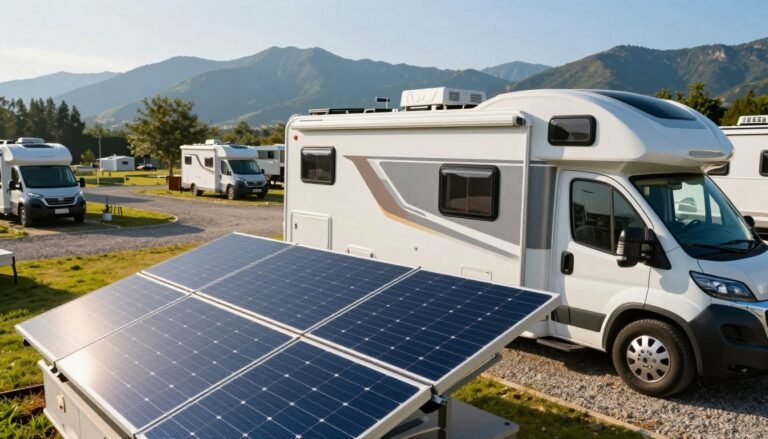
Not necessarily. Most 2026 units pair with portable folding solar panels, so you can charge without a permanent roof install — useful for rented RVs or if you move between vehicles.
How long do these batteries last?
Lithium iron phosphate (LiFePO4) cells, used in every unit on this list, typically rate for 3,000-4,000 charge cycles before dropping to 80% capacity — roughly a decade of regular use.
Bottom Line
For most RV owners, the Anker Solix F2000 is the safest pick for 2026 thanks to its native RV plug and balanced specs. Heavy power users should look at the EcoFlow Delta 3 Ultra Plus, weight-conscious boondockers should consider the Jackery 2000 Plus, and anyone testing the waters on a budget can start with the Bluetti AC180P or Jackery 1000 v2.
Whichever you choose, size it to your heaviest day of power draw — not your average one — and you won’t be caught short at the worst possible moment.