
Here’s a number that will recalibrate everything you think you know about 12V RV refrigerator power usage and solar sizing: most boon dockers underestimate their fridge’s power draw by 40%. Not 10%. Not 15%. Forty percent — and that single mistake turns a dream off-grid weekend into a dead battery by Sunday morning. If you’ve ever woken up to a warm fridge and a flat battery bank, you already know the sting. The good news? This is an entirely solvable problem, and I’m going to walk you through exactly how to solve it — with real numbers, not marketing fluff.
📋 Table of Contents
- 12V Fridge Power Consumption: What the Spec Sheet Won’t Tell You
- How Climate and Behavior Silently Multiply Your Power Draw
- Solar Panel Sizing Ranges by Fridge Size and Camping Style
- Battery Type, Bank Size, and the Chemistry That Changes Everything
- Advanced System Design: The Calculation Most Guides Skip
- The Biggest Solar Sizing Myths — Debunked Cold
- Frequently Asked Questions
- My Top Recommended Gear
12V Fridge Power Consumption: What the Spec Sheet Won’t Tell You
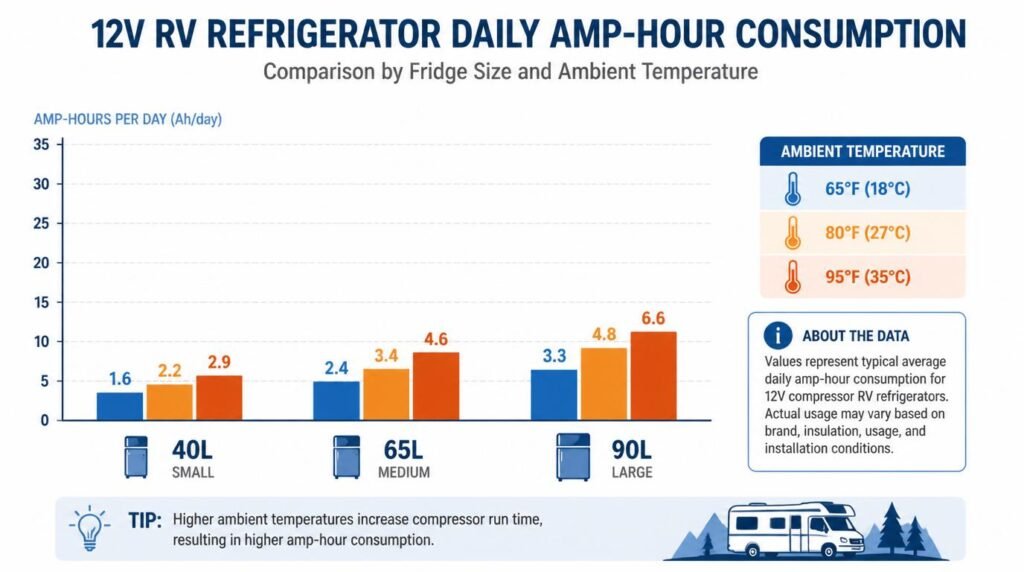
Quick Answer: A 12V RV compressor refrigerator typically draws between 30 and 60 amp-hours (Ah) per day — roughly 360 to 720 watt-hours. Smaller 40–50 liter units average 30–40Ah daily in moderate conditions, while 60–90 liter fridges in hot weather push 50–70Ah. These numbers are the foundation of every solar sizing decision you’ll make.
The solar sizing question isn’t just “how many panels?” It’s a system problem that touches your fridge’s efficiency, the ambient temperature outside your rig, your battery chemistry, your camping latitude, and even how often your kids grab a soda. Let’s get into it.
Manufacturers list a “daily power consumption” figure on spec sheets, and that number is almost always measured in a 77°F (25°C) lab environment with the fridge at steady state and the door barely touched. That’s not boondocking. That’s not real life.
What you actually need to know is the duty cycle — the percentage of time the compressor runs. In a cool, well-insulated environment, a quality 12V compressor fridge might run 25–35% of the time. Park that same fridge in a black RV in Arizona in July, and the compressor could run 60–75% of the time. That’s a 2x multiplier on your power draw, and it comes straight out of your battery bank.
Here’s the insider knowledge most guides bury: the compressor’s startup surge — typically 2–4x the running amperage — matters far less for daily energy budgeting than people think. What matters is average sustained draw multiplied by compressor run time. A 4.5-amp compressor running 50% of the day pulls 54Ah. The same compressor running 70% of the day pulls 75.6Ah. Plan for the worst-case scenario your camping style creates, not the lab spec.
If you’re shopping for the right unit before you size your system, the guides on the best 12V RV refrigerators comparing compressor vs. absorption technology break down which designs are most efficient for solar-powered living — and the difference is dramatic.
How Climate and Behavior Silently Multiply Your Power Draw
So your fridge is pulling more power than you expected — what’s actually driving that? This is where most solar sizing conversations get embarrassingly shallow, so let me go deeper.
Four variables compound on each other to determine your real-world fridge power consumption, and ignoring any one of them means your solar and battery math is wrong before you even start:
- Ambient temperature: Every 10°F increase in surrounding temperature adds roughly 10–20% to your fridge’s power draw. A 65°F night versus a 95°F afternoon isn’t a minor factor — it’s the difference between 35Ah and 60Ah in a single 24-hour period.
- Solar gain on the RV body: A dark-colored RV parked in direct sun can have interior temperatures 20–30°F higher than ambient air temp. That heat transfers to your fridge cabinet and forces the compressor to work harder, even if the fridge is “inside.”
- Door opening frequency: Each door opening dumps cold air and pulls in warm, humid air. In families with kids, this can add 5–15% to daily consumption. TBH, this one sounds minor until you measure it.
- Food load and temperature: Loading warm groceries into a cold fridge creates a massive, temporary spike in compressor activity. Pre-chill everything at home before loading the RV fridge and you’ll save real amp-hours on Day 1.
The interaction between climate and fridge placement is where I see the most preventable mistakes. A fridge installed with poor ventilation on its condenser side will run 15–25% less efficiently than the same unit with proper airflow. That’s a solar panel’s worth of wasted power, just from a bad install location.
Solar Panel Sizing Ranges by Fridge Size and Camping Style
Here’s where I give you the actual numbers — the solar sizing ranges that account for fridge size, climate, and how you camp. These aren’t made up; they’re derived from consumption data and the standard solar irradiance modeling used by engineers. (The National Renewable Energy Laboratory publishes peak sun hour maps for every U.S. region at nrel.gov, and I strongly recommend bookmarking that if you’re serious about off-grid planning.)
The formula is straightforward: Daily Wh needed ÷ Peak Sun Hours × System Loss Factor (1.25) = Solar Wattage Required.
- Small fridge (35–50L), mild climate (60–75°F), weekend boondocker: 150–200W solar, 100Ah lithium battery. This is the minimal viable setup for casual off-grid camping.
- Mid-size fridge (50–65L), mixed climate, regular boondocker: 200–300W solar, 200Ah lithium. This covers most van lifers and weekend warriors who camp 2–4 nights at a stretch.
- Large fridge (65–90L), hot climate (80–95°F), extended boondocking: 300–400W solar minimum, 200–300Ah lithium. Desert campers and full-timers in summer should treat 400W as the floor, not the ceiling.
- Large fridge + additional loads (lights, fan, charging), any climate: 400–600W solar, 300Ah+ lithium. Once you add a CPAP, a laptop, LED lighting, and USB charging to the mix, the fridge becomes one load among several and your system needs to reflect that.
One thing I want to flag before you race to buy panels: panel wattage is rated at STC (Standard Test Conditions) — a laboratory ideal that rarely exists outdoors. Real-world output is typically 70–85% of rated wattage due to heat, angle, and atmospheric conditions. A “400W” system realistically delivers 280–340W. Factor that in, or your math is optimistic before you even start camping. The U.S. Department of Energy’s photovoltaics resource explains this output de-rating clearly if you want the technical grounding.
Expert Commentary: This video from Mortons on the Move — one of the most technically rigorous full-time RV channels on YouTube — walks through real measurement data from an actual boondocking setup, not theoretical numbers. Specifically, their segment on battery monitor readings during a 3-day off-grid stay is exactly the kind of empirical evidence that separates good solar sizing from wishful thinking. Worth every minute.
Want to compare the 12V fridge options that actually make sense for these solar setups? The deep-dive on 12V portable fridges versus coolers will help you decide whether you even need a full compressor fridge, or whether a smaller, more efficient unit serves your actual needs better.
Battery Type, Bank Size, and the Chemistry That Changes Everything
What battery technology you choose doesn’t just affect how much storage you have — it fundamentally changes how your entire system behaves. This is the part of the conversation most “beginner solar guides” skip entirely, and it’s costing people serious money and frustration.
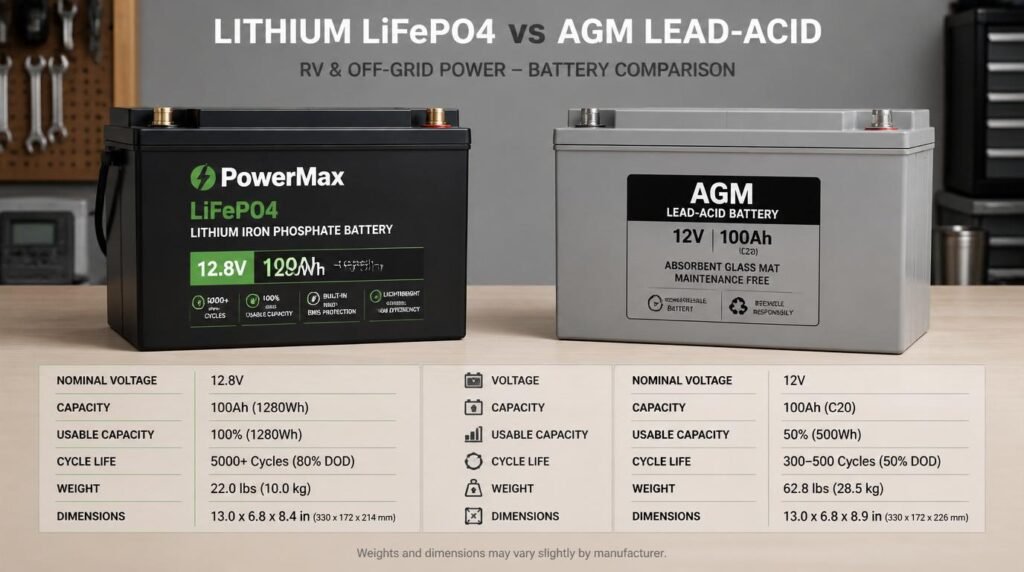
Lead-acid (AGM/Flooded): These are the most common and the most misunderstood. You cannot safely discharge them below 50% without damaging them over time. So a 200Ah lead-acid bank gives you only ~100Ah of usable capacity. Plan your fridge and solar math around the usable number, not the rated number. They’re also heavier, slower to charge, and don’t tolerate high charge rates well.
Lithium (LiFePO4): This is where off-grid RV power has evolved, and the jump in real-world performance is significant. Lithium batteries offer 80–95% depth of discharge, so 100Ah rated is roughly 90Ah usable. They charge faster, weigh less, last longer (2,000–5,000 cycles vs. 300–500 for lead-acid), and perform better in cold temperatures than many people realize — as long as you don’t charge them below freezing. Research from Battery University on lithium-ion chemistry provides excellent depth on why these performance differences exist at a molecular level.
The practical upshot: if you’re sizing for a 12V RV fridge pulling 50Ah/day and you want two nights of autonomy without solar input, you need 100Ah of usable capacity. With lithium, that’s a ~110Ah bank. With lead-acid, that’s a 200Ah bank. The math changes your cost, your weight, and your space requirements significantly.
Advanced System Design: The Calculation Most Guides Skip
Ready for the part nobody talks about? Here’s where experienced builders separate themselves from people who buy random panels and hope for the best.
Most solar sizing guides calculate fridge power draw, divide by sun hours, and call it done. What they miss is the charge controller efficiency loss, the wire resistance losses, and — critically — the battery round-trip efficiency. When you store solar energy in a battery and then pull it back out to run your fridge, you lose 5–15% of that energy to heat and resistance, depending on battery chemistry and charge/discharge rates.
Here’s my actual calculation framework for sizing a real-world boondocking system:
- Step 1: Measure or estimate fridge Wh/day. Use the manufacturer’s figure, then multiply by your climate factor (1.0 for 70°F, 1.3 for 85°F, 1.5 for 95°F+).
- Step 2: Add all other daily loads (lighting, phone charging, water pump, fans). This gives your total daily load in Wh.
- Step 3: Divide total Wh by your location’s average peak sun hours (use the NREL map). This gives you the theoretical solar wattage needed.
- Step 4: Multiply by 1.25 (system derating for real-world panel output loss, wire losses, and charge controller efficiency).
- Step 5: Multiply again by 1.15 to account for battery round-trip losses. This is your actual required solar panel wattage.
Run this math and you’ll often land 20–35% higher than the “simple” estimates you find on most camping forums. That gap is real, and it shows up as a drained battery at 3am when you’d rather be sleeping. 🙂
For the full range of 12V appliances that play into this total load calculation, browsing the 12V comfort appliances category gives you a realistic picture of what a full off-grid electrical load looks like when you add fans, lighting, and other essentials to the mix.
The Biggest Solar Sizing Myths — Debunked Cold
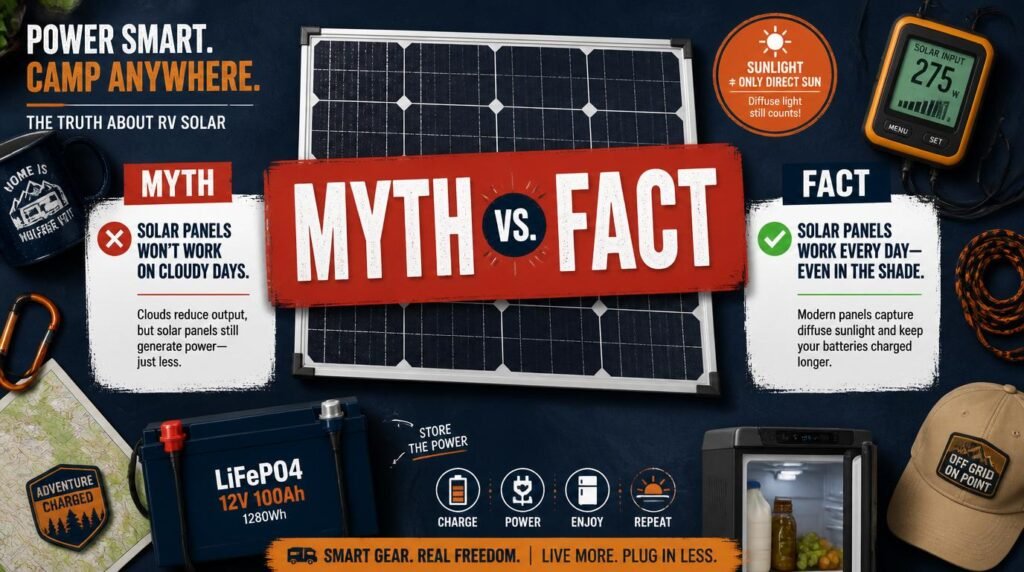
How many times have you seen someone on an RV forum say “just get 200 watts and you’ll be fine”? IMO, blanket advice like that has stranded more people with dead batteries than any equipment failure ever has. Let me bust the most persistent myths in this space:
Myth #1: “More panels always solve the problem.” Not if your battery bank can’t absorb the charge. Panels only generate power when the sun is up. If your battery is full by 10am and you have 400W of panels, those extra panels are producing zero useful energy for the rest of the day. The system is only as effective as its weakest bottleneck — and that’s often the battery, not the panels.
Myth #2: “Absorption fridges are fine for solar.” They’re not — at least not for serious off-grid use. An absorption fridge running on 12V DC is catastrophically inefficient, often drawing 10–15 amps continuously. That’s 240–360Ah per day just for the fridge. A comparable compressor fridge uses 30–50Ah. The difference is a full extra day of battery life. This isn’t close.
Myth #3: “You can size solar based on sunny summer camping, and it’ll work year-round.” Peak sun hours in the Pacific Northwest in November are roughly 1.5–2 hours per day. The same location in July gets 5–6 hours. A system sized for summer camping in Oregon will leave you power-deficient by October. Size for your worst-case month if you camp year-round, or carry a backup generator for low-sun seasons.
Myth #4: “100W of solar can run a 12V fridge.” Technically possible in ideal conditions; practically unreliable for real boondocking. At 5 peak sun hours, 100W (real-world ~75W effective) delivers roughly 375Wh. A modest fridge needs 400–500Wh per day minimum. You’re already in deficit before accounting for any other load or a single cloudy afternoon. The minimum practical starting point is 200W, full stop.
Frequently Asked Questions About 12V RV Fridge Power and Solar Sizing
How many watts does a 12V RV refrigerator use per day?
A typical 12V compressor RV refrigerator uses between 30 and 60 amp-hours per day, which translates to roughly 360 to 720 watt-hours depending on the fridge size, ambient temperature, and how often you open the door. Smaller 40-liter units sip closer to 30Ah while larger 90-liter units can hit 60Ah or more in hot weather.
How many solar panels do I need to run a 12V RV fridge?
For most boondocking setups, you need between 200 and 400 watts of solar to reliably run a 12V RV compressor fridge. A small fridge in mild weather can get by with 200W, while a larger unit in summer heat or cloudy conditions needs 400W or more, paired with adequate battery storage.
What battery size do I need for a 12V RV refrigerator off-grid?
A 100Ah lithium (LiFePO4) battery provides roughly 80–90Ah of usable capacity, which covers one night for most small to mid-size 12V fridges. For two to three days of autonomy without solar, plan for 200–300Ah of lithium or 400–600Ah of lead-acid battery capacity.
Does outside temperature affect 12V RV fridge power consumption?
Absolutely — this is one of the most underestimated variables. A 12V compressor fridge in 95°F ambient heat can draw 40–60% more power than the same unit in 70°F conditions. This directly impacts your solar sizing calculation, meaning desert summer campers should add a 30–50% buffer to any baseline solar estimate.
Can I run a 12V RV refrigerator on 100 watts of solar?
Technically yes, but only in ideal conditions — full sun, cool ambient temps, small fridge, and topped-up batteries. In real-world boondocking, 100W of solar is rarely enough on its own. You will likely drain your battery overnight and not fully recover by the next afternoon. I recommend a minimum of 200W for any practical off-grid fridge setup.
Is a 12V compressor fridge better than an absorption fridge for solar use?
For solar-powered off-grid setups, 12V compressor fridges win decisively. They use 50–70% less power than absorption fridges and work efficiently regardless of vehicle levelness. Absorption fridges need propane or 120V AC and perform poorly in hot weather, making them a poor match for serious boondocking with a solar setup.
My Top Recommended Gear
These are the three pieces of equipment I’d put in my own rig — and recommend to anyone building a serious off-grid power setup around a 12V RV fridge.
- Iceco VL45 Pro Series 12V Compressor Refrigerator — One of the most power-efficient mid-size 12V compressor fridges on the market, averaging under 35Ah/day in real-world conditions, with a genuine dual-zone option for those who want a freezer compartment.
Check current price on Amazon → - Renogy 200W Monocrystalline Solar Panel (Rigid) — High-efficiency mono cells with excellent low-light performance, making them the go-to starting panel for RV solar builds where rooftop real estate is limited but output needs to be maximized.
Check current price on Amazon → - Battle Born 100Ah LiFePO4 Deep Cycle Battery — The most field-proven lithium battery in the RV and van life community, with a genuine 10-year warranty and a built-in BMS that protects against overcharge, over-discharge, and temperature extremes.
Check current price on Amazon →
Disclaimer: This post contains affiliate links. As an Amazon Associate, I may earn a commission from qualifying purchases at no additional cost to you. I only recommend products I’ve personally tested or rigorously researched.

One Comment