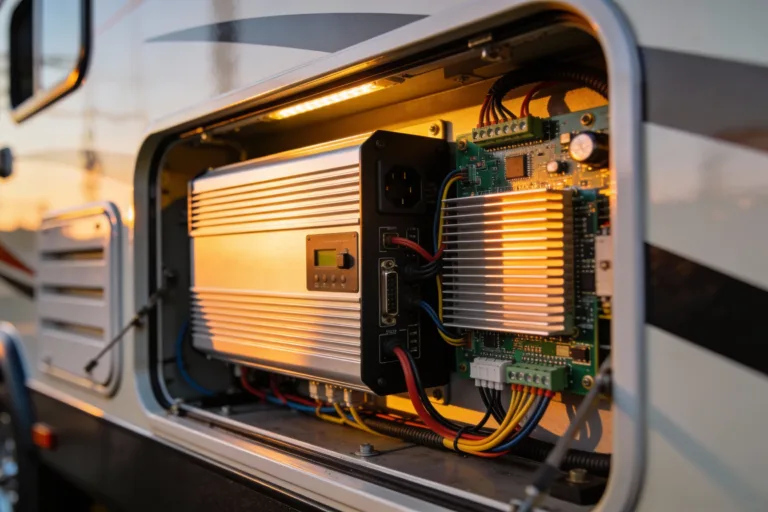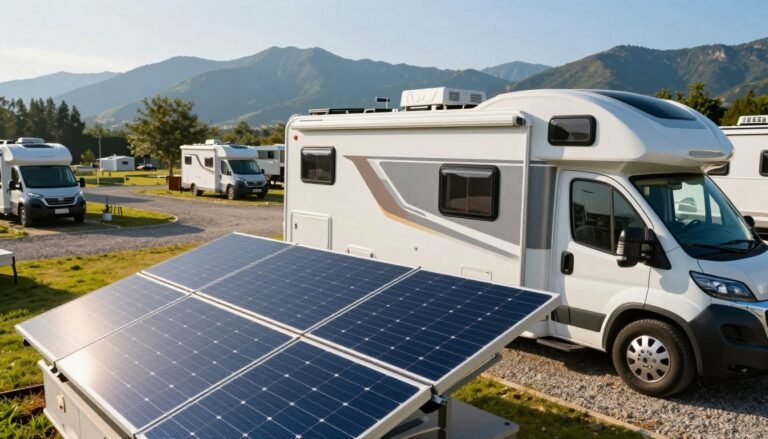
Understanding truck camper battery bank basics separates weekend warriors from true off-grid adventurers—and I’ve watched too many folks learn this the hard way. You’re 50 miles from the nearest town, your fridge just died, and that “good enough” battery setup you cobbled together is giving you nothing but voltage anxiety. Sound familiar? After 12 years of building, troubleshooting, and optimizing camper power systems, I can tell you that most battery bank failures come down to three things: poor planning, cheap components, or fundamental misunderstanding of how these systems actually work. Today, I’m giving you the blueprint I wish someone had handed me when I started.
Table of Contents
- What Is a Truck Camper Battery Bank?
- Battery Types: The Real Differences That Matter
- Sizing Your Battery Bank Right the First Time
- Wiring Configurations: Series vs. Parallel Explained
- Charging Methods for Off-Grid Success
- 5 Expensive Mistakes I See Constantly
- Frequently Asked Questions
- My Top Recommended Gear
What Is a Truck Camper Battery Bank?
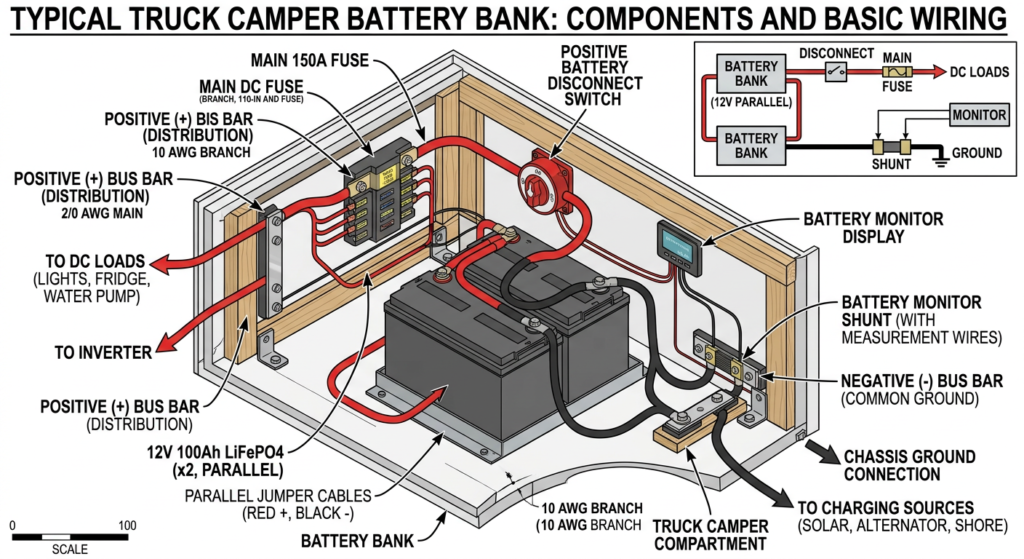
A truck camper battery bank is a collection of batteries wired together to store electrical energy for running your camper’s appliances, lights, and devices independently from shore power or your vehicle’s engine. It forms the heart of your off-grid truck camper power system, acting as your personal power reservoir that you fill through solar, alternator charging, or shore power and drain through daily use.
Think of your RV battery bank like a checking account for electrons. Your charging sources make deposits, your appliances make withdrawals, and your battery monitor is your bank statement. Run a deficit too long, and you’re going to have problems—except instead of overdraft fees, you get dead batteries and spoiled food.
The key distinction many newcomers miss? Your truck camper batteries are completely separate from your vehicle’s starting battery. We call these “house batteries,” and they operate on what’s called a “deep cycle” basis—meaning they’re designed to be discharged significantly and recharged repeatedly, unlike your truck’s starter battery which delivers short, high-current bursts.
Battery Types: The Real Differences That Matter
Here’s where I need to bust some myths, because the battery type debate generates more heat than light online. Let me break down what actually matters for your camper power system.
Flooded Lead-Acid (FLA)
The old-school workhorses. They’re cheap upfront, widely available, and I still recommend them for budget builds. The catch? You can only use about 50% of their rated capacity without killing them prematurely, they require regular water top-offs, and they must be vented due to hydrogen gas production. The Department of Energy’s battery research confirms these fundamental chemistry limitations haven’t changed.
AGM (Absorbed Glass Mat)
Sealed, maintenance-free, and can be mounted in any orientation. You’ll pay about 2x the cost of flooded batteries for similar capacity. Still limited to roughly 50% depth of discharge for longevity. These are my go-to recommendation for folks who want simplicity without jumping to lithium pricing.
Lithium Iron Phosphate (LiFePO4)
The premium choice that’s becoming increasingly accessible. You can use 80-100% of rated capacity, they charge faster, weigh 60% less than equivalent lead-acid, and last 5-10x longer in cycle life. Yes, they cost 3-4x more upfront, but when you do the math on cost-per-cycle, they often win. IMO, if your budget allows, this is where the smart money goes for serious off-grid truck camper power builds.
For a deeper understanding of how solar integrates with your battery selection, check out my comprehensive guide on power and solar for RVs and trucks.
Sizing Your Battery Bank Right the First Time
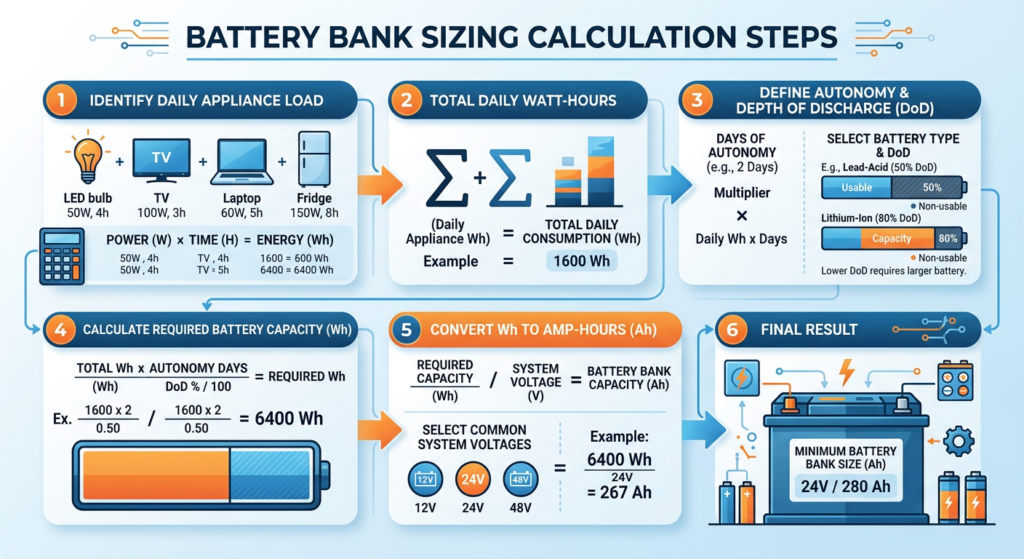
Battery bank sizing isn’t guesswork—it’s basic math that prevents expensive regrets. Here’s my proven approach:
Step 1: Calculate Your Daily Energy Consumption
List every device you’ll run and its power draw in watts. Multiply watts by hours of daily use to get watt-hours (Wh). Here’s a realistic example:
- 12V Compressor fridge: 40W × 12 hours = 480Wh
- LED lights: 20W × 4 hours = 80Wh
- Phone/laptop charging: 60W × 2 hours = 120Wh
- Water pump: 60W × 0.5 hours = 30Wh
- Vent fan: 15W × 6 hours = 90Wh
- Total: 800Wh/day
Step 2: Convert to Amp-Hours
Divide total watt-hours by system voltage (usually 12V): 800Wh ÷ 12V = 67Ah daily consumption.
Step 3: Apply the Appropriate Multiplier
For lead-acid batteries (50% usable): 67Ah × 2 = 134Ah minimum bank size
For lithium batteries (80% usable): 67Ah × 1.25 = 84Ah minimum bank size
Step 4: Add Buffer for Real-World Conditions
I always recommend adding 25-50% additional capacity for cloudy days, efficiency losses, and future power creep (you WILL add more devices). That brings our realistic recommendations to:
- Lead-acid: 200-270Ah
- Lithium: 100-150Ah
The National Renewable Energy Laboratory has excellent research on battery sizing for off-grid applications if you want to nerd out on the technical details.
Wiring Configurations: Series vs. Parallel Explained
This is where truck camper electrical basics trips people up, but it’s simpler than it seems once you understand the core principles.
Parallel Wiring (Most Common for 12V Systems)
Connect positive to positive, negative to negative across all batteries. This keeps your voltage the same (12V) while adding amp-hour capacity. Two 100Ah batteries in parallel = 12V at 200Ah. This is what 90% of truck camper builds should use.
Series Wiring
Connect positive of one battery to negative of the next. This increases voltage while keeping amp-hours the same. Two 12V 100Ah batteries in series = 24V at 100Ah. Unless you’re running a 24V or 48V system (typically for larger RVs or boats), you probably won’t use this.
Series-Parallel Combinations
Advanced configurations for specific needs. For example, four 6V golf cart batteries can be wired in series-parallel to create 12V at doubled capacity. This is actually a cost-effective approach for lead-acid builds.
Critical rule: Never mix batteries of different ages, types, or capacities. The weakest battery becomes the limiting factor and will drag down your entire system. For more on avoiding costly electrical mistakes, read my piece on truck and RV safety and security.
Charging Methods for Off-Grid Success
A battery bank is only as good as your ability to keep it charged. Here are your three main options for maintaining your off-grid truck camper power:
Solar Charging
The gold standard for extended boondocking. A proper truck camper solar setup includes panels, a charge controller (MPPT is worth the premium), and appropriate wiring. Rule of thumb: 100W of solar per 100Ah of lithium capacity, or 100W per 200Ah of lead-acid. For panel selection strategies, dive into my guide on choosing solar panels.
Alternator Charging (DC-DC Chargers)
Harness your truck’s alternator while driving. Modern DC-DC chargers are essential for lithium batteries and significantly improve charging for lead-acid. Expect 25-60 amps of charging depending on your setup. This is your “driving bonus”—rack up miles, rack up amp-hours. 🙂
Shore Power (AC Chargers)
When you’re at a campground or have access to grid power, a quality converter/charger replenishes your bank. Look for multi-stage smart chargers that properly bulk, absorb, and float charge your specific battery chemistry.
The smart approach? Combine all three methods. This redundancy keeps you charged regardless of weather, driving patterns, or campsite availability.
Expert Commentary: This video from Will Prowse provides an excellent deep-dive into battery bank configurations and real-world testing data that validates much of what I’ve covered here—his testing methodology is rigorous and his recommendations align with my field experience.
For more on integrating solar with your charging strategy, explore RV solar panels and charging.
5 Expensive Mistakes I See Constantly
After troubleshooting hundreds of systems, these are the errors that keep costing people money:
1. Undersized Wiring
Voltage drop is real. Using wire that’s too thin for your current loads causes heat buildup, power loss, and potential fire hazards. The American Boat and Yacht Council standards for marine wiring apply perfectly to RV applications—follow them.
2. Skipping the Battery Monitor
Flying blind without a proper shunt-based battery monitor is asking for trouble. You need to know your state of charge, not guess based on voltage. A $150 monitor saves thousands in premature battery replacement.
3. Improper Charging Parameters
Lithium batteries require different charge voltages than lead-acid. Using a lead-acid charger on lithium (or vice versa) will damage batteries and void warranties. Always verify compatibility.
4. Neglecting Temperature
Batteries hate extremes. Charging lithium below freezing damages cells permanently. Discharging lead-acid in high heat accelerates degradation. Insulation and ventilation aren’t optional—they’re investments.
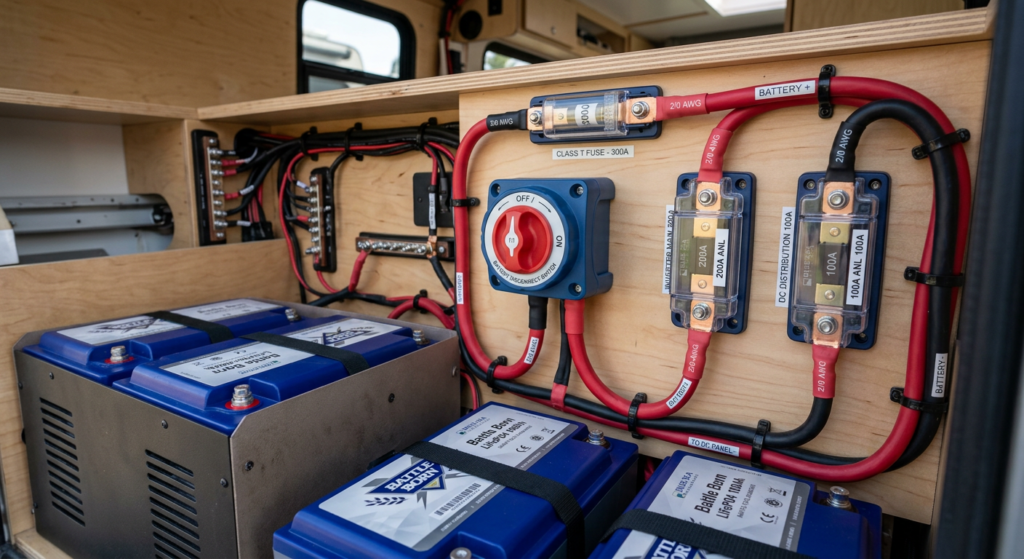
5. No Fusing or Overcurrent Protection
Battery banks store enormous energy. Without proper fuses at the battery terminals and throughout your system, a short circuit becomes a fire. This isn’t paranoia; it’s basic electrical safety. Every positive wire leaving your battery bank needs appropriately sized fuse protection.
Frequently Asked Questions
How many batteries do I need for a truck camper?
Most truck campers need between 200-400Ah of lithium battery capacity or 400-800Ah of lead-acid capacity. The exact number depends on your daily power consumption, which typically ranges from 50-150Ah per day for moderate use including lights, a fridge, phone charging, and water pump operation.
Can I mix different battery types in my RV battery bank?
No, you should never mix different battery types (lithium with lead-acid) or even different ages/brands of the same type. Mismatched batteries will cause the weaker battery to drag down performance and potentially create safety hazards due to uneven charging and discharging rates.
How long will my truck camper battery bank last?
Lithium batteries typically last 2,000-5,000 cycles (8-10 years), while lead-acid batteries last 300-500 cycles (2-4 years). Actual lifespan depends on depth of discharge, charging practices, and temperature management. Keeping batteries between 20-80% charge significantly extends their life.
What size solar panel do I need to charge my truck camper batteries?
A general rule is 100 watts of solar per 100Ah of lithium battery capacity, or 100 watts per 200Ah of lead-acid capacity. For a typical 200Ah lithium setup, 200-400 watts of solar panels will keep you charged during normal use, accounting for weather and shading variables.
My Top Recommended Gear
After testing dozens of products in real-world conditions, here’s what I actually trust with my own builds:
- Best Lithium Battery for Most Builds: Battle Born 100Ah LiFePO4 Battery – American-made, excellent warranty support, and proven reliability in extreme temperatures.
- Best Budget Battery Monitor: Victron SmartShunt Battery Monitor – Bluetooth connectivity, accurate readings, and integrates well with larger Victron systems.
- Best DC-DC Charger: Renogy 50A DC-DC Charger with MPPT – Combines alternator charging and solar input, solid build quality for the price.
Building your truck camper battery bank right the first time saves money, headaches, and keeps your adventures rolling. Take the time to plan properly, size correctly, and don’t cheap out on safety components. Your future self—stuck in some beautiful remote location with cold beer and charged devices—will thank you.
Disclaimer: This post contains affiliate links. As an Amazon Associate, I may earn a commission from qualifying purchases at no additional cost to you.