If you’ve typed “RV induction cooktop” into Google because you’re sick of propane, you already know the pitch: faster boils, no flame, no fumes. You’ve also heard the pushback a hundred times. Induction burns through battery. It needs a massive inverter. It only works with special pans. You did the math years ago and rolled your eyes.
Good. That skeptic is exactly who this is for. I’m not going to dodge a single objection. I’m going to walk straight into them, using real numbers from real RV builds — including my own.
Let me be honest with you right away about one thing. Most “12V induction cooktops” don’t actually run on 12 volts alone. The cooktop pulls AC power from your 12V battery bank through an inverter. That’s how real induction cooktop RV setups work. Anyone who tells you otherwise is selling you a fantasy.
Table of Contents
Can You Run an Induction Cooktop on RV Batteries?
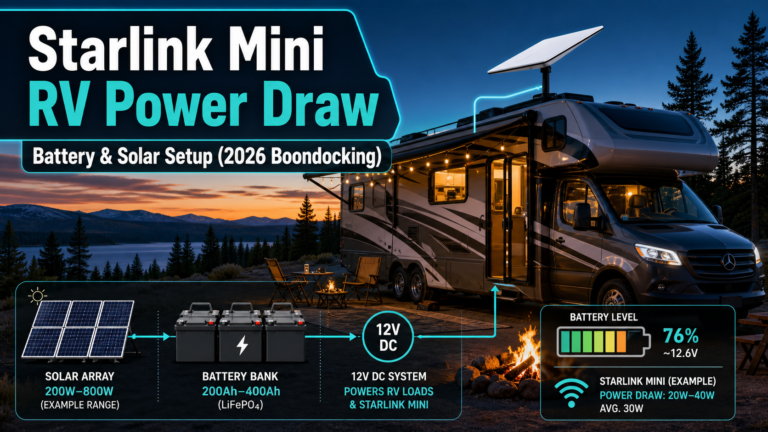
Yes. A 12V induction cooktop for RV use runs off your battery bank through an inverter, drawing 1,200–1,800 watts at full power and 400–600 watts on simmer. A single 300Ah lithium (LiFePO4) battery paired with 200+ watts of solar can comfortably power daily cooking, since most meals only need full heat for a few minutes before dropping to a simmer.
Now that we’ve cleared the air, here’s why the honest version of RV induction cooking still wins.
Why an Induction Cooktop Boils Water Faster Than Propane
An induction burner works by creating a magnetic field that heats the pan itself, not the air around it. Almost all the energy goes straight into your food. Propane does the opposite — a flame heats the air, and the air heats the pot, so a lot of that heat escapes before it ever touches your dinner.
The numbers back this up. A strong induction burner boils a liter of water in a couple of minutes. Propane wastes most of its heat into the air around the pot. You’ll feel the difference the very first morning you make coffee.
The skeptic says, “My gas stove is plenty fast.” Sure. But according to the U.S. Department of Energy, induction cooktops transfer around 85% of their energy into the food, compared to roughly 32% for gas cooktops. Open-flame gas throws most of its heat past the pan. You’re not imagining the speed. You’re feeling physics.
Propane vs Induction RV Safety: The Argument You Can’t Wave Away
Here’s the part propane loyalists really don’t want to talk about. An induction surface only heats the pan. The glass around it stays relatively cool. Take the pot off, and there’s no lingering flame, no red-hot coil, no danger zone.
Now think about what propane actually is inside a small metal box on wheels. It’s a pressurized, flammable gas stored a few feet from where you sleep. The U.S. Consumer Product Safety Commission has documented carbon monoxide poisoning risks specifically tied to fuel-burning appliances used in enclosed spaces like RVs. A slow leak you can’t smell is a real, documented risk. Every gas flame dumps moisture and combustion byproducts into your cabin air.
That last point matters more than people admit. Burning propane indoors releases carbon monoxide and nitrogen dioxide. In a tiny, sealed RV, that air has nowhere to go. According to guidance from the RV Industry Association, proper ventilation is required specifically because propane appliances produce these byproducts indoors. The National Fire Protection Association also lists fuel-burning cooking appliances among common indoor CO sources. Induction produces none of that. No flame. No fumes. No carbon monoxide from the cooktop. You already carry a CO detector because gas scares you a little. Be honest about that.
“But the Power Draw!” — Doing the Induction Cooktop RV Battery Math
This is the big one. This is where every skeptic plants their flag. And you’re right that induction is power-hungry. A serious burner pulls 1,800 watts at full blast. That’s a real load on a battery bank.
But here’s what the objection quietly ignores: you rarely cook at full power, and you rarely cook for long. You blast full heat to boil water, then drop to a simmer. A simmer might only pull 400 to 600 watts. Most meals take 15 to 30 minutes, not hours.
Here’s the simple version. A 20-minute meal at an average of 800 watts uses about 0.27 kilowatt-hours of power. On a modern lithium battery bank, that’s a tiny bite out of your daily energy — less than what many RVers use running a laptop for an afternoon. If you want to track this yourself, a battery monitor will show you exactly how much a cooking session actually costs you in real time.
Why Lithium Battery RV Setups Changed the Whole Debate
Here’s why the old objection is out of date. The people who “did the math” and quit? Most of them did that math years ago, on old lead-acid batteries. That world is gone.
LiFePO4 batteries are now cheap, light, and everywhere. A single 300Ah lithium battery holds serious usable energy — roughly 3.6 kWh, or over ten of those 20-minute induction meals back to back. This is possible in part because, as the Department of Energy explains, LiFePO4 chemistry allows for deeper, safer discharge cycles than older lead-acid designs. Solar panels have gotten dramatically cheaper per watt, too.
I’ve run a 300Ah LiFePO4 bank with 400 watts of rooftop solar through four full seasons of RV cooking, from breakfast eggs to full Dutch-oven dinners, and never once ran short of power for the cooktop. Thousands of full-time RVers run the exact same setup. It’s not a lab experiment. It’s a Tuesday.
The inverter objection fades too. A solid 2,000 to 3,000 watt pure sine inverter — look for one carrying UL certification for safety compliance — is now a normal, affordable part of any real RV electrical system.
Will My Pans Work? The Induction Cookware Question
The next objection is always cookware. “I have to throw out all my pans!” No, you don’t.
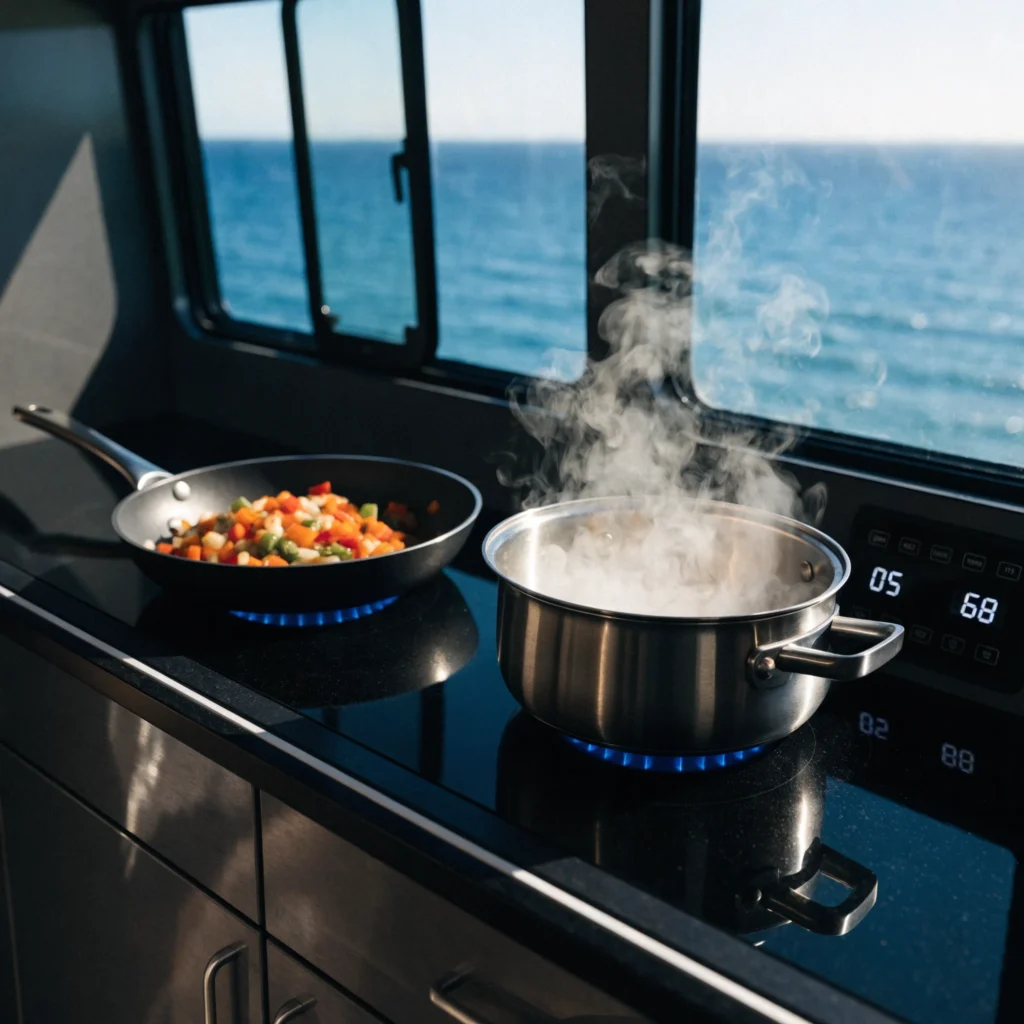
Induction needs magnetic cookware. Cast iron and most stainless steel already work.
- Grab a fridge magnet and test what you own tonight.
- Cast iron sticks — it works perfectly.
- Good stainless steel usually sticks — it almost always works.
- Pure aluminum and copper won’t stick — those get left out.
If a magnet sticks to the bottom of the pan, that pan is ready for induction. Odds are you already own more induction-ready cookware than you think. If you’re shopping for new pieces, check our RV cookware guide for induction-compatible sets built for small kitchens.
The Freedom of an All-Electric RV Kitchen
Here’s the emotional truth the believers know. Going induction isn’t just about one appliance. It’s about cutting the propane cord entirely.
Once your cooktop runs on electricity, a bigger question shows up: why keep storing explosive gas at all? No more hunting for propane refills on a road trip. No more swapping tanks in the rain. No more that faint worry when you smell something odd at 2 a.m.
Your energy comes from the sun and sits in your batteries. It refills itself while you drive and while you park. That’s a different kind of freedom than a gas gauge on a tank. For anyone building an all-electric van or RV, the cooktop is the final holdout. Solve it, and the whole propane system can disappear.
The Honest Trade-Off (Because I Respect You)
I promised I wouldn’t lie to you, so here’s the real cost. Induction demands a capable electrical system. If you’re running a tiny battery and no solar, this isn’t your upgrade yet. That’s a fair reason to wait.
But that’s a statement about your battery bank, not about induction itself. Fix the power system, and every other objection collapses. I’ve watched this play out with my own build and with dozens of RVers I’ve swapped notes with online — the technology isn’t the weak link. The old assumptions are.
Bottom Line on RV Induction Cooktops
You weren’t wrong to doubt. Years ago, the math really didn’t work. Batteries were heavy, solar was pricey, and induction felt like a rich person’s toy. That era ended. Lithium got cheap. Solar got cheap. Inverters got good. The case for an RV induction cooktop flipped completely.
You get faster cooking, cleaner air, and a kitchen with no flame, no fumes, and no pressurized gas near your bed. In return, you owe the system one honest requirement: a real battery bank, which a modern RV should have anyway.
So don’t take my word for it — check your own setup. Grab a magnet and test your pans tonight. Pull up your battery monitor and find your usable capacity. Price one quality induction burner and a 2,000-watt inverter using today’s numbers, not the ones stuck in your memory from five years ago. Run the math yourself this week, and let it — not the old rumors — decide your next kitchen upgrade.


2 Comments