
You’re parked at the most beautiful, secluded boondocking spot imaginable. The sunset is perfect. You go to brew a cup of coffee or charge your laptop, and… nothing. Silence. That’s the moment you realize relying solely on 12V DC power is a rookie mistake. If you want specific instructions on how to install RV power inverter systems correctly, stop scrolling. Most guides gloss over the dangerous stuff or bore you with theory.
We aren’t doing that here.
You’re tired of dead outlets when you aren’t plugged into shore power. I get it. It’s frustrating to have a $50,000 rig that can’t power a $20 toaster. This guide is your fix. I’m going to walk you through the nitty-gritty of getting 120V AC power from your battery bank without setting your rig on fire.
Table of Contents
- First: Why “Pure Sine Wave” Isn’t Just Marketing Hype
- How Hard Is It to Install an RV Inverter?
- The “Don’t Skimp” Shopping List
- Step 1: Location, Location, Airflow
- Step 2: Running the DC Cables (The Heavy Lifting)
- Step 3: The Fuse—Your Catastrophe Insurance
- Step 4: The Grounding Game
- Step 5: AC Output (Getting Power to the Outlets)
- Testing: The Moment of Truth
- The Final “Insider” Takeaway
First: Why “Pure Sine Wave” Isn’t Just Marketing Hype
Let’s bust a massive myth right out of the gate. You’ll hear people on forums say, “Save fifty bucks and get a Modified Sine Wave inverter. It works fine.”
Do not listen to them.
Modified sine wave inverters produce “dirty” power—blocky, choppy waves rather than the smooth undulation of grid power. I’ve seen modified sine inverters overheat microwave magnetrons, cause motors (like in your AC or fan) to buzz loudly, and fry the power bricks of expensive laptops.
If you value your electronics, Pure Sine Wave is the only game in town. It mimics the electricity you get from your house. IMO, buying a modified sine wave unit in 2026 is like buying a tube TV. Just don’t.
The Math You Can’t Skip (Sorry)
Before you buy anything, you need to know your load.
- Coffee Maker: 1000W
- Laptop: 65W
- Microwave: 1200W (Surge 2000W)
If you plan to run the microwave, a 1000W inverter won’t cut it. You need headroom. I usually recommend a 2000W or 3000W Pure Sine Wave Inverter for most RVers. It hits the sweet spot between capability and battery drain.
Expert Note: Inverters aren’t 100% efficient. They usually run at about 85-90% efficiency. If you need 1000W, your battery is actually supplying about 1150W. Factor that into your battery bank sizing calculations!
How to Install RV Power Inverter, Is it Hard?

Installing an RV inverter is moderately difficult and requires basic knowledge of electrical safety. It involves mounting the unit near the batteries, sizing heavy-gauge cables correctly, installing a high-amperage fuse, and grounding the system to the chassis. While a DIYer with a multimeter and crimping tools can do it in 3–5 hours, improper installation can cause fire hazards.
The “Don’t Skimp” Shopping List
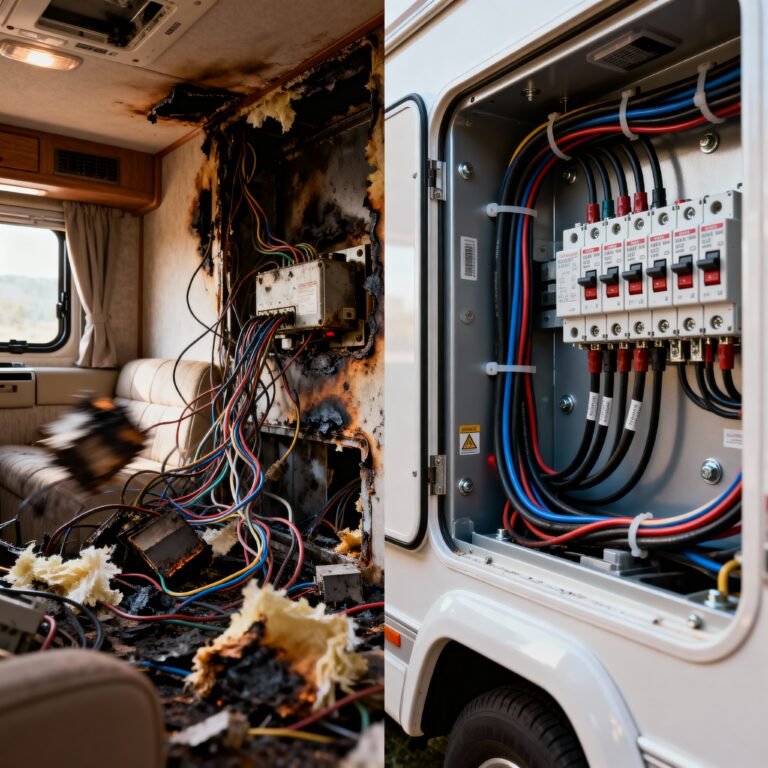
Here is where most DIYers fail. They buy a great inverter and hook it up with jumper cables and electrical tape. This is how rigs burn down.
To do this right, you need:
- The Inverter: 2000W+ Pure Sine Wave (Victron, Renogy, or Go Power are my go-to brands).
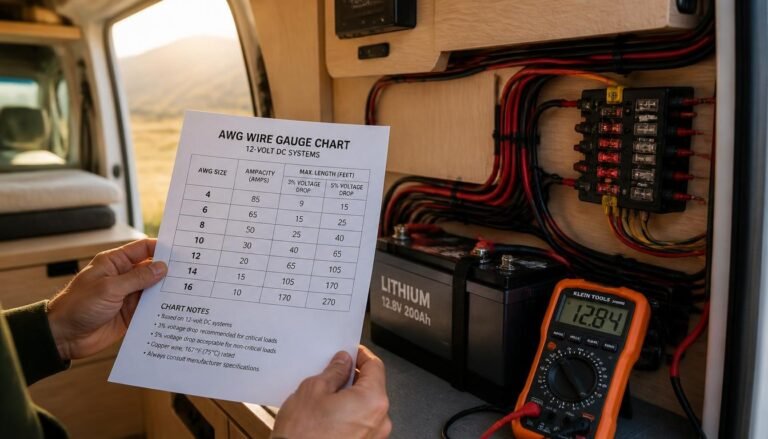
- Cables: 2/0 AWG or 4/0 AWG welding cable. Do not use standard car audio cable. Audio cable is often Copper Clad Aluminum (CCA), which creates more resistance and heat. You want 100% Pure Oxygen-Free Copper.
- ANL Fuse & Holder: Mandatory. This goes on the positive line.
- Lugs & Heat Shrink: For clean, safe connections.
- Remote Switch: So you don’t have to crawl into the basement to turn it on.
Step 1: Location, Location, Airflow

Heat is the enemy of electronics.
I once saw a guy mount his inverter inside a sealed plastic tote box to “protect it.” He cooked a $1,000 unit in two weeks.
The Golden Rules of Placement:
- Close to Batteries: You want the DC cables (battery to inverter) to be as short as physically possible—ideally under 5 feet. Long DC cables result in voltage drop. Voltage drop means your inverter shuts down early because it thinks the battery is dead.
- Ventilated: The fans will kick on. Give them room to breathe.
- Dry: Obvious, but worth saying.
- NOT in the Propane Compartment: Inverters can spark. Propane goes boom. Keep them separated. 🙂
Step 2: Running the DC Cables (The Heavy Lifting)
This is the most critical step. You are dealing with massive amperage here. A 2000W inverter pulling from a 12V battery can draw upwards of 170 Amps. That is welding territory.
[Image of RV inverter wiring diagram]
- Measure and Cut: Keep cables short.
- Crimp the Lugs: If you don’t have a hydraulic crimper, buy a hammer crimper or borrow one. A loose crimp creates a “hot spot” that can melt the insulation.
- Color Code: Use Red for Positive (+) and Black for Negative (-). Don’t be the person who uses black for everything and blows up the system later because they forgot which was which.
Insider Tip: If you absolutely must have a long run between the battery and the inverter, increase the cable thickness. When in doubt, go thicker. I’ve never heard anyone complain their cables were too efficient. Check out our guide on RV electrical safety for more details on cable sizing.
Step 3: The Fuse—Your Catastrophe Insurance
You must install a fuse on the Positive (+) cable, as close to the battery terminal as possible.
Why? If that thick positive cable accidentally chafes against the metal chassis of your RV, it will short out. Without a fuse, that cable becomes a glowing red heating element that will ignite your floorboards.
Sizing the Fuse:
The general rule is Wattage / Voltage = Amps.
- 2000W / 12V = ~166 Amps.
- Add 25% for safety headroom.
- Verdict: Use a 200-250 Amp ANL Fuse.
Step 4: The Grounding Game
Most instructions gloss over the chassis ground. Do not skip this.
Your inverter will have a grounding lug (usually a small nut on the casing). You need to run a copper wire (usually 8 AWG or thicker) from that lug to the metal chassis frame of your RV.
This creates a safety path. If an internal wire comes loose and touches the inverter casing, the electricity goes to the frame (and blows the fuse) rather than waiting for you to touch the case and become the ground. Safety first, friends.
Step 5: AC Output (Getting Power to the Outlets)

Now that the inverter has power, how do you get that power to your coffee maker? You have two main options:
Option A: The “Extension Cord” Method (The Easy Way)
The inverter has outlets on the front. You plug an extension cord in, snake it into the cabin, and plug your laptop into that.
- Pros: fast, cheap, zero wiring.
- Cons: Look messy, hassle to set up every time.
Option B: The Transfer Switch (The Pro Way)
This involves hardwiring the inverter into your RV’s breaker panel using an Automatic Transfer Switch (ATS).
When you are plugged into shore power, the ATS lets grid power pass through to your outlets. When you unplug, the ATS senses the loss of power and automatically switches your outlets to the inverter.
Warning: If you hardwire without a transfer switch (or a sub-panel), and you plug into shore power while the inverter is on, you will send AC power backwards into the inverter. We call this “letting the smoke out.” It kills the unit instantly.
If you aren’t comfortable messing with your 120V breaker box, hire an electrician for this part. It’s worth the $100–$200 labor cost.
Testing: The Moment of Truth

You’ve crimped, you’ve fused, you’ve grounded.
- Double Check Polarity: Positive to Positive. Negative to Negative.
- Connect the Negative Cable First.
- Connect the Positive Cable. Spark Alert: You might see a small spark when you touch the final cable to the terminal. This is normal—it’s just the capacitors inside the inverter charging up. Don’t panic.
- Turn the Switch On.
- Check the Voltage: Use a multimeter. You should see roughly 12.6V–13.5V at the inverter input terminals.
- Plug in a Load: Start small. A lamp or a phone charger. If it works, try the TV.
If you hear a high-pitched squeal, check your connections. It usually means low voltage input (loose cables or dead batteries).
The Final “Insider” Takeaway
Here is the secret that separates the pros from the frustrated amateurs: Battery Capacity.
You can install the biggest, baddest 3000W inverter on the planet, but if you are running a single 12V lead-acid marine battery, you’re going to be disappointed. A lead-acid battery shouldn’t be discharged below 50%. A microwave running for 5 minutes can pull enough amps to sag the voltage and trip the inverter’s “Low Voltage Cutoff” instantly, even if the battery isn’t actually empty.
My advice: If you are serious about inverting, upgrade to LiFePO4 (Lithium) batteries. They maintain high voltage under heavy loads and you can drain them almost to zero without damage. They are the perfect partner for a high-output inverter.
Ready to get off the grid?
Check your battery bank size today. If you’re still rocking the factory-installed dealer battery, put “Upgrade to Lithium” at the top of your list before you buy that inverter.
Happy trails!
Products & Resources Mentioned
To help you complete your installation safely, here is a consolidated list of the equipment I trust and use in the field.
- The Brains: Pure Sine Wave Inverters – Essential for protecting sensitive electronics like laptops and microwaves.
- The Veins: Oxygen-Free Copper Welding Cable – Don’t risk heat buildup with cheap audio cables.
- Safety First: ANL Fuse Kits – The cheapest insurance you can buy for your rig.
- Pro Integration: Automatic Transfer Switch – Seamlessly switch between shore power and battery power.
- Power Source: LiFePO4 Lithium Batteries – The necessary upgrade for reliable high-wattage inverting.
As an Amazon Associate, I earn from qualifying purchases.


One Comment