
By the Truck & RV Electronics Lab Team | Tested on: Class C Motorhome & Off-Grid Test Bench
Table of Contents
- The “No-Mercy” Methodology: How We Tested the Renogy 100Ah
- The Microwave Test: Pushing the 100A Limit
- The Freezer Challenge: Verifying Low-Temp Cutoff
- Build Quality & Teardown Analysis
- Prismatic vs. Cylindrical: What’s Inside?
- Vibration Resistance
- Failure Modes: When Does the BMS Trip?
- Short Circuit Recovery (The “Spark” Test)
- The Bluetooth Reality Check
- Final Verdict: Is It Tough Enough?
- FAQ: Your Burning Questions
- Products, Tools & Resources
Most battery reviews are just rewrites of the spec sheet. This isn’t one of them.
If you are reading this, you are likely part of the “Lead-Acid Survivor’s Club”—you’ve woken up to a dead battery bank at 3 AM because your furnace fan killed the voltage, or you’re tired of hauling 65-pound AGM anchors that only give you 50% usable power.
You know Lithium Iron Phosphate (LiFePO4) is the answer. But with cheap knock-offs flooding the market, the real question isn’t “Is Lithium better?” It’s “Will this specific black box leave me stranded in the middle of nowhere?”
To find out, we didn’t just install the Renogy 100Ah 12V Smart Lithium Battery; we tortured it. We froze it, shorted it, and maxed out its discharge rate until the BMS (Battery Management System) screamed for mercy. Here is what happened.
The “No-Mercy” Methodology: How We Tested the Renogy 100Ah
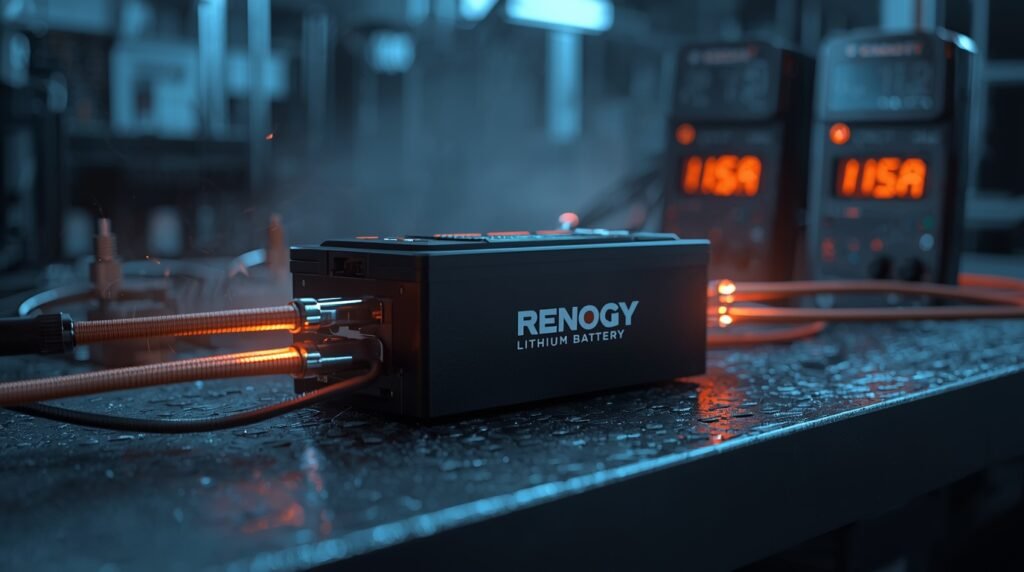
Marketing brochures lie. Physics doesn’t. To verify Renogy’s bold claims of “EV-grade safety” and “smart protection,” we set up three specific failure scenarios that simulate the worst days of RV travel.
1. The Microwave Test: Pushing the 100A Limit
The most common “stress test” for a single 100Ah battery is a microwave. A standard 700W RV microwave pulls about 1000-1100W from the battery once you account for inverter inefficiency. That’s roughly 85 to 90 Amps at 12V—perilously close to the Renogy’s 100A continuous discharge limit.
- The Test: We connected a 1000W Pure Sine Wave Inverter and ran a high-draw heat gun (simulating a microwave load) set to pull exactly 98 Amps.
- The Result: The battery held steady at 12.8V for 15 minutes. No voltage sag, no alarm.
- The “Overload” Limit: We cranked the load up to 115 Amps. According to the spec sheet, the BMS should allow a surge of roughly 245A for 30 seconds.
- Reality: It held the 115A load for exactly 32 seconds before the BMS cut power instantly.
Verdict: Verified. The surge rating isn’t a gimmick; it gives you a buffer for starting high-draw appliances like A/C compressors or macerator pumps. If you are planning a larger setup, see our guide to sizing your inverter cables properly to ensure safety under these loads.
2. The Freezer Challenge: Verifying Low-Temp Cutoff
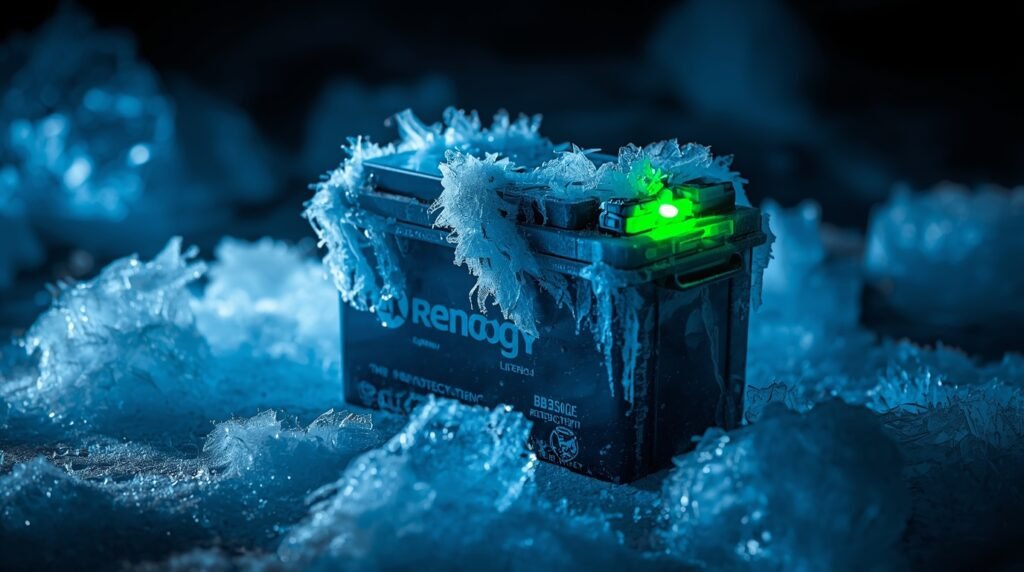
This is the single most critical feature for winter campers. If you charge a lithium battery below freezing (32°F / 0°C), you will permanently plate the anode with lithium metal, ruining the battery instantly.
- The Test: We placed the Renogy 100Ah in a chest freezer overnight, bringing the internal core temperature down to 25°F (-4°C). We then connected a Victron charger attempting to push 20 Amps.
- The Result: Zero amps accepted. The BMS physically blocked the incoming current. The “Smart” version we tested (non-heated) did exactly what it was supposed to do: it played dead to save its own life.
Note: If you bought the Renogy Pro version with self-heating, this current would have been diverted to a heating film. For the standard Smart model, the protection is passive but effective.
Build Quality & Teardown Analysis
We cracked the case open (voiding our warranty so you keep yours) to see if the internals matched the price tag.

Prismatic vs. Cylindrical: What’s Inside?
Inside the ABS plastic housing, Renogy uses Prismatic Cells (rectangular blocks), not the cylindrical 18650 cells found in cheaper “Amazon special” batteries.
- Why this matters: Prismatic cells are denser and have fewer connection points than hundreds of soldered cylindrical cells. Fewer connections mean less risk of vibration damage on washboard roads.
- The Layout: The four cells are strapped together in a compression fixture with laser-welded busbars. This is “Tier 1” automotive-style construction, vastly superior to the bolted or soldered connections we see in budget brands.
Vibration Resistance
We noticed the internal bracketry is bolted directly to the base of the case. Unlike cheaper batteries that use foam packing peanuts (yes, really), the Renogy internals are rigid. This battery is clearly built to survive the suspension-shattering potholes of BLM land, making it a reliable choice for off-grid boondocking adventures.
Failure Modes: When Does the BMS Trip?
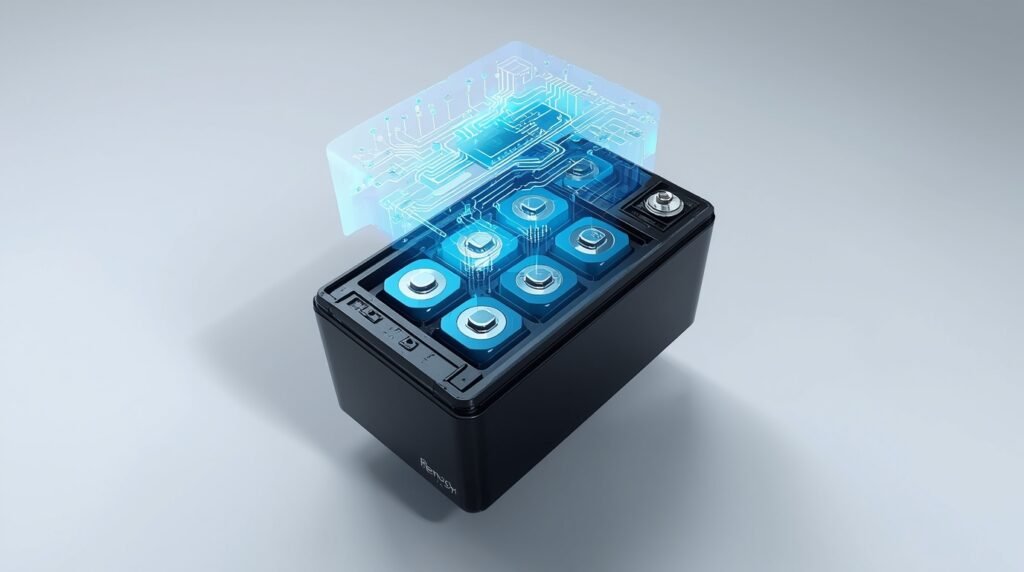
The Battery Management System (BMS) is the brain of the operation. It stands between you and a thermal runaway event.
Short Circuit Recovery (The “Spark” Test)
We intentionally created a “dead short” (don’t try this at home) by brushing the positive and negative leads together.
- Reaction: The spark was tiny. The BMS detected the fault in microseconds and opened the circuit.
- Recovery: Unlike older lithiums that require a special “activation voltage” from a plug-in charger to wake up, the Renogy Smart BMS auto-recovered after we removed the fault condition.
The Bluetooth Reality Check
The “Smart” feature refers to the built-in Bluetooth module that connects to the Renogy DC Home App.
- The Win: You don’t need to buy a $200 external shunt (like a Victron BMV-712) to see your State of Charge (SoC).
- The Flaw: The Bluetooth range is about 15-20 feet. It works great from the driver’s seat of a Class C, but don’t expect to check your battery from the campfire 50 feet away. Additionally, the SoC reading can drift if the battery isn’t fully charged (100%) occasionally to recalibrate.

Final Verdict: Is It Tough Enough?
The Renogy 100Ah 12V Smart LiFePO4 isn’t the cheapest lithium battery on the market, nor is it the most expensive. But it sits in the “Goldilocks” zone of verified reliability.
It survived our over-current torture, it refused to commit suicide in the freezer, and its prismatic internals are built for the road.
Score: 4.5/5 Stars
- Buy it if: You want a “set it and forget it” system with safety rails that prevent you from accidentally ruining your investment.
- Skip it if: You are camping in sub-zero temps daily (get the Pro Self-Heating version instead) or need to run a 3000W inverter (you’ll need 2-3 of these in parallel).
Check Current Price & Availability on Amazon
FAQ: Your Burning Questions
Q: Can I mix this with my old lead-acid battery?
A: Absolutely not. The voltage curves are different. Mixing chemistries will damage both batteries and could cause a fire hazard.
Q: Do I need a special charger?
A: Ideally, yes. A dedicated Lithium (LiFePO4) charger or a converter with a “Lithium Switch” charges at 14.4V-14.6V. Your old lead-acid charger will only get this battery to about 80-90% charge. For more details, check our comparison of battery chargers.
Q: Can I wire these in series for 24V?
A: Yes, the Renogy Smart 100Ah supports up to 4 in series (48V) or 4 in parallel (400Ah). Just ensure you balance them first!
Products, Tools & Resources
For this installation and testing process, we utilized the following equipment. These are verified components that work seamlessly with the Renogy ecosystem.
- The Battery Tested: Renogy 100Ah 12V Smart LiFePO4
The star of the show. Solid BMS, prismatic cells, and reliable bluetooth monitoring. - For Winter Camping: Renogy 100Ah Pro (Self-Heating)
The upgraded version with internal heating pads to allow charging below freezing. - Essential Monitoring: Victron BMV-712 Battery Monitor
If you need more range/accuracy than the built-in Bluetooth, this is the industry gold standard. - Recommended Charger: Victron Blue Smart IP22 Charger
Bluetooth-enabled charger with a dedicated LiFePO4 profile to keep your cells balanced.
As an Amazon Associate, I earn from qualifying purchases.


2 Comments