If you’ve added a lithium house battery to your RV, truck camper or van, you’ve probably hit the same fork in the road: keep the cheap battery isolator that came with the rig, or spend real money on a DC to DC charger.
The short answer: if your house battery is lithium (LiFePO4), your vehicle has a smart alternator, or the cable run to the house battery is long, get a DC to DC charger. If you run lead-acid or AGM batteries on an older fixed-voltage alternator with a short cable run, an isolator can still do the job.
This guide breaks down the DC to DC charger vs battery isolator decision in plain terms: what each device does, why lithium and smart alternators change everything, how to size a charger, and when an isolator is still the smarter buy.
This article contains affiliate links. As an Amazon Associate I earn from qualifying purchases. It doesn’t change what I recommend or the price you pay.
Table of Contents
DC to DC charger vs battery isolator: the quick answer
| Your situation | Battery isolator | DC to DC charger |
|---|---|---|
| Lead-acid or AGM house battery, older alternator, short cable run | Usually fine | Works, but optional |
| LiFePO4 (lithium) house battery | Risky: uncontrolled current and no lithium charge profile | Recommended |
| Smart (variable-voltage) alternator | Often undercharges the house battery | Recommended, with ignition trigger wire |
| Long cable run or charging through a trailer plug | Voltage drop leaves the battery undercharged | Recommended |
| Tight budget, simple setup | Lowest cost | Higher upfront cost |
The rest of this article explains why each row lands where it does.
What a battery isolator actually does
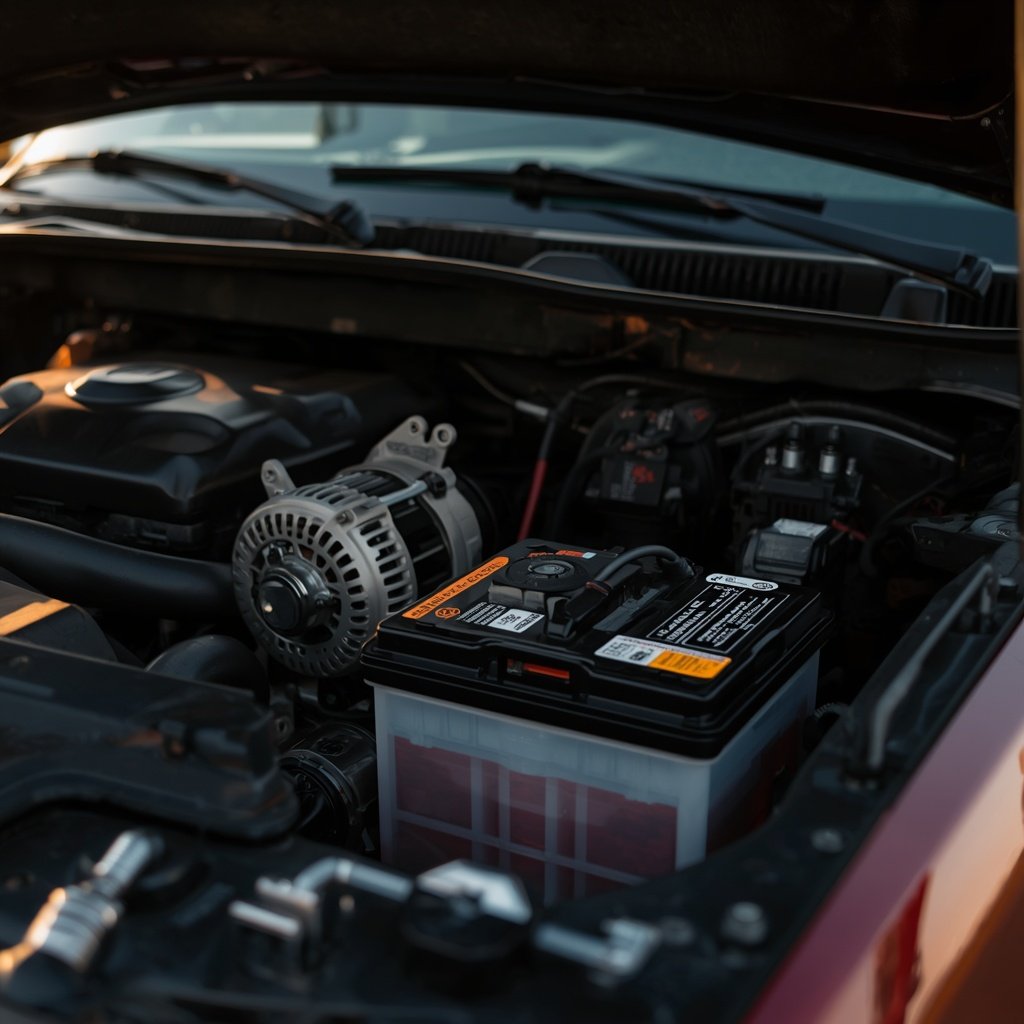
A battery isolator lets your alternator charge two batteries while keeping them separated when the engine is off, so running the fridge overnight can’t drain the battery you need to start the truck. What it doesn’t do is regulate anything. Whatever voltage the alternator puts out is roughly what your house battery sees, minus losses in the wiring.
Diode isolators, relays and voltage-sensitive relays
There are three common designs:
- Diode isolators use one-way diodes. They’re simple and have no moving parts, but diodes create heat and cost you some charging voltage.
- Solenoid relays connect the batteries whenever the ignition is on.
- Voltage-sensitive relays (VSRs), also called automatic charging relays (ACRs), watch battery voltage and connect the banks only when a charging source is active.
Blue Sea Systems, for example, explains that its dual-sensing ACRs combine the batteries once voltage holds at 13.0 V for two minutes, and separate them when both fall to 12.75 V for 30 seconds (Blue Sea Systems: Automatic Charging Relay explained). Thresholds vary between models, but the principle is the same: an isolator is a smart switch, not a charger.
What a DC to DC charger does differently
A DC to DC charger, also called a battery-to-battery or B2B charger, sits between the starting battery and the house battery and actively manages the charge. It takes whatever the vehicle supplies, within its input range, and converts it into a proper multi-stage charge (bulk, absorption and float) at the voltage your house battery chemistry wants.
Victron’s datasheet for the Orion XS 12/12-50A, for instance, lists a 9–17 V input range, up to 50 A of output adjustable in 0.1 A steps, 98.5% peak efficiency, and built-in engine-running detection so it only charges while the alternator is supplying power (Victron Orion XS datasheet). It also shuts down below a configurable input voltage, which protects your starting battery.
In practice, that adds three things an isolator can’t do:
- Correct charge voltage, regardless of what the alternator is doing.
- Current limiting, so the house battery can’t pull more than you allow.
- Battery-specific profiles for lithium, AGM, gel or flooded batteries.
Why lithium batteries change the answer
LiFePO4 batteries have very low internal resistance. Connect a deeply discharged lithium bank straight to an alternator through an isolator and it will accept close to whatever current the alternator and wiring can deliver, for as long as it takes to fill.
Most vehicle alternators aren’t designed to run at full output for long stretches. They’re built to top up a starting battery and power the vehicle’s own systems, and sustained maximum output is what drives the heat problem.
Lithium also wants specific voltages. Battle Born Batteries recommends bulk and absorption between 14.2 V and 14.6 V, with a 13.6 V float, when charging from an alternator through a DC-DC charger (Battle Born Batteries charging guide). An isolator can’t guarantee any of those numbers; it simply passes on whatever the alternator happens to produce.
The alternator heat problem, demonstrated
Victron Energy put this to the test on its own bench. In the video below, the company charges a 300Ah lithium battery from both a traditional and a regulated alternator at different engine speeds and shows what happens to the alternator. It’s worth eight minutes before you decide an isolator is good enough for a lithium bank.
Real installs differ from a bench test. Long, thin cables limit current somewhat, but that’s an accidental limit you can’t rely on. A DC-DC charger makes the limit deliberate and adjustable.
Smart alternators: the other reason isolators fall short
Many newer vehicles, including those built to Euro 5 and Euro 6 emissions standards, use smart or variable-voltage alternators. The engine computer raises or lowers alternator output to reduce engine load and fuel use.
REDARC, a maker of vehicle charging systems, reports smart-alternator output swinging from about 12.3 V to 15 V. Once the vehicle decides the start battery is full, it can cut output so the auxiliary battery gets little or no charge, even with the isolator switched on (REDARC: the truth about alternators).
A VSR may not even close at 12.3 V, and when it does, the house battery gets whatever the alternator is producing at that moment. A DC-DC charger with an ignition or trigger wire solves both problems: it switches on with the engine and boosts low input voltage to the correct charge voltage. Renogy’s 50A model, for example, uses an ignition signal wire for smart alternators (Renogy 50A DC-DC charger specifications).
Long cable runs and towing setups
Voltage drop quietly undermines alternator charging. Every foot of cable between the starting battery and the house bank costs voltage, and the higher the current, the bigger the loss. Victron lists long cable runs in RVs and boats as one of the main reasons service batteries never reach full charge.

This matters most when you charge a travel trailer or fifth-wheel battery from the tow vehicle. The charge line in a 7-pin trailer connector is often relatively light wire running the full length of truck and trailer, so by the time the voltage reaches the trailer battery it’s frequently too low to do more than maintain it.
Two practical fixes:
- Mount the DC-DC charger close to the house battery so it can boost the voltage that actually arrives, and size the feed cable for the charger’s full input current.
- For serious charging while towing, run a dedicated, properly fused heavy-gauge cable instead of relying on the 7-pin charge line. Use our RV wire gauge chart to size it for the run length.
What size DC to DC charger do I need?
Sizing comes down to three numbers: how much energy you need to put back, how long you usually drive, and how much current your alternator can spare.
Step 1: Work out the amp-hours to replace
Look at what your house battery typically loses between drives. If a 200Ah LiFePO4 bank regularly drops to 50% by morning, you need to put back about 100Ah.
Step 2: Divide by your typical drive time
If most days include two hours of driving, you need roughly 50 A of charging to replace 100Ah. A 20A charger would put back only about 40Ah in the same time. Allow some margin, because the charger tapers current as the battery approaches full.
Step 3: Check what your alternator can spare
Output current isn’t the same as input current. A 50A charger feeding a lithium bank at around 14 V delivers roughly 700 W, and it draws somewhat more than 50 A from the vehicle side once you account for conversion losses and the lower input voltage. Add the vehicle’s own loads (lights, blower fans, engine electronics) and compare the total with your alternator’s rating.
If the numbers are tight, choose a charger with an adjustable current limit and dial it back. A 30A setting that runs reliably all day beats a 50A setting that cooks your alternator. For help matching battery capacity to your charging sources and loads, see our truck camper battery bank basics.
When a battery isolator is still the right choice
A DC-DC charger isn’t automatically the better buy. An isolator, especially a quality VSR, still makes sense when:
- Your house batteries are flooded, AGM or gel, which tolerate unregulated alternator charging far better than lithium.
- Your vehicle has a conventional fixed-voltage alternator.
- The house battery sits close to the starting battery on a short, heavy cable run.
- You mostly recharge from solar or shore power, and alternator charging is a bonus.
If that describes your rig, an isolator costs less and has fewer parts to fail. You can add a DC-DC charger later if you switch to lithium.
Recommended DC to DC chargers and installation gear
If you’re going the DC-DC route, these are worth a look. I chose them based on their published specifications and documentation, not on personal bench testing.
Renogy 12V 50A DC-DC charger with MPPT
What it’s for: alternator charging and a solar MPPT controller in one box, which saves space in vans and truck campers. Best for: owners who want alternator and roof solar handled by a single unit. Keep in mind: according to Renogy, solar input tops out at 50 V and 660 W, so larger or series-wired arrays may need a separate controller. There’s no display; battery type is set with a button.
View the Renogy 50A DC-DC charger on Amazon
Victron Energy Orion XS 12/12-50A
What it’s for: a compact, highly efficient DC-DC charger configured over Bluetooth through the VictronConnect app. Best for: owners who want fine control of input and output current to protect a smaller alternator, or who already use Victron monitoring. Keep in mind: it handles alternator charging only, so solar needs its own charge controller.
View the Victron Orion XS 12/12-50A on Amazon
Blue Sea Systems 5005 ANL fuse block
What it’s for: a covered fuse holder for the heavy cables on each side of the charger. Best for: anyone installing a DC-DC charger. Keep in mind: fuses are sold separately, so match the rating to your charger’s manual and cable size.
View the Blue Sea Systems ANL fuse block on Amazon
Installation basics that prevent problems
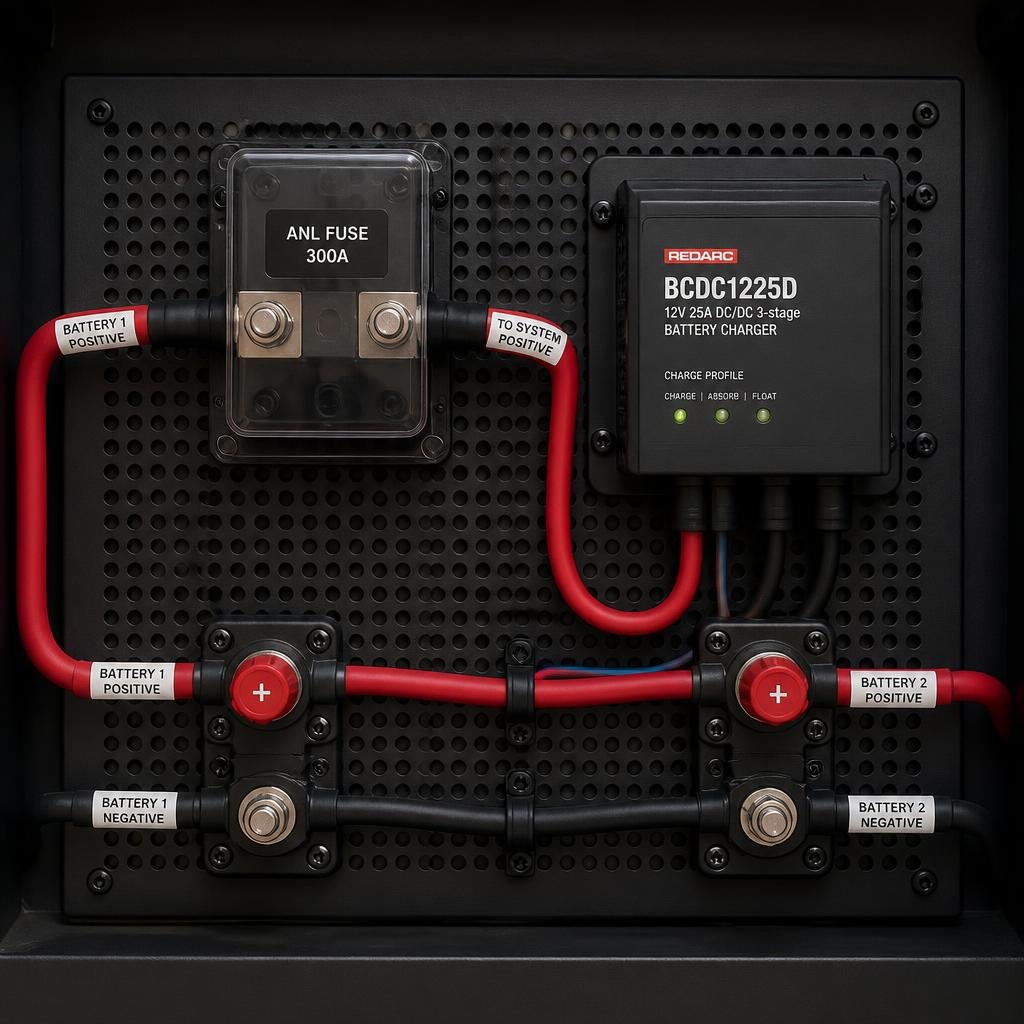
- Fuse both ends. Put a fuse close to the starting battery and another close to the house battery, sized per the charger manual. Renogy specifies 75–100 A fuses on input and output for its 50A unit. Weighing fuses against breakers? Our RV fuse vs breaker guide covers the trade-offs.
- Size cable for input current, not just output, and keep runs as short as practical.
- Connect the ignition or trigger wire if your vehicle has a smart alternator.
- Select the correct battery profile before the first drive.
- Mount the charger where air can circulate; these units shed heat under full load.
Planning solar alongside alternator charging? Our RV solar system design guide shows how the pieces fit together.
The bottom line
In the DC to DC charger vs battery isolator debate, battery chemistry and alternator type decide the winner. For a LiFePO4 house bank, a smart alternator or a long cable run, a DC-DC charger is the safer and more effective choice: it controls current, delivers the right charge profile and works with modern alternators. For lead-acid batteries on an older truck with a short cable run, a good isolator remains a sensible, affordable option.
Before you buy, write down four numbers: battery size, typical daily usage, drive time and alternator rating. Together they’ll tell you which device you need, and how big.
DC to DC charger FAQ
Do I need a DC to DC charger for lithium batteries?
In most cases, yes. LiFePO4 batteries have low internal resistance and can draw sustained high current from an alternator, and they need specific charge voltages, typically around 14.2–14.6 V absorption. A DC-DC charger limits current and applies the right profile; an isolator does neither.
Can a battery isolator charge a lithium battery?
It can pass current to one, but without control. The battery may draw more current than the alternator can comfortably supply for long periods, and charge voltage depends on the alternator rather than the battery’s needs. Check your battery manual, as some manufacturers specify what they allow.
Do I need a DC-DC charger if I have a smart alternator?
Usually. Smart alternators vary their voltage and can cut output once the start battery is full, leaving the house battery undercharged. A DC-DC charger with an ignition trigger switches on with the engine and boosts low input voltage to full charge voltage.
What size DC to DC charger do I need?
Divide the amp-hours you need to replace by your typical drive time. Replacing 100Ah over two hours takes about 50 A. Then confirm your alternator can supply the charger’s input current on top of the vehicle’s own electrical loads.
Can I use a DC to DC charger with AGM batteries?
Yes. Most DC-DC chargers include AGM, gel and flooded profiles. You’ll get a more complete charge than with an isolator, though the benefit is smaller than with lithium.
Will a DC-DC charger drain my starting battery?
Quality units include engine-running detection and a low-voltage cutoff, so they stop charging when the engine is off or the starting battery voltage drops too low. Check that these settings suit your vehicle during setup.
Is a DC to DC charger the same as a solar charge controller?
No. A DC-DC charger converts alternator power, while a solar charge controller converts panel power. Some units, such as Renogy’s 50A model, combine both functions in one box.