The ACTFLAME 7-Layer Thickened RV Cover is the kind of product you buy after you’ve watched two cheaper covers self-destruct like tissue paper in a windy storage lot.
And if you’re thinking “a cover is a cover,” here’s the truth: most RV covers fail for the same boring reasons—bad sizing, weak seams, and zero respect for wind load and trapped moisture.
Table of Contents
- What You’re Really Buying With a “7-Layer” CoverACTFLAME 7-Layer Thickened RV Cover
- Quick Answer: Is ACTFLAME 7-Layer Worth It?
- Where RV Covers Usually Fail (And Why)
- Layers, Fabric, and the Stuff That Actually Matters
- Fit & Sizing: The Fastest Way to Waste Your Money
- Wind Management: Straps, Panels, and Tear Prevention
- Breathability & Mold: The Silent RV Killer
- UV and Sun Damage: Why Covers Age Faster Than You Think
- Install & Maintain It Like You Want It to Survive
- Who Should Buy This (And Who Shouldn’t)
- Insider Buying Checklist
- Bottom Line Takeaway
What You’re Really Buying With a “7-Layer” Cover
“7-layer” is marketing… and also not marketing. It’s marketing when brands use it as a vibe with no detail. It’s real when the construction actually changes how the cover behaves in wind, rain, and UV.
In practical terms, multi-layer RV covers usually aim to do three jobs at once:
- Take impact and abrasion (from branches, sharp edges, ladder brackets, gutters).
- Block UV and heat so your decals, roof material, and plastics don’t get cooked.
- Breathe so you don’t trap moisture and grow a science project under the cover.
Quick Answer: Is ACTFLAME 7-Layer Worth It?
The ACTFLAME 7-Layer Thickened RV Cover is worth it if you store outdoors and want fewer tears, less UV exposure, and better ventilation than bargain covers. The key is sizing correctly and tensioning straps to reduce flapping. If you store indoors, it’s overkill.
Where RV Covers Usually Fail (And Why)
Most RV covers don’t “wear out.” They get murdered.
Here are the usual suspects:
- Wind flapping: fabric oscillation turns seams into perforation lines. If it flaps, it rips—eventually.
- Sharp edges: gutters, ladder mounts, awning hardware, and corner trim are basically tiny knives.
- Bad fit: too big = sail. Too small = stress points. Either way, you lose.
- Moisture trapped: tarps and non-breathable covers create condensation and mold-friendly conditions.
If you’re building out your storage routine, don’t treat the cover as the whole security plan. Pair it with basic electrical protection, too—especially if you’re plugged in at storage. A good place to start is a proper surge protector setup (not the $9 power strip “solution”). Secure your RV with the best surge protector.
Layers, Fabric, and the Stuff That Actually Matters
Let’s talk reality, not brochure poetry.
A “thickened” multi-layer cover typically uses a tougher top panel (where sun and rain hit hardest) plus lighter, breathable side panels. That design makes sense: top takes abuse; sides need airflow.
What I like about covers marketed as 7-layer (when done right) is they often include:
- Reinforced roof section for UV + rainfall impact
- Corner reinforcements (because corners are where wind loads spike)
- Integrated vents to prevent condensation
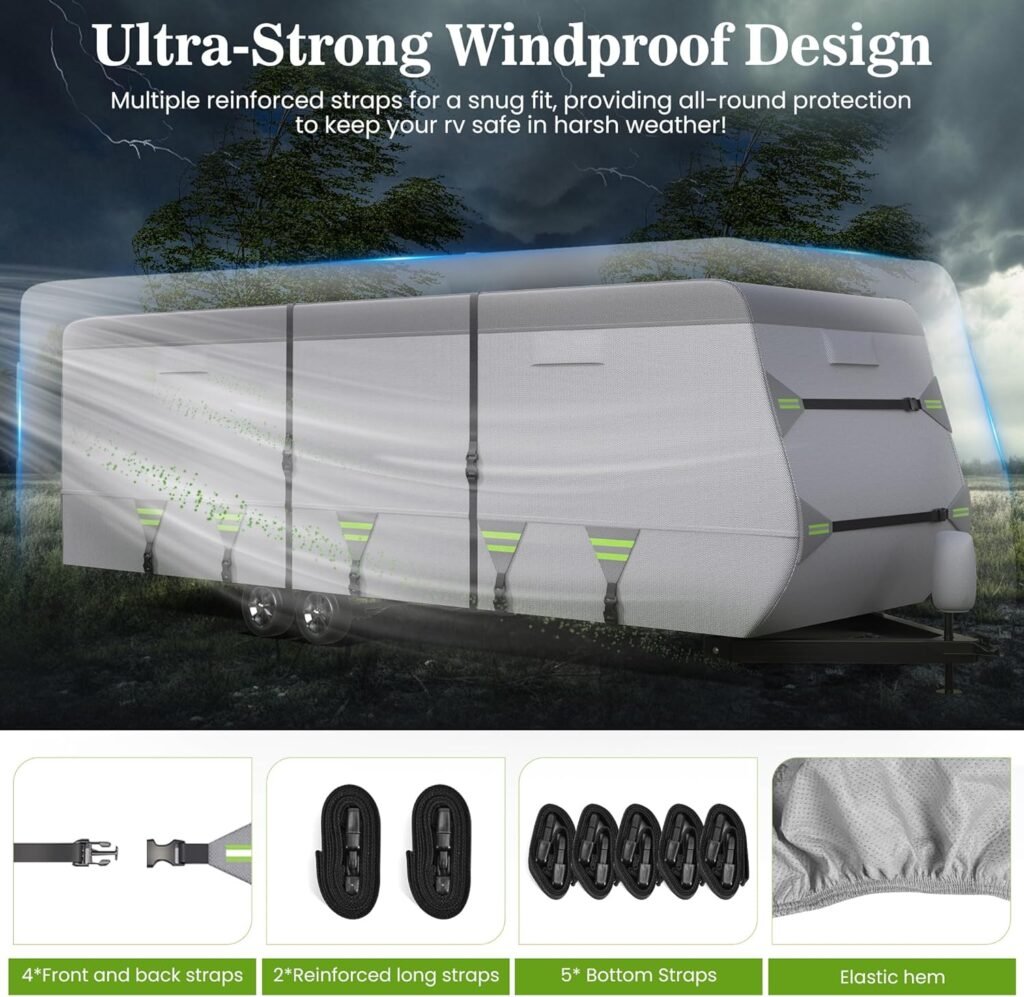
- More tie-down points to manage uplift and flutter
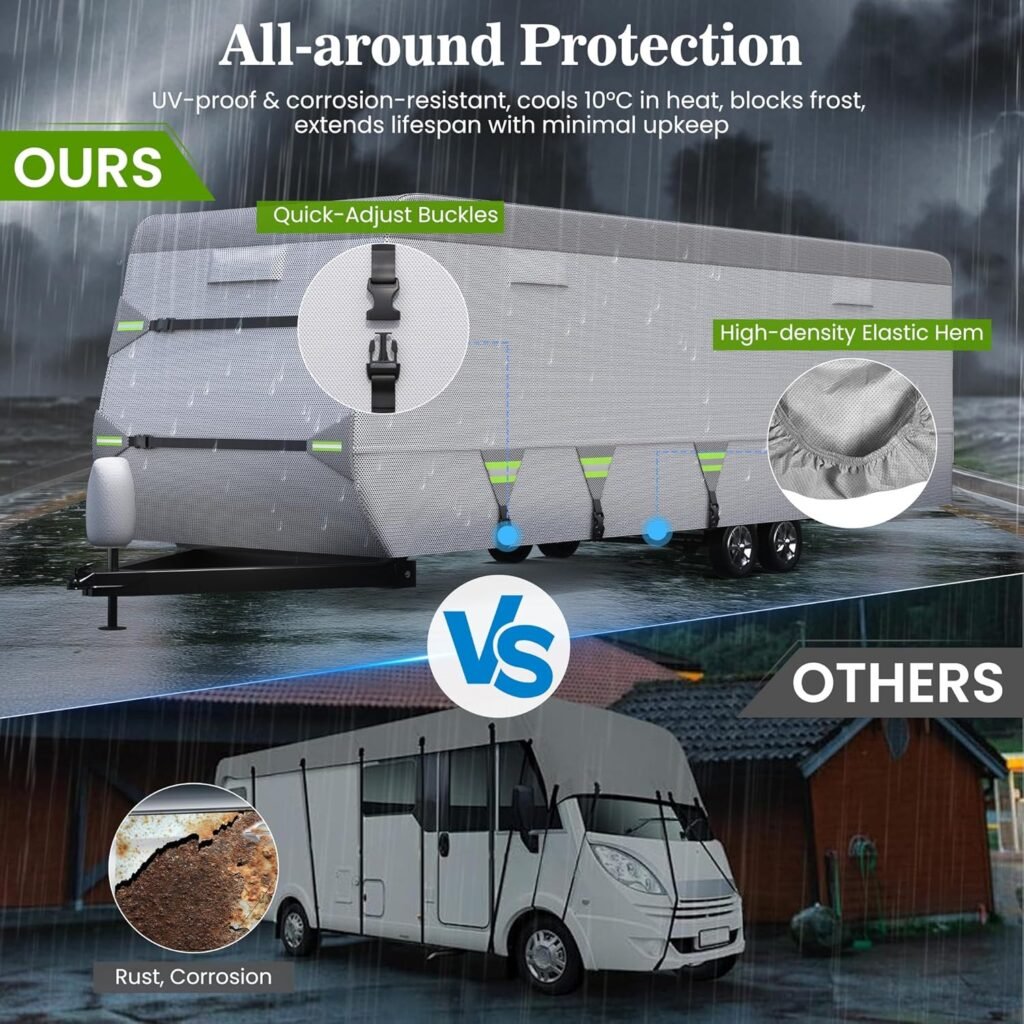
ACTFLAME specifically calls out vents and a reinforced strap system on its product listings, which is a strong signal it’s targeting the real failure modes, not just selling “thickness.” :contentReference[oaicite:1]{index=1}
One engineer-ish note: thickness isn’t automatically better if the fabric turns into a stiff sail. The win is controlled tension + reinforcement + breathability. Thickness without smart anchoring is just a louder failure.
Fit & Sizing: The Fastest Way to Waste Your Money
If you buy the wrong size, you can’t “strap your way out of it.” You’re just choosing what kind of failure you prefer.
How to size it (without guessing)
- Measure bumper-to-bumper (not “floor length”). Include spare tire bump-outs if applicable.
- Measure height to the highest hard point (AC shroud, roof rack, etc.).
- Account for accessories: ladders, bike racks, rear storage boxes. These create high-wear contact points.
- Stay inside the size band printed on the cover’s range (example: 20–22 ft). Don’t “sort of” fit.
Pro move: if your trailer is right at the top end of a size range, go up one size only if the tie-down system is robust. Otherwise you’re buying extra fabric that wind will happily weaponize.
While you’re refining your RV systems, keep your broader maintenance and storage checklist tight. If you need a clean checklist hub, park this in your bookmarks: Truck and RV guides and tips.
Wind Management: Straps, Panels, and Tear Prevention
Wind is the boss fight.
Here’s the problem: a cover is basically a flexible shell. Wind creates pressure differences, then the fabric starts oscillating. Oscillation = repeated bending. Repeated bending at seams = tearing. That’s the whole movie.
What you want is a system that does two things:
- Prevents lift (so it doesn’t balloon and slap itself to death)
- Distributes load (so one seam doesn’t take all the punishment)
How to strap it like you mean it
- Snug, not crushing: overtightening can stress seams and corners. You’re reducing flapping, not shrink-wrapping.
- Cross-strap if possible: a mild X-pattern under the belly helps resist side gusts.
- Pad sharp edges: pool noodles, foam pipe insulation, or purpose-made RV cover guards are cheap insurance.
If your storage lot is windy, the strap system is not a “nice to have.” It’s the whole point.
Breathability & Mold: The Silent RV Killer
People blame covers for mold. Covers don’t create mold. Trapped moisture and poor ventilation do.
How to avoid the “condensation trap”
- Don’t cover a wet RV. If it rained, let it dry. Yes, that’s annoying. Mold is more annoying.
- Open interior cabinets and use moisture absorbers if you’re storing for months.
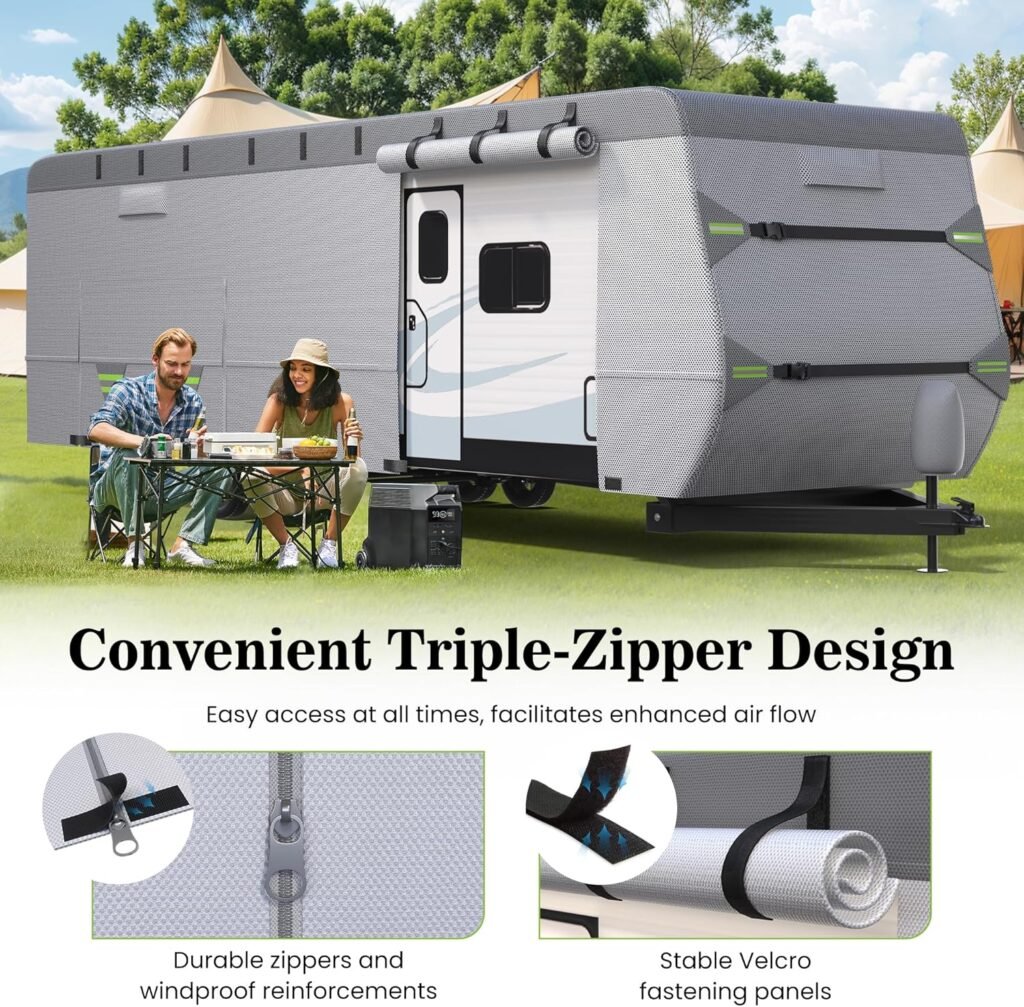
- Ensure vents aren’t blocked by straps or bunched fabric.
- Check after the first windy day. If it shifted, you now have abrasion points.
If you’re building a full “storage hardening” routine, I’d bundle cover setup with the rest of your prep steps in one repeatable checklist. This broader hub is a solid anchor for that workflow: truck and RV guides and tips.
UV and Sun Damage: Why Covers Age Faster Than You Think
UV is sneaky because it doesn’t look violent. It just quietly turns polymers brittle over time.
And no, this isn’t “only a desert problem.” The UV Index can get very high depending on season, altitude, cloud cover, and ozone. NOAA’s UV Index guidance spells out that the index reflects the amount of skin-damaging UV radiation reaching the surface and can reach into the mid-teens under certain conditions. :contentReference[oaicite:5]{index=5}
Translation: if you store outdoors year-round, the cover is a consumable item. A better cover just makes the “consumable cycle” longer and less annoying.
Install & Maintain It Like You Want It to Survive
Most people install an RV cover like they’re throwing a bedsheet on a mattress.
Then they act surprised when it rips at the ladder bracket. Classic.
Installation workflow (fast, clean, fewer swear words)
- Pad contact points first: gutters, ladder mounts, sharp trim edges, antenna housings.
- Get it centered: roof panel aligned before you start tightening anything.
- Connect straps gradually: alternate sides to keep tension balanced.
- Verify vent alignment: make sure vents aren’t folded or blocked.
- Walk the perimeter and look for “hot spots” (tight corners, abrasive rub points).
Maintenance that actually matters
- Inspect after storms: wind shift causes rubbing; rubbing causes failure.
- Clean gently: harsh brushing tears fibers and degrades coatings faster.
- Dry before storage: storing a damp cover is how you create mildew on the cover itself.
One more blunt truth: if you’re in a high-wind region and you refuse to pad sharp edges, you’re basically feeding the cover to a shredder and calling it “bad quality.”
Who Should Buy This (And Who Shouldn’t)
Buy the ACTFLAME 7-Layer Thickened RV Cover if:
- You store outdoors and want a cover designed around wind + ventilation failure points. :contentReference[oaicite:7]{index=7}
- You’ve already torn cheaper covers and you’re tired of donating money to the “flimsy fabric” industry.
- You’re willing to do basic setup correctly (padding + proper tension + periodic checks).
Skip it (or buy cheaper) if:
- You store indoors most of the year. Dust protection doesn’t require a “7-layer” anything.
- You won’t size correctly. Wrong size beats any feature list.
- You plan to use it like a tarp with zero ventilation awareness (that’s how moisture gets trapped). :contentReference[oaicite:8]{index=8}
If you’re comparison shopping, here are safer Amazon search paths (so you can check current availability and options without relying on a dead listing):
- Search ADCO travel trailer RV covers on Amazon
- Search King Bird 7-layer RV covers on Amazon
- Search Camco travel trailer RV covers on Amazon
Insider Buying Checklist
Use this before you click “buy,” and you’ll dodge 90% of cover regret.
- Vent count and placement: you want airflow up high, not just “a mesh patch somewhere.” :contentReference[oaicite:9]{index=9}
- Strap system: more than two belly straps; look for multiple tie points to reduce flutter. :contentReference[oaicite:10]{index=10}
- Reinforced corners and roof: the top takes UV/rain abuse; corners take wind load.
- Correct size band: don’t gamble. Measure, then choose the right range.
- Edge padding plan: if you don’t have padding material ready, you’re installing wrong on day one.
- Local UV reality: high UV accelerates polymer aging; plan for eventual replacement. :contentReference[oaicite:11]{index=11}
Bottom Line Takeaway
Your job is to size it correctly, pad the sharp edges, and tension it like you understand that wind is a mechanical force—not a mild suggestion.
If you do that, you’ll get what you actually want: fewer tears, less UV damage, and an RV that doesn’t smell like a damp basement when you unwrap it.
Now go measure your rig properly. Future-you will thank you. Present-you might curse a little. That’s normal.
As an Amazon Associate, I earn from qualifying purchases.