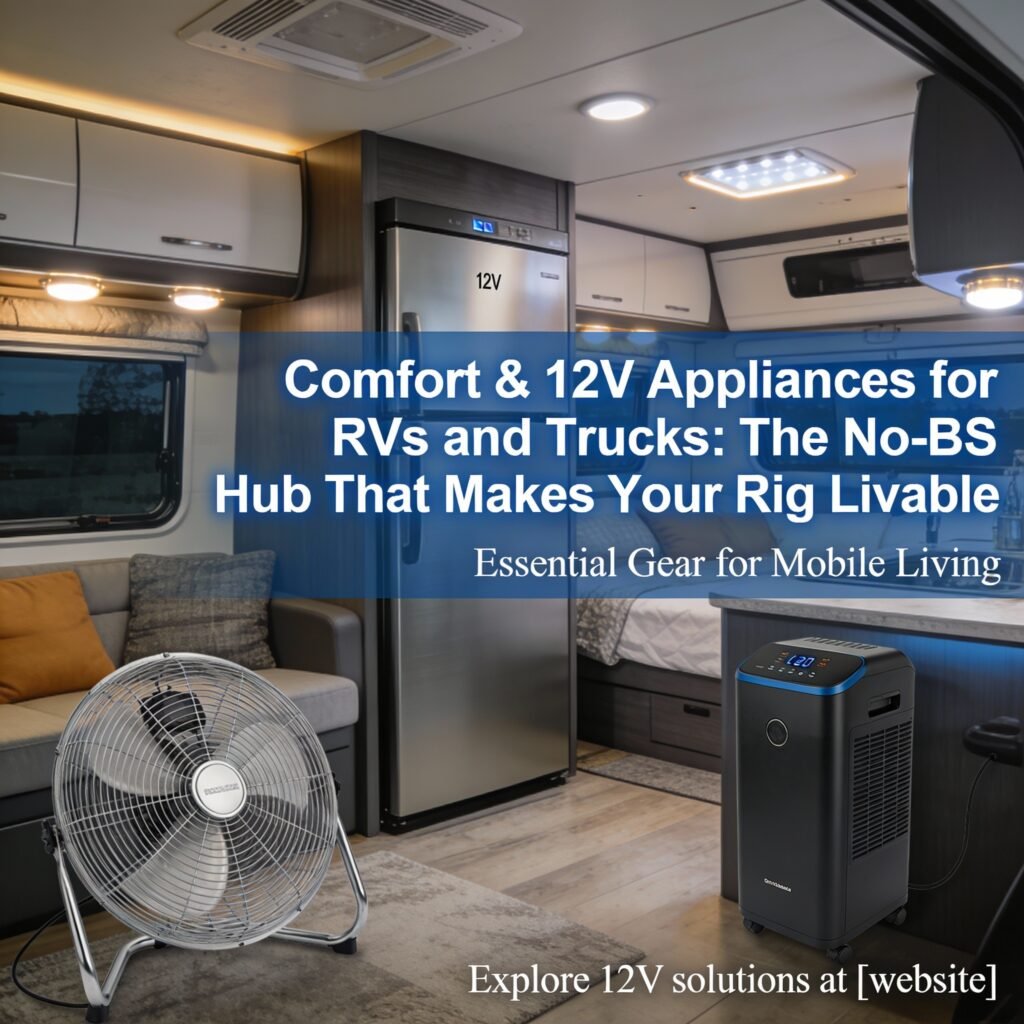
Comfort & 12V Appliances for RVs and Trucks: The No-BS Hub That Makes Your Rig Livable
Comfort gear is where people blow money the fastest—because it feels “optional,” then it becomes “I can’t live without this.” Fridges, fans, heaters, hot water, HVAC, cooking, humidifiers, dehumidifiers… it stacks up quick. And if you’re not careful, you build a rig that’s comfortable for 45 minutes… until the batteries tap out and your inverter starts screaming.
This hub is the practical playbook for RV-first comfort (with truck notes where it matters). We’re going to design comfort like an engineered system: pick the right appliances, choose 12V-first where it makes sense, minimize power waste, and avoid the classic traps that turn “cozy” into “constant troubleshooting.”
What you’ll get from this hub:
- A clear way to choose between 12V appliances vs 120V appliances (so you stop draining your battery for no reason)
- How to pick a 12V RV fridge that actually holds temps and doesn’t destroy your power budget
- Real guidance for RV climate control (A/C, 12V HVAC options, airflow, insulation tactics that aren’t hype)
- Heating and ventilation rules that keep you comfortable and safe
- Buyer decisions that make sense for boondockers, weekenders, and full-timers
Quick Start: pick your reality and jump to the right plan.
- I want the “what should I buy” answer
- I want to understand comfort as a system (so my power lasts)
- I need the right RV fridge choice (12V compressor vs absorption)
- I need cooling: fans, A/C, 12V HVAC options, airflow
- I need heat: safe heating strategy that won’t ruin my air
- Help me match comfort gear to my battery/solar/inverter setup
Table of Contents
- 1) Quick Answer: Comfort Stack That Works
- 2) Your Best Next Reads (Internal Guides)
- 3) Comfort as a System: Heat, Air, Water, Power
- 4) 12V vs 120V Appliances: The Rules That Save Your Batteries
- 5) RV Refrigerators: 12V Compressor vs Absorption (Pick the Right One)
- 6) Cooking Comfort: Low-Power Options That Don’t Kill Your Night
- 7) Cooling & Climate Control: Fans, A/C, 12V HVAC, Airflow
- 8) Heating: Comfort Without Dangerous Shortcuts
- 9) Humidity, Condensation, and Air Quality: The “Silent Discomfort” Problem
- 10) Sleep Systems: Quiet Cooling, CPAP Power, and Night Stability
- 11) Comfort Power Math: Batteries, Solar, Inverters, and Runtime
- 12) Installation & Safety: Wiring, Ventilation, Mounting, Fire Prevention
- 13) Maintenance: Keep Your Comfort Gear from Turning Into Junk
- 14) Buyer Guide: Spend vs Save
- 15) FAQ: Comfort & 12V Appliances
- 16) Authority References
1) Quick Answer: Comfort Stack That Works
If you want a comfort setup that feels like a real home without needing a generator 24/7, build around this principle:
Go 12V-first for constant loads, and use 120V only for short bursts.
Here’s the baseline comfort stack that works for most RVers:
- Fridge: 12V compressor fridge (stable temps, predictable power draw)
- Cooling: high-quality 12V fans + airflow strategy (and A/C when you have shore or serious power)
- Heating: a safe heating method + ventilation discipline (don’t trap moisture and CO risk)
- Cooking: propane or efficient low-power alternatives; avoid “inverter lifestyle creep”
- Power: battery capacity sized to your daily comfort loads, with charging that can keep up
If you’re a full-timer or remote worker, add:
- Monitoring: battery monitor so you stop guessing
- Redundancy: two ways to stay cool/heat (fans + A/C; safe heater + backup)
2) Your Best Next Reads (Internal Guides)
This hub is the master map. These internal pages are your “execution modules”:
- Category overview: Truck & RV Comfort and 12V Appliances
- Fridge decision (core): Best 12V RV Refrigerators: Compressor vs Absorption
- Cooling/comfort deep dive: RV Climate Control & 12V HVAC Systems (Buyer’s Guide)
And because comfort gear lives and dies by power, these two links support almost every comfort upgrade:
3) Comfort as a System: Heat, Air, Water, Power
Comfort isn’t one appliance. It’s four systems that constantly bully each other:
- Thermal: how heat enters/leaves your rig (sun, insulation, windows, airflow)
- Air: ventilation, humidity control, and air quality
- Water: hot water, shower use, condensation, moisture
- Power: batteries + charging + conversion losses
Here’s the real-world relationship: when you cool, you usually use a lot of power; when you heat, you often create moisture; when moisture rises, you feel colder; when you run an inverter all day, you waste power even when you think you’re not “using anything.”
Comfort strategy that actually works:
- Reduce the thermal load first (shade, airflow, sealing obvious leaks)
- Choose appliances that match your energy reality
- Make “always-on” loads 12V and efficient
- Reserve 120V for short bursts and shore power
4) 12V vs 120V Appliances: The Rules That Save Your Batteries
The most common comfort failure is simple: people treat their rig like a house and run everything through an inverter. Then they get shocked when their “big battery” isn’t big anymore.
Rule 1: Anything that runs for hours should be 12V-first
Examples:
- fridge
- fans
- routers/Starlink gear
- lighting
- small chargers
Why: every time you convert DC (battery) → AC (inverter), you pay a conversion tax. Plus, many inverters draw power just sitting on standby.
Rule 2: Anything with high heat should be treated as “shore power only” unless you’re built for it
Examples:
- electric space heaters
- air fryers, toaster ovens
- electric kettles, hot plates
- hair dryers
Can you run them on batteries? Sure—if you built a serious battery/inverter system and you accept the runtime cost. Most rigs aren’t built for that. Most people don’t admit it.
Rule 3: Don’t confuse “it turns on” with “it’s sustainable”
A 1500W appliance that runs for 10 minutes might be fine. A 1500W appliance that you use constantly is a battery murder plan. Comfort should be repeatable, not a one-time flex.
5) RV Refrigerators: 12V Compressor vs Absorption (Pick the Right One)
The fridge is the single most important comfort appliance in a modern rig—because it’s always on and it impacts your food, your schedule, and your stress.
If you want the full comparison (with practical pros/cons), this is your core internal page: Best 12V RV Refrigerators: Compressor vs Absorption
Compressor fridges (12V): the modern default for off-grid
Why people love them:
- stable temps (food stays safe)
- they cool faster
- they don’t rely on a perfect level surface
- they integrate naturally with solar + lithium setups
Real cost: they use power every day. That’s not a problem if you sized your batteries/charging like an adult.
Absorption fridges (propane/electric): the old-school RV staple
Why people still use them:
- propane mode can reduce electrical load
- they’re common in older rigs
Where people get burned: absorption fridges can be sensitive to leveling and ventilation, and they involve propane systems that require respect and maintenance. Manufacturer manuals contain explicit warnings about propane leak risks if components are damaged or cleaned improperly—this is not a “DIY freestyle” zone. (See Norcold owner’s manual warnings in the Authority section.)
Decision shortcut (the one that usually holds up)
- Boondock often + solar + lithium: 12V compressor fridge wins for stability and simplicity
- Mostly hookups + older rig: absorption can still work if maintained properly
- Hot climates + heavy use: compressor tends to handle the reality better
Fridge performance upgrades that actually matter
- Ventilation: improve airflow around the fridge cavity (huge impact)
- Door discipline: stop treating it like a house fridge you open every 3 minutes
- Thermal planning: park for shade, reduce cabin heat load (your fridge is fighting your rig)
6) Cooking Comfort: Low-Power Options That Don’t Kill Your Night
Cooking is the fastest way to destroy a power plan if you insist on electric heating appliances off batteries.
Good cooking strategies by power profile
Boondockers (battery-focused)
- propane cooking for heat-heavy tasks
- DC-friendly meal prep tools (small loads)
- avoid high-wattage resistive appliances unless you built for it
Hookup-heavy campers
- electric appliances are fine when you’re plugged in
- still watch circuit limits and avoid running everything at once
Truck sleeper setups
- 12V appliances and efficient heating solutions
- targeted inverter use only when needed
- keep cooking simple; prioritize low-watt tools
Practical comfort tip: cooking creates heat and moisture. If you cook inside in a small rig with no ventilation, you will feel uncomfortable even if your HVAC is strong. Ventilation is part of cooking comfort.
7) Cooling & Climate Control: Fans, A/C, 12V HVAC, Airflow
If you’ve ever tried sleeping in an RV on a hot night with weak airflow, you already know: cooling comfort is not optional. It’s survival-level.
Your internal deep dive on this topic is here: RV Climate Control & 12V HVAC Systems (Buyer’s Guide)
Cooling hierarchy (the order that saves you power)
1) Reduce the heat load
- park for shade (yes, it’s that powerful)
- use reflective window covers
- block direct sun on the windshield and big glass
- reduce internal heat sources (cooking, laptops, bulky electronics)
2) Move air intelligently
- use high-efficiency 12V fans to create crossflow
- pull hot air out high, pull cooler air in low when conditions allow
- don’t fight physics: hot air rises; help it leave
3) Use A/C when you have the power reality
Rooftop A/C can be amazing—but it’s a power hog. If you want to run A/C off-grid, you need a real energy plan (battery + inverter + charging) and a willingness to manage runtime.
For efficiency basics (including modern efficiency metrics like EER2), the U.S. Department of Energy’s guidance is a solid reference point. See Authority section.
12V HVAC: what it is (and what it isn’t)
12V HVAC options can be a game changer for certain rigs, but they’re not “free cooling.” They still require significant power. The benefit is often about system integration and efficiency—not breaking the laws of energy.
Why “my A/C is weak” is usually not the A/C’s fault
- poor sealing and huge air leaks
- overheated roof cavity and sun load
- blocked filters and dirty coils
- bad airflow distribution (cold air doesn’t reach where you sleep)
Operational fix: treat the rig like a thermal box. Reduce load, improve airflow, then evaluate A/C performance.
8) Heating: Comfort Without Dangerous Shortcuts
Heating comfort is where safety mistakes happen—because people get desperate.
Two big heating realities
- Heat methods often create moisture (especially combustion-based heat)
- Bad ventilation can make you feel worse and increase risk
Safe heating mindset
- Ventilate even when it’s cold (controlled ventilation beats damp misery)
- Don’t “seal everything and pray” — you’ll trap moisture and can create unsafe air conditions
- Use equipment as intended; don’t invent new uses because “it seems fine”
Comfort-first heating strategy
- insulate obvious weak points (windows, drafts)
- use efficient bedding/sleep systems (massive ROI)
- heat the person before heating the whole air volume when possible
Truck note: sleeper comfort often improves more by reducing drafts and improving airflow than by adding brute-force heat.
9) Humidity, Condensation, and Air Quality: The “Silent Discomfort” Problem
Humidity is the sneaky reason your rig feels clammy, cold, or “stale.”
Why humidity spikes in RVs
- small air volume
- breathing overnight adds moisture
- cooking adds moisture
- wet gear adds moisture
- bad ventilation traps it
Condensation = heat loss + discomfort
Condensation on windows and walls isn’t just annoying—it signals that your interior moisture is high and your surfaces are cold. That’s how you get that gross “cold damp” feeling even when you’re technically warm.
Fixes that work
- vent strategically (small opening + fan often beats “sealed tight”)
- reduce internal moisture sources where possible
- use dehumidification when appropriate (especially in shoulder seasons)
10) Sleep Systems: Quiet Cooling, CPAP Power, and Night Stability
Sleep comfort is where your system either earns your trust or becomes a nightly drama.
Quiet cooling matters
A loud fan or cycling A/C can ruin sleep. A good setup uses:
- smooth airflow (not a tornado aimed at your face)
- stable temperature strategy (reduce the daytime heat load so night cooling isn’t extreme)
CPAP and medical devices
If you rely on medical gear, your power system must be stable at night. That means:
- don’t run your battery down to the edge
- avoid leaving the inverter on all night unless necessary
- prefer DC options when available
Bottom line: night stability is a system design choice, not a wish.
11) Comfort Power Math: Batteries, Solar, Inverters, and Runtime
Comfort upgrades fail when they aren’t matched to the power system. Here’s the clean logic:
- List the comfort loads (fridge, fans, HVAC, cooking, hot water components)
- Identify what’s continuous (always-on) vs burst loads
- Convert to daily energy (Wh/day)
- Size your battery for usable energy (not sticker capacity)
- Ensure charging can replace consumption (solar/alternator/shore)
If you want the exact math workflow for solar and runtime planning, send readers here: RV Solar Sizing Calculator: Stop Guessing Your System
Comfort runtime mindset (what “good” looks like)
- Your fridge runs without anxiety
- Your fans run as needed without “battery panic”
- Your heavy loads (A/C, cooking) are scheduled around shore power or strong charging windows
- Your night power never runs at the cliff edge
The inverter trap (comfort edition)
If you run everything through an inverter, your system can feel “easy” at first—until you realize you’re bleeding energy constantly. Make the core comfort loads DC-efficient, then treat AC like a specialty tool.
If you’re installing or upgrading an inverter, this internal guide keeps it clean and safe: How to Install RV Power Inverter (DIY Guide)
12) Installation & Safety: Wiring, Ventilation, Mounting, Fire Prevention
Comfort gear is still electronics and appliances. Install discipline is not optional.
Wiring basics that prevent failures
- size wiring for current draw (especially fridges and HVAC components)
- use proper fusing close to the power source
- secure cables against vibration and chafe
- avoid “temporary wiring” becoming permanent
Ventilation and combustion appliances
Any propane-based appliance requires respect. Follow manufacturer instructions, maintain components, and do not improvise cleaning methods that can damage orifices or seals. Manufacturer manuals include explicit warnings about propane leak and ignition risk (see Norcold manual in Authority section).
Mounting and airflow
- don’t block appliance ventilation paths
- don’t trap heat around compressors or electronics
- allow service access (you will need it eventually)
For broader install best practices across the rig, your DIY hub supports comfort upgrades too: RV DIY & Installation Guides for Safe, Clean Upgrades
13) Maintenance: Keep Your Comfort Gear from Turning Into Junk
Comfort gear doesn’t usually “break suddenly.” It degrades quietly until it fails at the worst time.
High-ROI maintenance habits
- Clean filters and vents (airflow equals performance)
- Inspect seals (fridge doors, window leaks, roof penetrations)
- Check wiring connections annually (vibration loosens reality)
- Keep condenser areas clean for compressor fridges
Thermal management maintenance
- replace worn weather stripping
- maintain window coverings and sun blocks
- verify fans and vents operate correctly
Maintenance feels boring until you’re hot, tired, and stuck with a dead fridge.
14) Buyer Guide: Spend vs Save
Spend here (comfort ROI is real)
- Fridge quality (food safety + daily reliability)
- Fans and airflow tools (cheap fans often disappoint)
- HVAC components if you rely on them frequently
- Power system stability (battery capacity + charging + monitoring)
- Bed sheets
Be strategic here
- luxury gadgets (buy after the core comfort stack works)
- kitchen extras (optimize for low-watt/dual-fuel solutions)
Where people waste money
- buying high-watt appliances and expecting small batteries to cope
- trying to “solve heat” with brute force instead of reducing thermal load
- running an inverter all day for tiny loads
- ignoring ventilation and then chasing humidity problems with more gadgets
15) FAQ: Comfort & 12V Appliances
What’s the most important comfort upgrade for boondocking?
A 12V compressor fridge and a smart airflow setup (fans + venting). Those give you comfort every day without requiring shore power.
Can I run A/C off batteries?
Yes, but you need a serious battery + inverter setup and the charging capacity to replace what you use. If you can’t replace the energy, you’re just borrowing comfort from tomorrow.
Why does my rig feel humid even when it’s warm?
Because moisture gets trapped in a small air volume. Ventilation and moisture management matter as much as heating.
What’s the “best” fridge type?
For modern off-grid builds, 12V compressor fridges often win on stable temps and simplicity—if your power system is sized correctly. Absorption can work, but it demands correct install, leveling, ventilation, and respect for propane maintenance.
16) Authority References
- CDC: Heat-related illnesses (signs and symptoms)
- U.S. DOE: Air conditioning efficiency, sizing, and EER2
- AHRI: SEER explained (AC efficiency metric)
- Norcold Absorption Refrigerator Owner’s Manual (propane safety warnings)
Bottom line: Comfort is a system. Build it 12V-first, reduce thermal load before buying bigger appliances, and match everything to a power plan that can actually sustain your lifestyle.