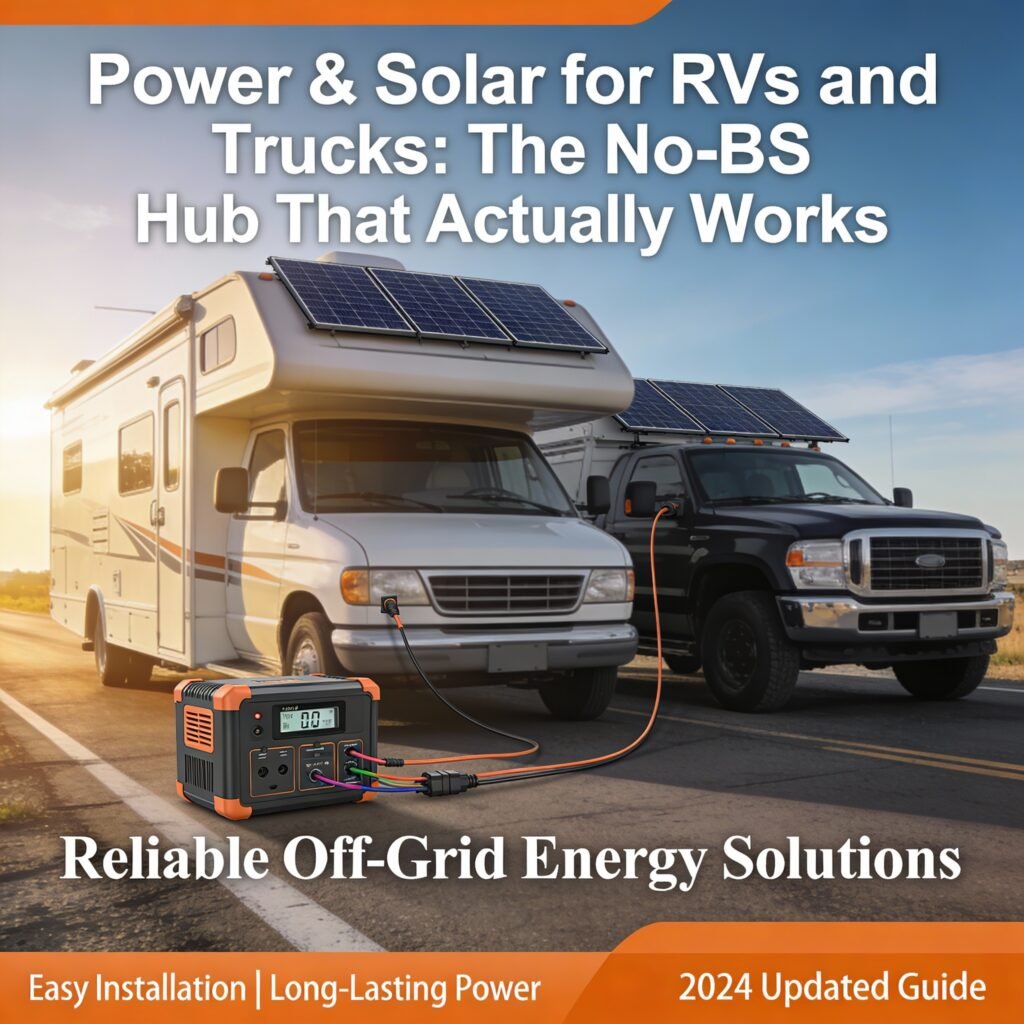
Power & Solar for RVs and Trucks: The No-BS Hub That Actually Works
If you want Power & Solar that behaves like a real system (not a collection of “cool gadgets”), you’re in the right place. This hub is built for one outcome: predictable power. Not “it worked last weekend,” but “it works every day, in real weather, with real loads, and real mistakes.”
Most rigs don’t have a power problem. They have a planning problem—people buy panels first, then wonder why their battery dies at 10pm like clockwork. So we’re going to run this like a systems upgrade: define the objective, quantify the loads, size the storage, then design the charging and distribution to match. That’s the whole game.
Who this hub is for: RVers, van lifers, overlanders, and truckers who want reliable off-grid power for fridges, Starlink, CPAP, laptops, cooking gear, heat management, and all the little stuff that quietly drains your battery while you sleep.
Quick Start: Pick your “power mode” and jump to the right section.
- Weekend Warrior (simple, budget, reliable)
- Off-Grid Serious (lithium, inverter, monitoring)
- Hybrid Upgrade (shore power + smarter charging)
- Trucker Sleeper Setup (12V appliances + alternator-first)
Table of Contents
- 1) Decide Your Power Mode (Stop Buying Random Gear)
- 2) Load Audit: The Only “Calculator” That Matters
- 3) Battery Bank: Capacity, Chemistry, and the “Usable Energy” Truth
- 4) Charging Sources: Solar, Alternator, Shore, Generator (How They Play Together)
- 5) Solar Array Sizing: Panels, Shading, Roof Reality, and Why “More” Isn’t Always Better
- 6) Charge Controllers: PWM vs MPPT (and the Specs People Misread)
- 7) Inverters: Pure Sine vs “Close Enough,” Surge Power, and Real-World Sizing
- 8) Wiring & Protection: Fuses, Breakers, Voltage Drop, and Fire Prevention
- 9) Distribution: DC Panels, Busbars, Grounding, and Clean Layout
- 10) Monitoring & Control: Don’t Fly Blind
- 11) The 12 Failure Modes That Kill RV Power Systems
- 12) Build Blueprints by Use Case (Copy/Paste Designs)
- 13) Buyer Guide: What to Spend On vs Where to Save
- 14) Your Next Reads (Internal Guides That Move You Forward)
- 15) FAQ: Power & Solar
- 16) Authority References (Real Sources, Not Forum Folklore)
1) Decide Your Power Mode (Stop Buying Random Gear)
Every clean build starts with a decision: what job is the system supposed to do? If you can’t answer that in one sentence, your shopping cart will become an expensive guessing game.
Here are the four power modes that cover 95% of real rigs:
Weekend Warrior
Goal: lights, phone charging, water pump, maybe a fan or small DC fridge support. Minimal inverter use. Simple and stable.
Typical stack: modest solar, a decent battery (AGM or small LiFePO4), basic DC distribution, and one rule: avoid inverter lifestyle creep.
Win condition: You camp two nights and never think about power once.
Off-Grid Serious
Goal: real off-grid living: 12V compressor fridge, Starlink/router, laptops, coffee gear, cooking loads, and comfort demands. You’ll run an inverter daily.
Typical stack: LiFePO4 bank, MPPT controller, inverter (pure sine), DC-DC alternator charging, shore charger, monitoring, clean protection layout.
Win condition: You can ride out cloudy days without “battery anxiety.”
Hybrid Upgrade
Goal: you use shore power often, but you want upgrades that eliminate weak links: better charging, cleaner distribution, reliable inverter for short bursts, better battery health.
Typical stack: smart shore charger, upgraded battery, proper wiring/protection, maybe a modest solar array for maintenance/offset.
Win condition: your system behaves like an engineered product, not a DIY science fair.
Trucker Sleeper Setup
Goal: efficient 12V comfort: fridge, microwave alternatives, fans, CPAP, device charging, maybe a small inverter but not a house-on-wheels build.
Typical stack: alternator-first charging (smart DC-DC), strong battery setup, efficient 12V appliances, targeted inverter use, clean cab wiring discipline.
Win condition: you stop idling for comfort and stop killing batteries.
Decision rule: If your life depends on AC power (coffee maker, air fryer, “I’ll just run this one thing”), you’re not a Weekend Warrior. Own that up front and build for it.
2) Load Audit: The Only “Calculator” That Matters
Your power system exists for one reason: to cover your energy consumption. So we start with consumption. Not vibes. Numbers.
Do a simple load audit in watt-hours (Wh). Here’s the process that won’t waste your time:
- List your daily loads (fridge, router, lights, water pump, devices, fans, etc.).
- Estimate watts from labels/manuals or measured tools.
- Estimate hours per day (be honest—Starlink and fridges don’t care about optimism).
- Compute Wh/day = watts × hours.
Why Wh/day? Because it speaks both languages: solar production and battery storage. Amp-hours alone lies to people because it hides voltage. Wh is the common currency.
If you want a fast way to stop lying to yourself about solar production in your region, use NREL PVWatts. It’s not “RV-specific,” but it’s a credible reality check for solar output based on location and assumptions. It will keep you from building a system that only works in perfect sun on perfect days.
Operational insight: Most people undercount two things:
- Always-on loads (router, Starlink, detector boards, monitors, parasitic draw)
- Inverter tax (efficiency losses + idle draw if you leave it on)
If you treat those as “small,” they’ll become the reason you wake up at 3am to a low-voltage alarm.
3) Battery Bank: Capacity, Chemistry, and the “Usable Energy” Truth
Panels refill the tank. Batteries are the tank. If you build the wrong tank, nothing else matters.
Battery sizing in plain English
Battery capacity should cover your daily Wh with a buffer for:
- Days of autonomy (how long you want to survive without good sun)
- Depth of discharge (how much you can use without degrading the battery)
- Voltage stability (some chemistries sag hard under load)
Usable energy is the metric that pays the bills. A battery’s sticker capacity is not the same as usable energy in your actual setup.
LiFePO4 vs lead-acid: the no-drama breakdown
- Lead-acid (flooded/AGM): cheaper up front, heavier, hates deep cycling, voltage sag under load, shorter useful life if abused.
- LiFePO4: higher up-front cost, lighter, stable voltage, handles cycling far better, typically the best long-term ROI for serious off-grid use.
If you’re considering a popular entry-point lithium size, your site already has a practical deep dive worth linking to: Renogy 100Ah 12V LiFePO4 Battery Review: Torture Test. It’s a good “real-world expectations” anchor before anyone starts stacking batteries like Lego.
Battery capacity rules of thumb (that don’t embarrass you)
Rule 1: If you use a compressor fridge + internet daily, 100Ah lithium is a starter battery, not a full solution.
Rule 2: If you rely on AC loads through an inverter, plan for higher daily Wh and higher peak amps.
Rule 3: Don’t design right to the edge. Your system should handle “normal bad days,” not just “perfect days.”
4) Charging Sources: Solar, Alternator, Shore, Generator (How They Play Together)
A mature power system isn’t “solar only.” It’s a charging portfolio. Each source has a role, and the best builds are designed so no single source has to be the hero.
Solar charging
Solar is silent, cheap to run, and perfect for steady daily replenishment—until weather, shade, and winter angles show up. Design solar to cover your average daily use, then use other sources as strategic backup.
Alternator charging
Alternator charging is the productivity hack most people ignore. If you drive regularly, alternator charging can do the heavy lifting. But you must do it right—especially with lithium—using smart DC-DC charging and proper protection. “Just wire it in” is how people cook components.
Shore power charging
Shore power is stable and fast. The weakness is that many factory chargers are mediocre: slow, non-configurable, and not optimized for lithium. Upgrading shore charging is one of the highest-leverage hybrid improvements you can make.
Generator charging
Generators are loud insurance. If you boondock hard or work remotely, a generator becomes a resilience tool, not a lifestyle choice. If you need it daily, that’s a design signal: either you’re under-paneled, under-batteried, or running inefficient loads.
5) Solar Array Sizing: Panels, Shading, Roof Reality, and Why “More” Isn’t Always Better
Solar sizing is simple to explain and easy to mess up.
Core objective: Your array should replace the energy you used yesterday under normal conditions. If it can’t, your battery becomes a slowly draining savings account.
Here’s the clean workflow:
- Compute your daily Wh from the load audit.
- Estimate realistic sun hours (not the best-case marketing number).
- Apply a loss factor (heat, dirt, wiring, controller, angle, shading).
- Size the array to meet the target.
If you want the full math-and-reality approach, you already have a strong internal anchor: RV Solar Sizing Calculator: Stop Guessing Your System. That’s the page you send people to when they say “I think 200W is enough.”
Roof constraints: the real limiting factor
On many rigs, roof space—not budget—limits solar. Vents, AC units, skylights, racks, and “stuff” eat the best panel real estate. That means the practical move is often:
- Use higher-efficiency panels in limited space
- Reduce shading hotspots (one small shade can nerf output)
- Optimize wiring and controller choice to reduce losses
Series vs parallel: don’t overcomplicate it
Series raises voltage (helpful for MPPT efficiency and long wire runs). Parallel increases current (sometimes more tolerant of partial shading patterns, depending on the design). The right answer depends on your controller limits, wire runs, and shading reality. If you don’t know, design around safety and maintainability: fusing, combiner strategy, and clean labeling matter more than “the perfect internet wiring diagram.”
6) Charge Controllers: PWM vs MPPT (and the Specs People Misread)
PWM works, but it leaves performance on the table in many installs. MPPT costs more but typically extracts more real-world power, especially in colder weather and when panel voltage sits above battery voltage.
The common failure isn’t choosing PWM. It’s choosing a controller that can’t handle:
- Panel input voltage (especially when panels are in series)
- Total array current
- Your battery chemistry settings (especially lithium profiles)
Executive summary: If you’re running meaningful solar and you care about performance, MPPT is usually the grown-up choice.
7) Inverters: Pure Sine vs “Close Enough,” Surge Power, and Real-World Sizing
Inverters are the gateway drug to “I’ll just run one more thing.” That’s not moral judgment—it’s physics forecasting.
Pure sine vs modified sine
Pure sine plays nice with modern electronics and motor loads. Modified sine can cause noise, heat, weird charging behavior, and shorter lifespan for some devices. If you’re running sensitive gear or anything with a motor/compressor, pure sine is the safest operational standard.
Continuous vs surge
Many loads draw a surge at start-up. If your inverter can’t deliver that surge, it will shut down or brown-out the device. That’s why people buy “2000W” and still can’t run what they want. It’s not always about the headline number. It’s about surge behavior and battery/wiring delivering the amps.
Want the clean install playbook?
Don’t freestyle this. Use your internal guide: How to install RV power inverter: DIY Guide. The fastest way to create an unreliable system is to treat inverter install like “just mount it somewhere.” Heat, wire gauge, fuse placement, and grounding discipline matter.
8) Wiring & Protection: Fuses, Breakers, Voltage Drop, and Fire Prevention
This is the part that separates a professional-grade build from a “works until it doesn’t” rig.
Non-negotiable principle: Every positive conductor leaving a battery should be protected as close to the source as practical. Not “somewhere,” not “eventually,” not “I’ll do it later.”
Voltage drop isn’t a nerd issue—it’s a performance issue
Undersized wire doesn’t just “run a little warm.” It wastes power, causes devices to behave badly, and amplifies inverter/charger instability. The result is a system that feels haunted: random shutoffs, low-voltage alarms, and gear that “works at home” but not in the rig.
If you want a credible wiring sanity check tool and guidance, Blue Sea Systems publishes solid references. Start here: Blue Sea Systems: Choosing the Correct Wire Size for a DC Circuit and their Circuit Wizard for quick sizing decisions.
Fuses vs breakers
Fuses are simple and fast. Breakers add convenience and reset capability. Many systems use both strategically. The “best” option is the one you can maintain, label, and troubleshoot without turning your storage bay into a wiring crime scene.
Thermal and mechanical reality
Secure cables. Protect against chafe. Provide airflow around inverters/chargers. Don’t mount high-current gear in sealed boxes. Electrical fires are not “bad luck”—they’re usually predictable results of bad layout and poor protection decisions.
9) Distribution: DC Panels, Busbars, Grounding, and Clean Layout
Distribution is where builds either become scalable and serviceable—or become fragile and confusing.
Best practice layout:
- Battery → main fuse → main disconnect
- Main feed to busbars (clean, accessible)
- Branch circuits protected and labeled to loads
- Separate high-current inverter paths from low-current accessory circuits
Grounding note: Different rigs have different grounding realities (RV chassis, truck chassis, isolated DC systems, etc.). The safe operational approach is to follow manufacturer guidance for your gear and avoid “internet wiring shortcuts.” If you don’t understand your grounding scheme, you don’t have a scheme—you have a risk.
10) Monitoring & Control: Don’t Fly Blind
If you can’t measure it, you can’t manage it. A power system without monitoring is like driving without a fuel gauge and guessing based on “how the engine feels.”
Minimum viable monitoring:
- Battery state (not just voltage)
- Charge/discharge current
- Solar production
- Inverter status and load
Business-like reality: Monitoring pays for itself by preventing the two most expensive events: destroying batteries early and designing upgrades blindly.
11) The 12 Failure Modes That Kill RV Power Systems
Most power failures aren’t mysterious. They’re repeats. Here are the big ones:
- No load audit (system built on hope)
- Undersized battery (daily deep discharge)
- Under-paneled solar (battery never fully recovers)
- Shading hot spots (one shadow, big loss)
- Wrong controller limits (voltage/current mismatch)
- Inverter sized by ego (surge kills the dream)
- Undersized wiring (voltage drop + heat)
- Missing/incorrect fusing (fire risk)
- Bad crimps/terminals (resistance = heat)
- No ventilation (thermal shutdowns)
- Parasitic draw ignored (mysterious overnight drain)
- No monitoring (you discover problems when they’re expensive)
Fixing these makes systems boring—in the best way. Boring means reliable.
12) Build Blueprints by Use Case (Copy/Paste Designs)
Blueprint A: Weekend Warrior (Simple DC-First)
- Battery sized for 1–2 days of realistic DC loads
- Modest solar + MPPT if budget allows
- DC distribution panel, proper fusing, clean labeling
- No always-on inverter (use DC chargers instead)
Why it works: You avoid inverter losses and keep the system stable, cheap, and easy to troubleshoot.
Blueprint B: Off-Grid Serious (Lithium + Inverter + Monitoring)
- LiFePO4 bank sized for your daily Wh plus autonomy buffer
- Solar array sized to replace daily consumption under normal conditions
- MPPT controller sized for array voltage/current
- Pure sine inverter sized for continuous + surge loads
- Smart alternator charging (DC-DC) if you drive often
- Shore charger configured for lithium profile
- Battery monitor + solar monitor
Why it works: It’s a complete charging portfolio with visibility.
Blueprint C: Hybrid Upgrade (Shore-Heavy, Stability-First)
- Upgrade charger and battery health first
- Improve distribution/protection layout
- Add solar for maintenance and offset (not miracle expectations)
- Use inverter for targeted tasks, not all-day lifestyle
Why it works: You remove the most common weak links without redesigning the whole rig.
Blueprint D: Trucker Sleeper (Alternator-First Comfort)
- Battery sized around overnight comfort loads
- Efficient 12V appliances (fridge/fans/chargers)
- Smart DC-DC alternator charging
- Targeted inverter use only when needed
Why it works: You reduce idling, reduce drain, and improve reliability.
13) Buyer Guide: What to Spend On vs Where to Save
If you want a system that doesn’t waste money, here’s the spending hierarchy:
Spend your money here
- Battery quality + correct sizing (this is the tank)
- Protection hardware (fuses, breakers, disconnects, proper terminals)
- Inverter quality if you rely on AC (pure sine + real surge behavior)
- Monitoring (prevents expensive mistakes)
Be strategic here
- Panels: brands matter less than correct design, mounting, and wiring.
- Controllers: match specs to your array and battery chemistry. “Bigger” isn’t always better; “correct” is better.
Where people waste money
- Buying panels first before knowing daily Wh
- Buying a huge inverter to run one occasional device
- Stacking batteries without upgrading wiring and protection
- Ignoring alternator charging if you drive daily
14) Your Next Reads (Internal Guides That Move You Forward)
These are your best “next actions” based on where you are in the process:
- Need sizing clarity: RV Solar Sizing Calculator: Stop Guessing Your System
- Want the full build workflow: Master RV Solar System Design in 6 Simple Steps
- Battery decision support: Renogy 100Ah 12V LiFePO4 Battery Review: Torture Test
- Installing an inverter correctly: How to install RV power inverter: DIY Guide
- DIY upgrade strategy (clean installs): RV DIY & Installation Guides for Safe, Clean Upgrades
15) FAQ: Power & Solar
How much solar do I need for boondocking?
Enough to replace your daily Wh under normal conditions with a loss buffer. If your system only works in perfect sun, it’s undersized.
Can I run AC appliances all day on solar?
Yes, but only with the right battery bank, inverter, and enough array + charging strategy. Most “I’ll just do solar” plans collapse because the battery tank is too small.
Is lithium worth it?
If you cycle daily or rely on power for work/comfort, lithium usually wins long-term ROI and stability. If you camp lightly and rarely deep-cycle, you can make lead-acid work—just don’t abuse it and expect miracles.
What’s the fastest path to reliability?
Load audit → battery sizing → charging portfolio → correct wiring/protection → monitoring. If you skip steps, you pay later.
16) Authority References (Real Sources, Not Forum Folklore)
- NREL PVWatts Calculator (solar production reality check)
- Blue Sea Systems: Choosing the Correct Wire Size for a DC Circuit
- Blue Sea Systems Circuit Wizard (wire + protection sizing tool)
- NFPA 1192: Standard on Recreational Vehicles (safety baseline)
Bottom line: If you want power that “just works,” treat it like a system. The math is simple. The discipline is what most people avoid. Do the audit, size the tank, then build charging and protection like you care about not getting stranded.